The open-source AI movement has transformed the way developers build and deploy artificial intelligence. Instead of relying entirely on cloud-based providers, organizations can now run powerful large language models on their own infrastructure, giving them greater control over costs, privacy, and customization.
Two platforms that frequently appear in these conversations are Ollama and Hugging Face. While they are often compared against one another, they are not direct competitors in the traditional sense. In many cases, they solve different problems and work exceptionally well together.
Understanding what each platform does—and where it excels—can help you decide which one belongs in your AI stack.
What Is Ollama?

Ollama is designed to make running large language models locally as simple as possible. Traditionally, setting up open-source models required downloading model weights, configuring inference frameworks, managing dependencies, and optimizing hardware settings. Ollama removes much of that complexity.
With a single command, developers can download and run models such as Llama, Mistral, Gemma, and Qwen on their local machines. The platform handles model management, quantization, and serving behind the scenes, making advanced AI accessible even to developers without a deep machine learning background.
This simplicity has made Ollama particularly popular among developers building private AI assistants, internal business tools, and autonomous agents that need to run without sending data to external providers.
What Is Hugging Face?

If Ollama simplifies model execution, Hugging Face serves as the foundation of the open-source AI ecosystem.
Often referred to as the “GitHub of AI,” Hugging Face hosts hundreds of thousands of machine learning models covering everything from text generation and image creation to speech recognition and multimodal AI. It has become the primary destination for researchers, startups, and enterprises looking to discover and share AI models.
The platform extends far beyond model hosting. Hugging Face provides an entire suite of tools for training, fine-tuning, evaluating, and deploying machine learning systems. Libraries such as Transformers, Datasets, Diffusers, PEFT, and Accelerate have become industry standards and are used by developers around the world.
As a result, Hugging Face is often the first place where new breakthroughs in open-source AI become available.
The Biggest Difference Between Ollama and Hugging Face
The simplest way to understand the distinction is that Ollama focuses on running models, while Hugging Face focuses on building the ecosystem around them.
Ollama is primarily an inference platform. Its goal is to make it easy to download, manage, and execute AI models locally. Hugging Face, on the other hand, is a complete ecosystem for discovering, training, sharing, evaluating, and deploying machine learning models.
In fact, many of the models that eventually become available through Ollama originate from repositories hosted on Hugging Face.
Ease of Use
For developers who simply want to run a language model, Ollama is difficult to beat.
The installation process is straightforward, and most users can begin interacting with advanced models within minutes. There is very little setup required, and the platform abstracts away much of the technical complexity that typically accompanies local AI deployment.
Hugging Face offers significantly more flexibility, but that flexibility comes with a steeper learning curve. Users often need to understand concepts such as tokenization, model architectures, quantization methods, inference pipelines, and GPU optimization strategies.
For someone building a local AI assistant over a weekend, Ollama will usually be the faster path. For someone developing custom AI infrastructure, Hugging Face provides far more room to grow.
Model Availability
When it comes to model selection, Hugging Face operates on an entirely different scale.
The Hugging Face Hub hosts models from organizations such as Meta, Microsoft, Google, Mistral AI, Alibaba, DeepSeek, Stability AI, and countless independent researchers.

Some of the models available on Hugging Face (Source: Hugging Face)
Whether you’re looking for a coding assistant, a medical language model, an image generator, or a highly specialized industry-specific model, chances are you’ll find it there.
Ollama supports a growing collection of popular open-source models, but its catalog is intentionally curated. The emphasis is on delivering optimized versions that can run efficiently on local hardware rather than providing access to every model available.
For developers who value choice and experimentation, Hugging Face has a clear advantage.
Privacy and Data Control
One of Ollama’s strongest selling points is privacy. Because models run entirely on local infrastructure, data never needs to leave the organization. This eliminates API costs while giving businesses complete control over how information is processed and stored. For companies working with sensitive customer data, proprietary research, or internal documentation, this level of control can be extremely attractive.
Hugging Face can also support private deployments and self-hosted environments, but many users interact with its cloud-hosted services and inference endpoints. As a result, privacy requirements often play a significant role in determining which platform is used for production workloads.
Deployment Flexibility
Hugging Face shines when organizations need deployment options. The platform allows developers to deploy serverless endpoints, dedicated inference infrastructure, cloud-hosted GPUs, interactive demonstrations through Spaces, and custom training pipelines. It effectively provides an end-to-end environment for building and scaling AI applications.
Ollama remains focused on local and self-hosted deployments. While that simplicity is one of its strengths, it also means the platform offers fewer enterprise-scale deployment capabilities than Hugging Face.
Organizations building large-scale AI products will often find Hugging Face’s infrastructure more suitable for production environments.
Performance Considerations
Performance depends largely on the model being used and the hardware available.
Ollama is highly optimized for local inference and provides quantized versions of popular models that can run surprisingly well on consumer hardware. For developers building chatbots, coding assistants, or AI agents, the performance is often more than sufficient.
Hugging Face offers greater control over optimization techniques and deployment architectures. Teams can fine-tune models, experiment with different inference frameworks, and maximize GPU utilization across clusters and cloud environments.
The trade-off is flexibility versus simplicity. Ollama prioritizes convenience, while Hugging Face prioritizes control.
Ollama and Hugging Face for AI Agents
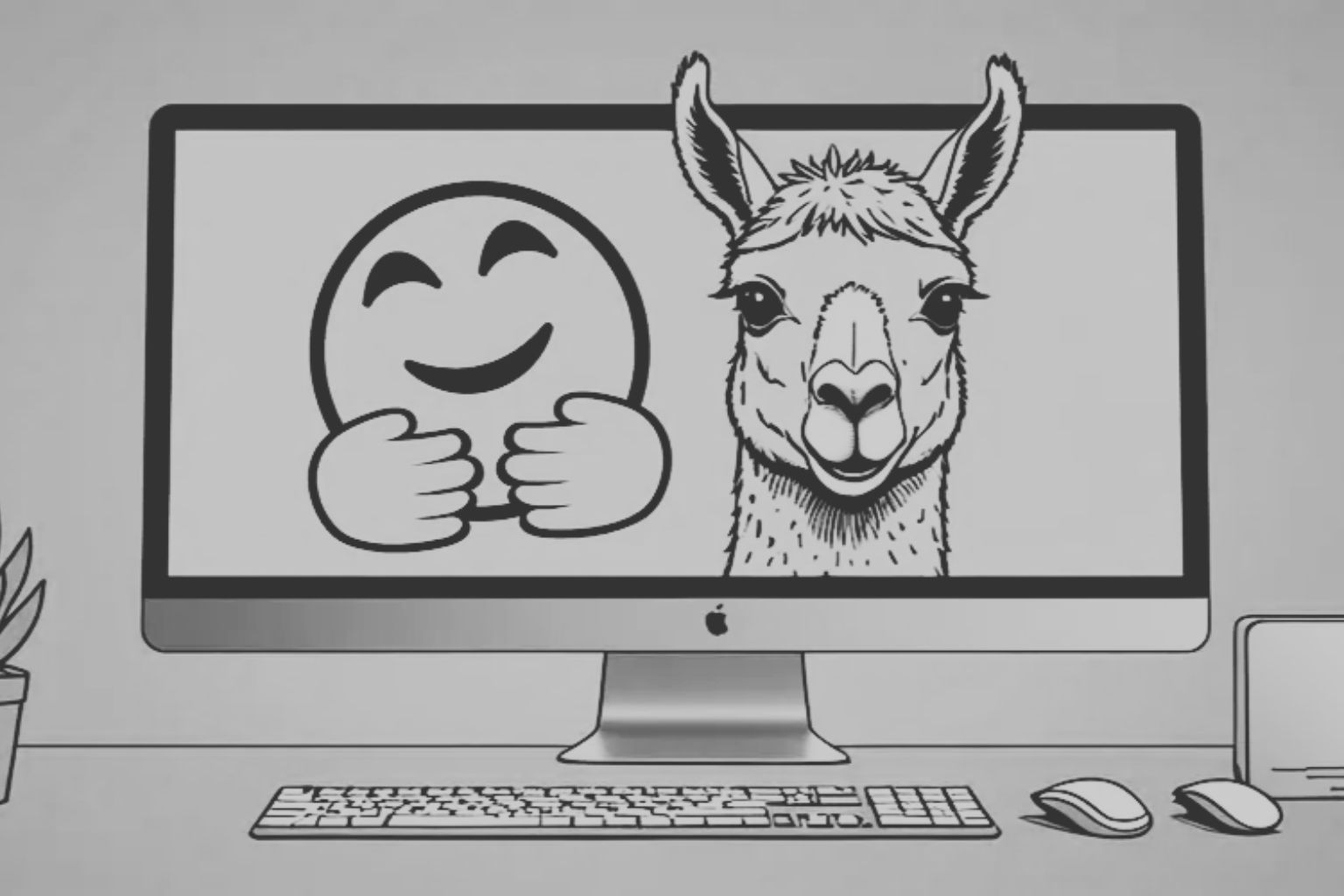
For AI agent developers, the comparison becomes particularly interesting because many projects use both platforms simultaneously.
A common workflow starts with discovering a model on Hugging Face. Once the appropriate model has been identified, it can be downloaded, optimized, and run locally through Ollama. The model is then connected to frameworks such as LangChain, LlamaIndex, CrewAI, or custom agent architectures.
Having spent considerable time building AI agents and autonomous systems as an AI engineer, I’ve found this hybrid approach increasingly common. Hugging Face acts as the discovery layer, while Ollama becomes the execution layer.
This combination allows developers to take advantage of the rapid innovation occurring within the open-source AI community while maintaining local control over inference and data privacy.
The Future of Open-Source AI
The debate between Ollama and Hugging Face highlights a much larger trend within the AI industry.
Only a few years ago, running state-of-the-art language models required specialized infrastructure and significant financial resources. Today, developers can download advanced models from Hugging Face and run them locally through Ollama on consumer-grade hardware.
This shift is democratizing artificial intelligence at an unprecedented pace. Startups can build sophisticated AI products without massive budgets. Researchers can experiment freely. Enterprises can deploy AI while retaining ownership of their data and infrastructure.
Rather than competing, Ollama and Hugging Face are helping to build different layers of the same open AI ecosystem.
Final Verdict
If your primary goal is to run AI models locally with minimal setup, Ollama is likely the better choice. Its simplicity, privacy benefits, and developer-friendly experience make it one of the easiest ways to get started with local AI.
If you need access to the largest collection of models, advanced machine learning tools, fine-tuning capabilities, and enterprise deployment options, Hugging Face is difficult to beat.
For many developers, however, the best solution is not choosing one over the other.
Hugging Face provides the world’s largest open-source AI marketplace and development ecosystem, while Ollama provides one of the easiest ways to run those models locally. Together, they form a powerful combination that is helping accelerate the adoption of open-source AI across the world.
Frequently Asked Questions
Is there anything better than Ollama?
It depends on what you’re trying to achieve. If your goal is to run open-source AI models locally with minimal setup, Ollama is one of the best options available. However, alternatives such as LM Studio, vLLM, Text Generation Inference (TGI), and Open WebUI may be better suited for specific use cases.
For example, LM Studio offers a graphical interface that many beginners prefer, while vLLM is optimized for high-performance production deployments. Ollama’s strength lies in its simplicity, developer experience, and ease of running models locally.
Does Ollama use Hugging Face?
Not directly, but the two platforms are closely connected. Many of the open-source models available through Ollama originally come from repositories hosted on Hugging Face.
Hugging Face acts as the discovery and distribution layer for AI models, while Ollama focuses on making those models easy to run locally. In many real-world workflows, developers find a model on Hugging Face and then deploy it through Ollama for local inference.
Is Hugging Face still free?
Yes. Hugging Face continues to offer a generous free tier that includes access to its model hub, datasets, libraries, and community resources.
However, certain services such as dedicated inference endpoints, enterprise features, managed infrastructure, and high-performance hardware require paid plans. Most developers can explore, download, and experiment with open-source models on Hugging Face without paying anything.
Is Ollama good for coding?
Yes. Ollama is widely used for running coding-focused models locally, including Code Llama, DeepSeek Coder, Qwen Coder, StarCoder, and other developer-oriented language models.
Many developers use Ollama to power local coding assistants, code review tools, AI agents, and IDE integrations. While cloud-based services like GitHub Copilot or Claude may still offer stronger performance on some complex tasks, Ollama provides a private and cost-effective way to use coding models without sending source code to external providers. For developers working with sensitive or proprietary codebases, this can be a significant advantage.

Steven Walgenbach is an AI Engineer specializing in AI agents, large language models, retrieval-augmented generation and business process automation. He designs and builds practical AI systems that connect with existing tools, data sources and workflows to help businesses reduce manual work, improve decision-making and scale more efficiently.
His work includes developing multi-agent systems, private and locally hosted AI solutions, custom knowledge assistants, SEO automation pipelines and LLM-powered applications using Python, LangGraph, CrewAI, the OpenAI Agents SDK and other modern AI frameworks.
Through AIMEC, Steven helps businesses move beyond AI experimentation and identify practical opportunities where artificial intelligence can deliver measurable operational and commercial value.