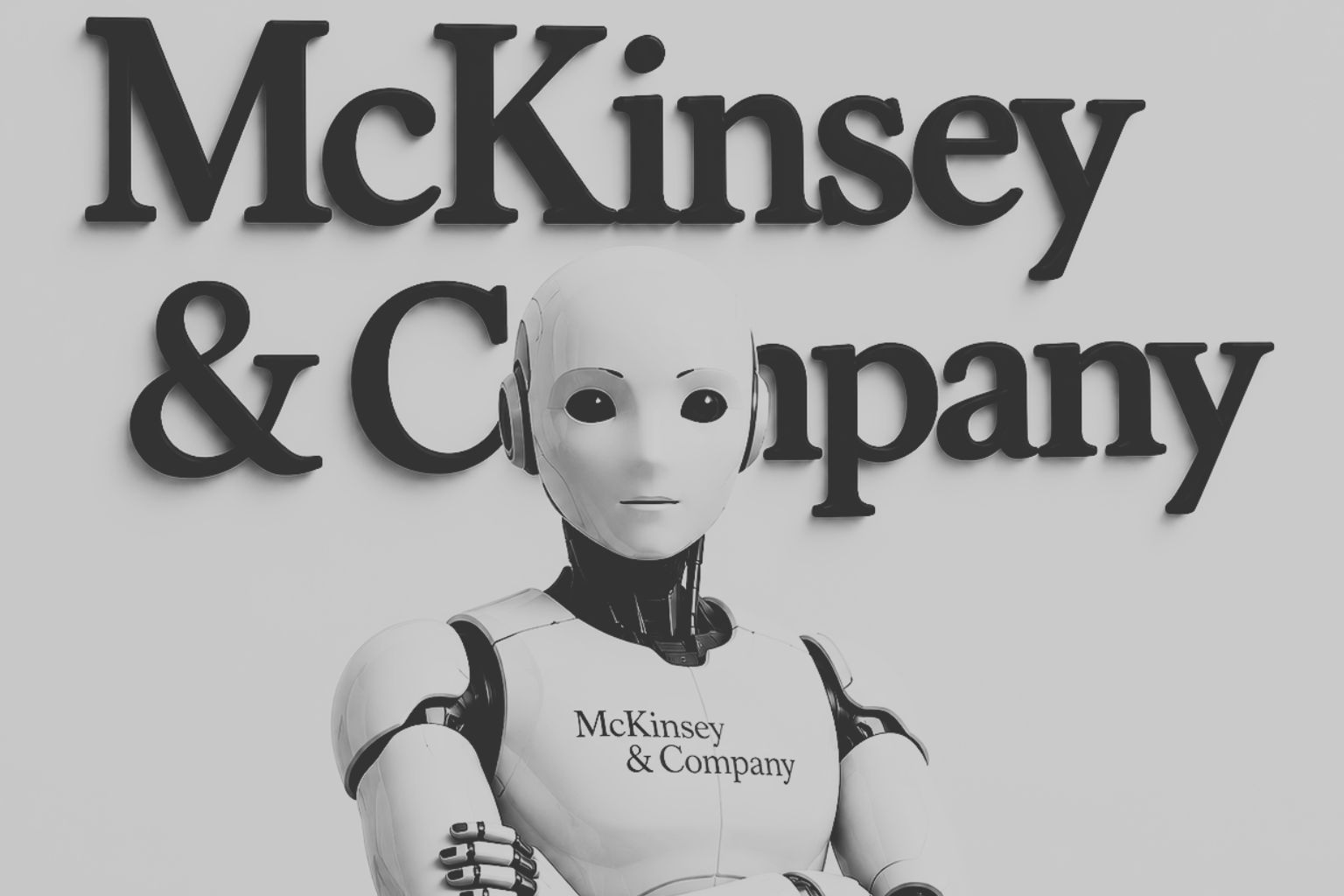
A recent article from McKinsey & Company made something very clear: the future of enterprise AI is not just about automation anymore. It is about agentic AI systems — autonomous AI agents capable of reasoning, adapting, collaborating, and making decisions across entire workflows.
That distinction is important because most businesses today are still operating with fragmented systems and isolated automations. They may have a chatbot connected to a knowledge base, some workflow automations running in the background, and perhaps a few predictive AI models helping with forecasting or reporting. But in most organizations, humans are still the glue holding everything together. Employees move information between systems, validate outputs, handle exceptions, and step in whenever workflows break down. McKinsey argues that this operating model is starting to reach its limit.
The companies that gain the biggest advantage from AI will not simply be the ones deploying the most AI tools. They will be the ones redesigning their organizations around AI agents that function more like digital employees than isolated assistants.
From Automation to AI Employees
One of the most interesting insights from the McKinsey article is that companies should stop asking, “What can we automate?” and instead begin asking, “Which decisions should AI make?” That is a completely different way of thinking about enterprise AI, and is often the question I pose to clients when they talk about AI adoption.
Traditional automation systems are rigid. They follow predefined workflows and deterministic logic trees. If something unexpected happens, the workflow usually breaks and requires human intervention. Agentic AI systems work differently. They can reason through changing conditions, retrieve information dynamically, collaborate with other agents, and adapt their behavior over time. In many ways, they begin behaving less like software scripts and more like workers.
That is exactly why the concept of the AI employee is becoming so important. At AIMEC, we are actively building an AI agent employee system designed to move beyond simple prompting and into operational AI systems capable of functioning inside real business environments. We recently detailed part of this architecture in this article. The goal is not to build another chatbot. The goal is to build AI systems capable of operating across workflows, interacting with tools, accessing memory, learning from outcomes, and functioning as long-term operational assets within organizations.
Why Most AI Implementations Struggle
One of the biggest misconceptions in the AI industry right now is the belief that model intelligence alone solves enterprise problems. In reality, many AI implementations fail because the surrounding infrastructure is weak. The issue is rarely that the model itself is not intelligent enough. The issue is usually that the model lacks operational context, persistent memory, workflow awareness, structured reasoning, or reliable access to tools and systems. This is why architecture matters so much.
At AIMEC, we view the model as only one component within a much larger operational framework. The AI employee architecture we are building combines long-term memory, modular skill systems, tool orchestration, retrieval pipelines, file awareness, and structured workflows that allow the AI to operate with far more consistency and context than a traditional chatbot interaction.
Much like the brain alone cannot make a person function, we need to provide it with a bunch of peripherals. However, only after we do this will we see the true power of AI. The ability to explore, self-evolve and communicate thinking. But will we be the first species to create a…
— Steven Walgenbach (@Steven_AI_Dev) May 23, 2026
Instead of relying entirely on prompts or massive context windows, the system retrieves operational knowledge dynamically and follows structured processes when executing tasks. That creates a far more scalable and enterprise-ready approach to AI deployment.
McKinsey Is Right About Governance
Another major point raised in the McKinsey article is that organizations should start treating AI agents as “corporate citizens.” This means giving them responsibilities, measurable objectives, oversight, governance structures, and accountability frameworks similar to human employees. This is an area where much of the current AI hype starts to break down.
Many public AI agent demonstrations focus heavily on autonomy but ignore operational discipline. Businesses cannot run on systems that hallucinate workflows, improvise inconsistently, or operate without accountability. If AI agents are going to handle meaningful operational work, they need clearly defined boundaries and structured processes.
That is one reason why we strongly emphasize modular skills and governed workflows within our AI employee architecture at AIMEC. Instead of allowing the model to improvise every task from scratch, the system can read structured skill files that define how workflows should operate. This improves consistency, reduces hallucinations, and creates operational reliability.
The future enterprise AI stack is not just about intelligence. It is about controlled intelligence.
The Real Opportunity Is Human and AI Collaboration
One of the strongest ideas from McKinsey’s report is that future competitive advantage will not come from simply “having AI.” Instead, it will come from designing better operating models for collaboration between humans and AI systems. This is where many businesses are still unprepared.
Most organizations still treat AI as a productivity layer added on top of existing workflows. But agentic AI changes the structure of work itself. Humans increasingly move toward oversight, governance, strategic thinking, and exception handling, while AI systems take on repetitive execution, workflow orchestration, monitoring, retrieval, and operational coordination.
That shift requires companies to rethink not only technology, but also workforce design and organizational structure. We believe businesses will eventually operate with both human employees and AI employees functioning together inside the same operational ecosystem. The challenge is not replacing humans. The challenge is building systems where humans and AI can collaborate effectively, safely, and productively.
Why Context Engineering Matters
One thing the broader industry still underestimates is the importance of context engineering.
Large language models are already extremely capable. The real bottleneck is getting the right information to the model at the right time. That means businesses need structured memory systems, retrieval pipelines, operational awareness, workflow management, and persistent knowledge architectures.
This is one reason why our AI employee architecture focuses heavily on modularity. An AI system should not depend entirely on a giant context window. It should actively retrieve operational knowledge, procedural workflows, and historical memory as needed. This approach is significantly more scalable, controllable, and reliable for enterprise environments.
The Rise of AI-Native Organizations
The biggest takeaway from the McKinsey report is that agentic AI is not simply another software upgrade. It represents a shift toward entirely new organizational models.
We are moving toward a world where businesses will operate with both human employees and AI employees working together across interconnected operational systems. The organizations preparing for that future now will have a major advantage over those still treating AI as a disconnected assistant or surface-level automation layer.
At AIMEC, we believe the real challenge is no longer building intelligent models. The real challenge is building intelligent systems around them.

Steven Walgenbach is an AI Engineer specializing in AI agents, large language models, retrieval-augmented generation and business process automation. He designs and builds practical AI systems that connect with existing tools, data sources and workflows to help businesses reduce manual work, improve decision-making and scale more efficiently.
His work includes developing multi-agent systems, private and locally hosted AI solutions, custom knowledge assistants, SEO automation pipelines and LLM-powered applications using Python, LangGraph, CrewAI, the OpenAI Agents SDK and other modern AI frameworks.
Through AIMEC, Steven helps businesses move beyond AI experimentation and identify practical opportunities where artificial intelligence can deliver measurable operational and commercial value.