Model Context Protocol (MCP) is often described as a client-server protocol, but that description leaves out one of the most important parts of its architecture: the host.
Understanding the difference between an MCP host, MCP client and MCP server matters when you start building real AI systems. Each component owns a different part of the workflow, sees different information and carries different security responsibilities.
The distinction has become even more important following the July 28, 2026 MCP specification, which moved the protocol core away from the previous session-based architecture. MCP requests are now stateless and self-contained, with protocol version and client capability information attached to each request.
This guide explains the current MCP architecture, how the three components communicate and what the design looks like when MCP is used inside a business AI agent.
MCP Architecture in 60 Seconds
The simplest way to understand MCP architecture is:
- MCP host: The AI application that coordinates the model, user experience, permissions and MCP connections.
- MCP client: A protocol component running inside the host that communicates with exactly one MCP server.
- MCP server: A component that exposes tools, resources and prompts to the host through MCP.
- Upstream service: The API, database, filesystem, SaaS platform or other system that an MCP server may connect to.
A single host can create multiple MCP clients. Each client connects to one server, allowing the host to use many independent MCP servers without giving every server visibility into the entire AI system. The current MCP architecture explicitly defines this one-client-to-one-server relationship.
A simplified architecture looks like this:
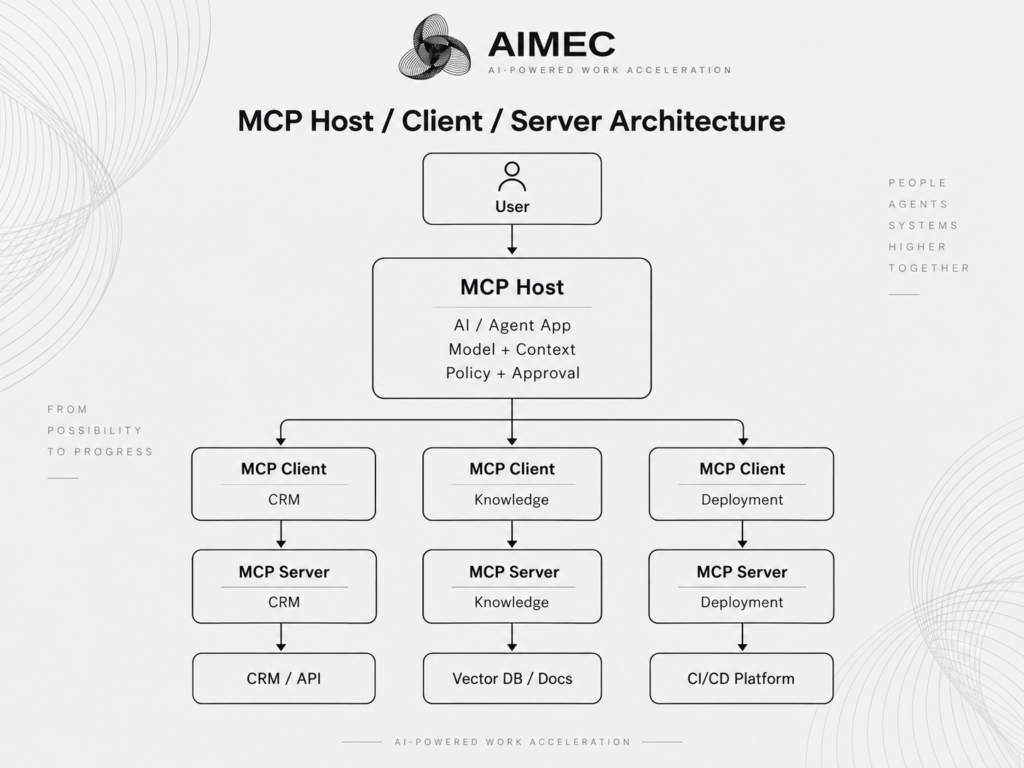
The important point is that MCP is the communication layer between the AI application and the capabilities it wants to use. The MCP server does not necessarily replace the underlying API or database.
MCP Host vs MCP Client vs Server Comparison
| Component | Runs where | Owns what | Sees what | Security responsibility | Example |
| MCP host | AI application | Model interaction, orchestration, user experience, context and connection policy | User conversation and information returned from connected clients | User consent, context sharing, server permissions and cross-server isolation | Enterprise AI assistant |
| MCP client | Inside the host | Communication with one MCP server | Messages exchanged with its assigned server | Connection security, authorization and maintaining server boundaries | CRM client inside an agent |
| MCP server | Local process or remote service | Tools, resources and prompts | Only information supplied through MCP requests | Validate requests, restrict capabilities and securely access upstream systems | CRM MCP server |
| Upstream service | External or internal system | Business data or operations | Whatever its existing permissions allow | Existing API, database or application security | Salesforce, PostgreSQL or GitHub |
This separation of responsibilities is one of MCP’s most important architectural characteristics.
What Is an MCP Host?
An MCP host is the AI application that creates and coordinates MCP clients while controlling how external capabilities interact with the model and user.
The host might be an AI assistant, IDE, enterprise agent, desktop application or another system containing an LLM.
It is responsible for the larger application experience rather than simply transferring MCP messages.
According to the current MCP architecture, the host can create and manage multiple clients, enforce security policies and user consent, coordinate AI integration and combine information received through different MCP connections.
Imagine an enterprise assistant connected to three business systems:
- Salesforce
- an internal knowledge base
- a deployment platform
The host does not need one giant MCP connection containing everything. Instead, it can create three MCP clients, with each client connecting to a separate server.
This also gives the host an important governance role. It can decide which servers are available, what information they receive and whether sensitive actions require human approval.
What Is an MCP Client?
An MCP client is the protocol component inside a host that communicates with one MCP server.
This is where MCP terminology commonly becomes confusing.
A single MCP client does not normally represent the entire AI application. It represents one connection between the host and a particular MCP server.
The current specification describes this as a 1:1 relationship between client and server. A host that connects to five MCP servers would therefore generally manage five client instances.
The client handles the MCP communication required for that server, including request metadata, protocol messages, capability information and supported notification mechanisms.
This architecture also creates isolation between servers.
A CRM MCP server does not automatically get access to information coming from a deployment server simply because both are connected to the same AI agent. The host controls what information moves between those boundaries.
What Is an MCP Server?
An MCP server exposes capabilities that an AI application can discover and use through the Model Context Protocol.
Those capabilities normally fall into three major categories:
- Tools allow the model to perform actions or retrieve information.
- Resources provide contextual information such as files, records or documents.
- Prompts provide reusable templates or instructions that can help structure model interactions.
An MCP server might expose a tool called get_customer_status, for example. The important distinction is that the server does not necessarily contain the customer database itself. It might instead translate the MCP tool call into a request against Salesforce, HubSpot or an internal REST API.
The architecture could therefore look like:
AI Host

   │

MCP Client

   │

MCP Server

   │

REST API

   │

CRM Database
The MCP server is the standardized AI-facing capability layer. The REST API remains the interface used to communicate with the underlying business system.
How an MCP Request Flows
Consider a business agent where a user asks:
“What is the current status of customer ACME’s account?”
A simplified request flow could work as follows.
- The user sends the request to the AI application.
The MCP host receives the conversation and makes the relevant capabilities available to the model. - The model determines that CRM data is required.
It selects a tool such as get_customer_status. - The host routes the operation through the CRM MCP client.
The client associated with the CRM server prepares the MCP request. - The MCP client sends the request to the CRM MCP server.
Under the current protocol, required version and capability metadata travels with the request rather than relying on an earlier initialization session. - The MCP server validates the request.
It checks the requested operation, arguments and relevant authorization. - The MCP server calls the upstream CRM.
This could mean querying a REST API, database or internal business service. - The result returns through the MCP client.
The host receives the structured information. - The model generates the user-facing answer.
The MCP server does not need the entire conversation to perform this task. Ideally, it receives only the information required for the specific operation.
What Changed in the Current MCP Architecture?
Current architecture — MCP 2026-07-28
The current MCP core is stateless. The previous initialize/initialized handshake and protocol-level session model were removed. Requests now carry their protocol version and client capabilities individually. Servers can optionally expose server/discover so clients can inspect capabilities before making other requests.
This is a significant architectural change. Older MCP diagrams and tutorials may show an initialization handshake followed by a persistent MCP session. That accurately described previous versions of the protocol, but it should not be treated as the default architecture for new implementations targeting the current specification. Stateless MCP does not mean an application cannot maintain state.
An agent might still maintain conversation history, workflow state, approval state or business-process state. The difference is that the MCP protocol itself no longer depends on a connection-level session for that information.
This makes horizontal scaling easier because individual requests can be routed independently instead of requiring every request to return to the same session-aware server instance.
Local vs Remote MCP Servers
MCP client versus MCP server is a protocol distinction. Local versus remote is a deployment distinction. They should not be confused.
The current specification defines two standard transport bindings: stdio and Streamable HTTP. Protocol semantics remain the same regardless of the transport being used.
Local MCP with stdio
With stdio, the MCP client launches the server as a subprocess.
Messages move between the client and server using standard input and output. This approach is well suited to local integrations such as filesystem access, local developer tools or processes running on the same machine.
Remote MCP with Streamable HTTP
A remote server can expose an MCP endpoint over Streamable HTTP.
Under the current specification, each JSON-RPC message is sent through its own HTTP POST. Responses can return as a JSON object or through a request-scoped SSE stream when streaming is required.
Neither deployment model changes the fundamental host-client-server relationship.
Tools vs Resources vs Prompts
MCP servers can expose different types of capabilities.
Tools
Tools are executable functions that an AI model can invoke.
Examples include:
- lookup_customer
- create_support_ticket
- deploy_application
- query_inventory
They are useful when the agent needs to perform an action or actively retrieve information.
Resources
Resources expose contextual data.
Examples could include:
- product documentation
- customer records
- files
- repository content
- policy documents
Resources are useful when the model needs information rather than an operation.
Prompts
Prompts are reusable templates or instructions supplied through an MCP server.
For example, an organization could expose a standardized incident-analysis prompt through its internal MCP server.
These primitives allow MCP servers to publish capabilities consistently instead of every AI application requiring a completely custom integration.
Security and Trust Boundaries
MCP makes integration more standardized, but it does not eliminate the security risks associated with allowing AI systems to interact with external systems. The host should remain the primary policy boundary.
A well-designed implementation should use least privilege. A customer-support agent that only needs to look up order information should not automatically receive tools capable of deleting customer records.
Servers should also receive only the context required for their task. The MCP architecture specifically emphasizes that servers should not see the entire conversation or automatically see information belonging to other servers.
For HTTP-based deployments, the MCP specification provides an authorization framework and requires important controls around token handling and token audience validation. Access credentials intended for one MCP server should not simply be forwarded to another system.
Local servers deserve similar scrutiny. Because a local MCP server may execute with the user’s system privileges, official security guidance recommends controls such as explicit consent, restricted filesystem and network access, authentication where appropriate and sandboxing for higher-risk deployments.
AI-specific risks remain relevant as well. Tool descriptions, retrieved documents and tool results can contain untrusted content. MCP therefore needs to sit inside a broader agent-security design that controls which actions the model can trigger and where human approval is required.
MCP Architecture for a Business Agent
The architecture becomes particularly useful when an organization gives an AI agent access to multiple business systems.
Consider an enterprise agent that can:
- search company knowledge,
- check CRM records,
- generate quotes,
- open support tickets,
- and trigger deployments.
Putting every capability behind a single unrestricted integration would create a large security and operational boundary.
MCP allows the architecture to be separated instead:
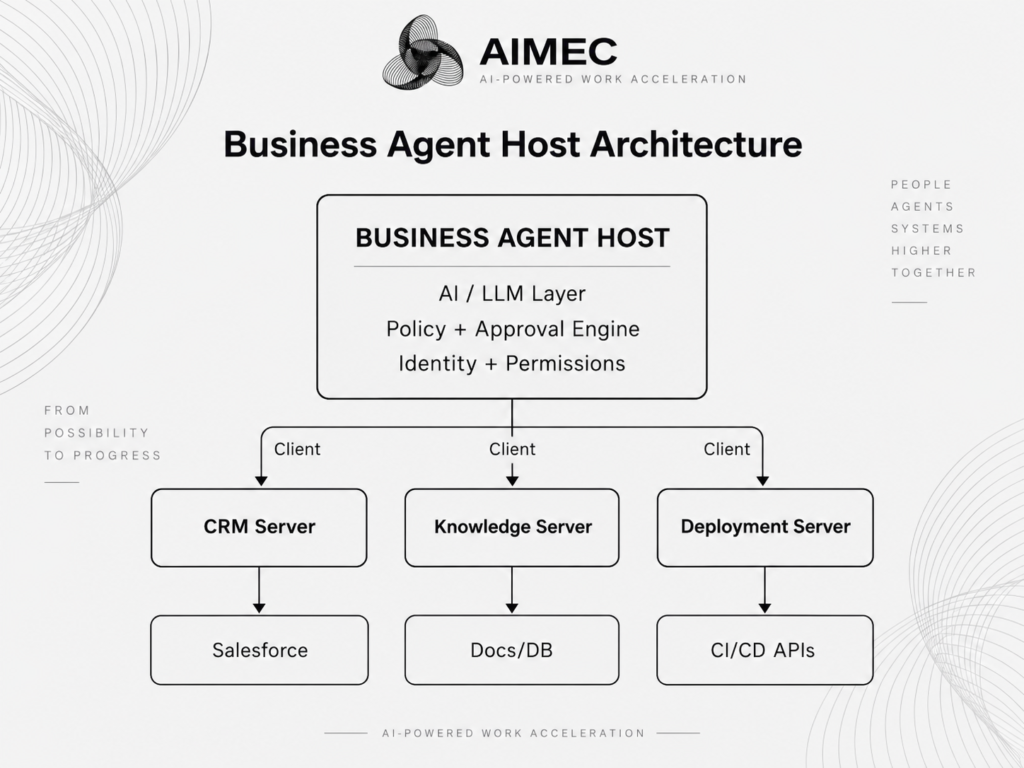
A request involving customer information can be routed to the CRM capability without automatically exposing deployment credentials.
A deployment action can require approval without changing how the knowledge server works.
This separation is especially important as businesses move from simple AI chat interfaces toward agents capable of taking real actions.
For a deeper look at deploying these capability layers, see AIMEC’s guide to MCP Servers for AI and its MCP Integration Services.
Common MCP Architecture Mistakes
Several misconceptions appear repeatedly when teams begin implementing MCP.
Treating the MCP server as the AI model.
The server exposes capabilities. The host normally owns the model interaction and orchestration.
Assuming one MCP client connects to every server.
MCP uses a one-client-to-one-server relationship. A host can manage many clients.
Assuming the server sees the entire conversation.
The architecture is specifically designed so servers can receive only the information required for their responsibility.
Using older session-based architecture diagrams.
The 2026-07-28 specification removed protocol-level sessions and the old initialization handshake.
Giving one server excessive authority.
Breaking capabilities into focused servers can create clearer permission and security boundaries.
Treating MCP as a replacement for every API.
MCP servers frequently sit on top of existing APIs. MCP standardizes how AI applications discover and interact with capabilities; the underlying service may still use REST, GraphQL, SQL or another interface.
When to Use MCP vs a Direct API
A direct API integration can still make sense when an application connects to one known service and the integration is simple and tightly controlled.
MCP becomes more attractive when the same AI application needs to discover and interact with multiple tools or data sources through a consistent interface.
This makes MCP particularly useful for extensible AI assistants, agent platforms, developer environments and enterprise systems where capabilities can change independently of the host.
The two approaches are not mutually exclusive.
An MCP server often uses a direct API internally.
The architectural question is therefore not always “MCP or API?” It can instead be:
Should the AI application integrate directly with this API, or should the API be exposed through an MCP capability layer?
For a detailed comparison, read MCP vs API: Which One Is Best?.
As more services become directly accessible to AI agents, this standardized capability layer also forms part of the broader shift toward the agentic web.
Understanding MCP as an Architecture, Not Just a Protocol
The most useful way to think about Model Context Protocol is not simply as another API format. MCP creates a standardized boundary between an AI application and the capabilities it can use. The host owns the AI experience and orchestration. The client connects that host to one MCP server. The server exposes a focused set of capabilities. And the upstream system continues to perform the actual business operation or provide the underlying data.
Keeping those responsibilities separate makes MCP architectures easier to scale, govern and secure.
For organizations building AI agents that need to operate across many business systems, that separation may ultimately be more important than the protocol syntax itself.
Frequently Asked Questions
Can one MCP client connect to multiple servers?
No. The MCP architecture defines a one-to-one relationship between an MCP client and a server. A host that connects to multiple servers creates and manages multiple client instances.
Can one MCP host use multiple MCP servers?
Yes. A host can create multiple MCP clients and use them to communicate independently with multiple servers.
Is MCP stateless?
The current MCP 2026-07-28 protocol core is stateless. Each request carries the metadata required to process it. Applications and upstream systems can still maintain their own state when required.
Is an MCP host local or remote?
It can be either. Local servers commonly use stdio, while remote deployments can use Streamable HTTP. The client/server role is independent of where the server is deployed.
Does MCP replace REST APIs?
Not necessarily. An MCP server can wrap an existing REST API and expose its capabilities to AI applications through a standardized MCP interface. MCP can therefore complement existing APIs rather than replacing them.

Steven Walgenbach is an AI Engineer specializing in AI agents, large language models, retrieval-augmented generation and business process automation. He designs and builds practical AI systems that connect with existing tools, data sources and workflows to help businesses reduce manual work, improve decision-making and scale more efficiently.
His work includes developing multi-agent systems, private and locally hosted AI solutions, custom knowledge assistants, SEO automation pipelines and LLM-powered applications using Python, LangGraph, CrewAI, the OpenAI Agents SDK and other modern AI frameworks.
Through AIMEC, Steven helps businesses move beyond AI experimentation and identify practical opportunities where artificial intelligence can deliver measurable operational and commercial value.