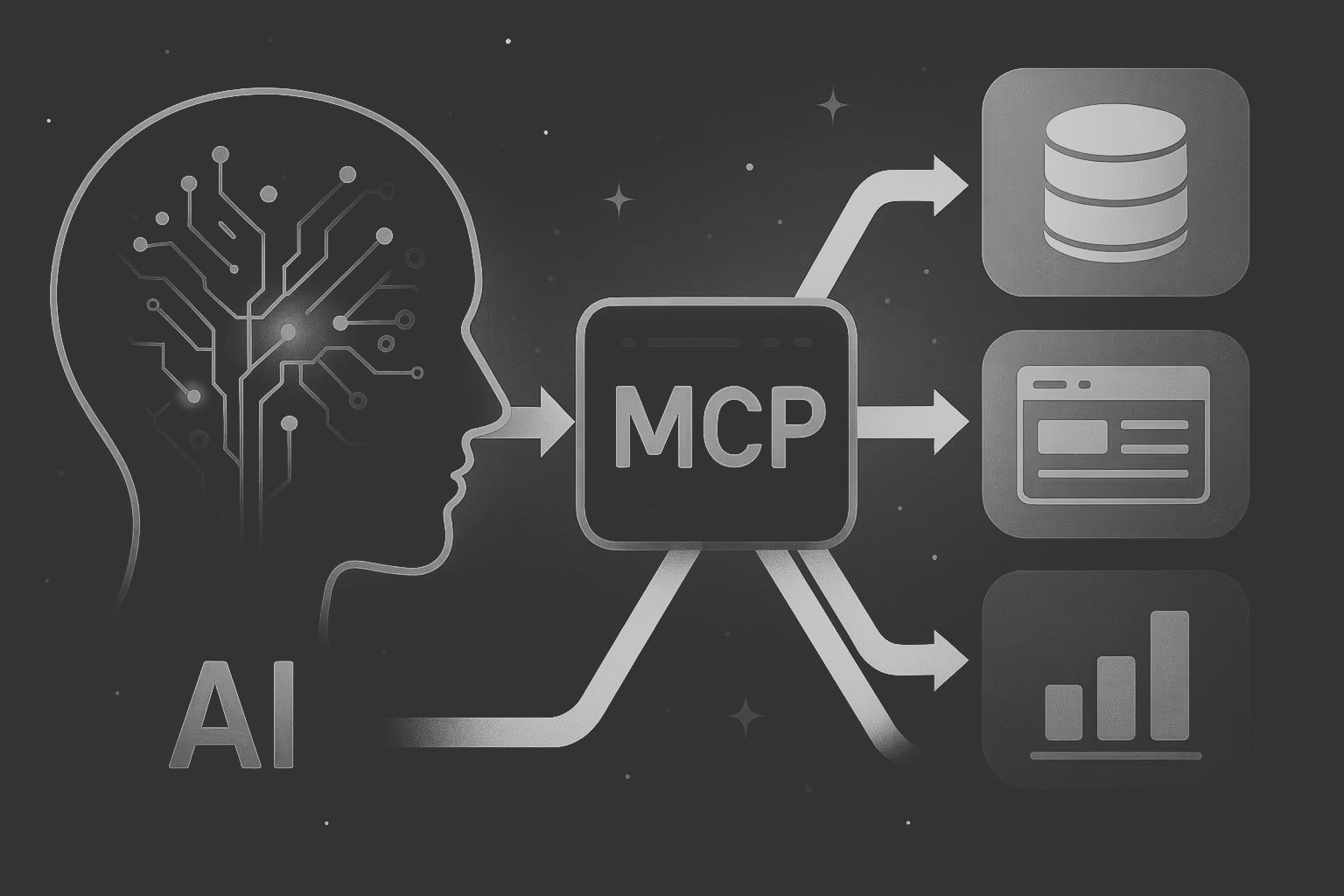
MCP integration services help businesses connect AI agents and applications to the tools, data, APIs, and internal systems they already use through the Model Context Protocol.
The idea is relatively simple. Instead of building a different custom integration every time an AI system needs to interact with a CRM, database, analytics platform, document repository, or internal application, businesses can expose those capabilities through a standardized interface designed specifically for AI.
But implementing MCP in a production environment involves considerably more than installing an MCP server.
Businesses need to think about authentication, permissions, data exposure, tool design, infrastructure, monitoring, human approval, model compatibility, and whether MCP is even the right architecture for the problem being solved.
That is where MCP integration services come in.
TL;DR
- MCP integration services connect AI agents and applications to business systems through the Model Context Protocol.
- A proper implementation can include MCP server development, client integration, authentication, permission controls, tool design, deployment, monitoring, and testing.
- MCP does not replace APIs. In many systems, an MCP server provides an AI-friendly layer over existing APIs.
- Not every AI project needs MCP. For a small number of tightly defined tools, direct integrations may be simpler and cheaper.
- Security and governance become particularly important when MCP tools allow an AI agent to change data or perform actions rather than simply retrieve information.
What Are MCP Integration Services?
MCP integration services are professional engineering services focused on implementing the Model Context Protocol within an organization’s AI infrastructure.
An MCP integration can allow an AI application to discover and interact with capabilities exposed by different business systems. An MCP server might, for example, expose tools that allow an agent to retrieve a customer record, query an analytics platform, search company documentation, create a support ticket, update a CRM, or initiate an internal workflow.
Instead of teaching every new AI application how each individual backend system works, MCP creates a standardized interface through which those capabilities can be presented to compatible AI applications.
The current MCP ecosystem supports concepts including tools, resources, and prompts, while the specification has continued evolving rapidly. The July 28, 2026 specification introduced a stateless protocol core, improved authorization, cacheable capability lists, an extensions framework, and changes designed to make remote MCP infrastructure easier to scale.
This evolution is important for businesses because MCP is increasingly moving beyond developer experimentation toward production AI infrastructure.
OpenAI, for example, now describes MCP as the open standard connecting ChatGPT to external tools and data and has built its Apps SDK around the protocol.
Why Are Businesses Looking at MCP Now?
The first generation of business AI was largely isolated from the systems where actual work happens.
A chatbot could generate an email, summarize a document, or answer a question, but it could not necessarily check the company’s CRM, retrieve the latest stock level, update an order, query an internal database, or send information into an existing workflow.
AI agents change that. Agents become substantially more useful when they can use external tools. However, this creates another engineering problem: every system has its own API, authentication mechanism, data structure, and integration requirements.
Imagine a business wants its AI infrastructure to interact with ten internal and external systems.
Without a standardized integration layer, developers may need to define and maintain ten different tool integrations for one agent. A second AI application might require another set of integrations. Migrating to a different agent framework can introduce even more work.
MCP attempts to provide a common interface between these AI applications and the capabilities they need.
This is also why MCP should be considered as part of the wider shift toward the agentic web. As more software is consumed by agents rather than only humans clicking through graphical interfaces, businesses need to start thinking about how their services are exposed to machines as well as people.
What Do MCP Integration Services Actually Include?
The exact scope depends on the organization, but a production MCP implementation normally involves much more than creating a few tool definitions.
| Area | What the Integration Work Involves |
| Architecture | Identifying which systems should use MCP, APIs, direct tools, RAG, or other integration methods |
| MCP server development | Building servers that securely expose business capabilities to compatible AI clients |
| MCP client integration | Allowing an existing agent, application, or AI platform to connect to MCP servers |
| Existing API integration | Connecting MCP tools to existing REST APIs, GraphQL services, databases, SaaS platforms, and internal services |
| Tool design | Creating clear, tightly scoped tools that models can reliably understand and invoke |
| Authentication | Connecting MCP infrastructure to appropriate identity and authorization mechanisms |
| Permission design | Determining exactly which users or agents can access individual tools and resources |
| Human approval | Requiring confirmation before sensitive actions such as sending, deleting, purchasing, publishing, or modifying records |
| Infrastructure | Deploying local, cloud, on-premise, or hybrid MCP services |
| Observability | Logging requests, tool calls, errors, latency, usage, and important agent actions |
| Testing | Evaluating whether agents select the right tools and use them correctly |
| Maintenance | Updating integrations as MCP, connected APIs, models, and business requirements change |
The engineering work is therefore not simply “connect the AI to MCP.”
The real objective is to create a controlled interface between AI systems and the business.
5 Top MCP Servers Businesses Should Know About
The MCP ecosystem is expanding quickly, with software companies increasingly exposing their platforms directly to AI agents through official MCP servers.
There is no single “best” MCP server because the value depends on what systems a business wants its agents to interact with. However, several official MCP implementations provide useful examples of what businesses can already do with the protocol. Here are five MCP servers worth knowing about.
1. GitHub MCP Server

The GitHub MCP Server is one of the clearest examples of how MCP can turn an existing business platform into something AI agents can actively work with.
Maintained by GitHub, the server allows compatible AI tools to interact with GitHub repositories and functionality while respecting the user’s existing GitHub access permissions. GitHub makes its MCP server available to GitHub users, although individual tools may still depend on the features available under their GitHub plan.
For a software company, this opens the door to agents that can work much more closely with the development lifecycle.
An engineering agent could potentially use GitHub capabilities alongside its reasoning process to inspect repositories, investigate issues, work with pull requests, or retrieve development context without developers having to manually copy information between systems.
Business use case: An internal engineering agent investigates a reported bug, retrieves the relevant GitHub issue and repository context, analyzes the affected code, and prepares information for a developer to review.
2. Notion MCP
Notion MCP allows compatible AI applications to interact directly with a company’s Notion workspace.
Notion describes its MCP implementation as a bridge between AI applications and Notion that can provide real-time read and write access to workspace content. It supports AI platforms including ChatGPT, Claude, and Cursor.
This is particularly interesting for businesses because large amounts of internal company knowledge already live inside systems such as Notion.
Instead of exporting documents into a separate AI knowledge base, an authorized agent can potentially interact with the existing knowledge environment directly.
Business use case: A product agent analyzes customer research stored in Notion, creates a proposed feature specification, and adds a launch checklist to the company’s existing product workspace.
3. Stripe MCP Server
The Stripe MCP Server demonstrates what MCP looks like when agents are connected to operational financial systems.
Stripe’s official MCP integration can connect compatible AI clients to parts of the Stripe platform and exposes both read and write capabilities for supported resources. For example, Stripe’s MCP permissions can include access to payment-related information and actions such as working with charges and refunds.
This is also a good illustration of why MCP security matters.
Reading payment information is one thing. Allowing an autonomous system to initiate or modify financial actions introduces a completely different level of risk.
Businesses implementing similar tools should therefore combine MCP with carefully scoped permissions, audit trails, and human approval where appropriate.
Business use case: A finance support agent investigates a customer’s payment problem, retrieves relevant transaction information, prepares the appropriate action, and asks an authorized employee to approve a refund before it is executed.
4. Playwright MCP
Microsoft’s Playwright MCP Server gives AI agents browser automation capabilities through the Model Context Protocol.
Rather than relying primarily on screenshots, Playwright MCP can interact with web pages using structured accessibility information. Microsoft lists compatibility with several MCP clients and AI development environments.
This is particularly useful when a business still relies on websites or internal applications that do not expose the APIs an agent needs.
An agent could potentially navigate an application, enter information, retrieve data, or complete browser-based workflows in much the same way a human employee would.
However, browser automation is generally less predictable than interacting with a stable API, so businesses should still prefer properly designed APIs or MCP tools where they are available.
Business use case: An operations agent needs to retrieve information from an older supplier portal with no suitable API. Playwright MCP allows it to navigate the portal and retrieve the required information through the browser.
5. Cloudflare MCP Servers

Cloudflare takes the concept further by operating a collection of managed remote MCP servers covering different parts of its platform.
Its MCP servers can allow compatible agents to read account configuration, analyze information, make recommendations, and in some circumstances make changes across Cloudflare services related to areas such as application development, security, and performance. Cloudflare’s managed servers also support OAuth-based connections and the current MCP specification.
This demonstrates where MCP can become particularly valuable for infrastructure management.
Instead of an AI assistant merely explaining how an infrastructure setting should be changed, an authorized agent can potentially inspect the real environment and interact with the systems involved.
Business use case: An infrastructure agent investigates a website performance issue, reviews relevant Cloudflare configuration and analytics, recommends changes, and submits sensitive modifications for human approval.
What These MCP Server Examples Tell Businesses
The important takeaway is not that every business should immediately install these five MCP servers. It is what they represent.
| MCP Server | Capability Exposed to AI |
| GitHub | Software development and repository operations |
| Notion | Company knowledge and collaborative workspaces |
| Stripe | Payments and financial operations |
| Playwright | Browser interaction and web automation |
| Cloudflare | Infrastructure, security, and web operations |
Together, these examples show how MCP can give agents access to very different parts of a company’s technology stack.
The same model can be applied internally. A business could create private MCP servers for its ERP, inventory system, customer database, quotation platform, analytics infrastructure, proprietary APIs, or other internal tools.
This is where MCP integration services become particularly valuable. The objective is not necessarily to find an existing MCP server for every piece of software a company uses. It is to decide which existing servers can be safely adopted, which business systems should receive custom MCP interfaces, and how those capabilities should be governed once AI agents can use them.
MCP Integration Services Do Not Mean Replacing Your APIs
One of the most important things businesses need to understand is that MCP and APIs are not competitors.
APIs remain the foundation of most modern business software. An MCP server will frequently call those existing APIs behind the scenes.
Consider a company with an existing endpoint for retrieving customer information:
GET /api/customers/12345
A traditional application can call that endpoint directly.
An AI agent could also be given direct access to that API through a custom function. Alternatively, an MCP server could expose a higher-level tool such as:
get_customer(customer_id)
The MCP server receives the agent’s request, handles the appropriate authentication and API interaction, and returns the information in a form the AI application can use.
The underlying API has not disappeared.
MCP has instead created an AI-oriented interface on top of it.
This distinction matters because businesses should not begin ripping out functioning APIs simply because MCP adoption is growing. As I discuss in AIMEC’s MCP vs API guide, the two technologies often work best together.
When Do MCP Integration Services Make Sense?
MCP starts becoming particularly interesting when the same business capabilities need to be available across multiple AI systems.
Imagine an organization has developed tools that allow AI agents to query inventory, retrieve customer information, search internal documentation, generate quotations, create support tickets, and check account balances.
If those capabilities are tightly coupled to one proprietary agent, introducing another AI application can mean rebuilding significant portions of the integration layer.
MCP can provide a reusable boundary.
The same set of business capabilities can potentially be exposed to multiple compatible clients without redesigning each underlying system.
This makes MCP especially relevant for businesses planning broader agent infrastructure rather than a single isolated chatbot.
MCP integration services are also useful when a company wants to turn its own software into something external AI agents can interact with. Instead of AI only operating inside the organization, the company’s products or services could eventually expose controlled agent-accessible capabilities.
That becomes increasingly important as the internet evolves toward an environment where AI agents can perform more work on behalf of users.
When MCP May Be Unnecessary
MCP is useful, but adding an architectural layer purely because it is popular is rarely a good engineering decision. A focused internal agent with three simple functions may not need an MCP server at all. Direct tools could be faster to build, easier to test, and cheaper to maintain.
This is something I have encountered when working with smaller local AI models as well. Giving a model an enormous catalogue of tools can create additional context, latency, and reasoning requirements. In environments where compute resources are constrained, a handful of purpose-built functions may outperform a larger MCP integration.
The correct question is therefore not:
“How do we implement MCP?”
It is:
“What is the simplest secure architecture that gives our AI the capabilities the business actually needs?”
Sometimes the answer will be MCP. Sometimes it will be a direct API integration. And increasingly, the answer will be a combination of both.
MCP Security Is a Business Architecture Problem
Giving an AI model access to a tool is fundamentally different from giving it access to information. A tool can do something. This means poorly designed MCP integrations can create genuine business risk.
Consider the difference between an MCP tool that retrieves a customer profile and one that deletes that customer’s account. Both may be technically easy to expose. Their risk profiles are completely different.
MCP authorization has consequently become an important part of the specification. The current protocol includes mechanisms around OAuth-based authorization and resource-specific access, while the latest specification has introduced additional authorization hardening. MCP’s maintainers have specifically highlighted authorization as one of the areas where implementers spend significant integration effort.
A production MCP architecture should therefore follow the principle of least privilege. An agent should receive access only to the data and capabilities required for the task it is performing. Read access and write access should be treated differently. Sensitive operations should be logged. High-risk actions may require human approval before execution. This becomes even more important as businesses move from AI assistants that suggest actions toward autonomous agents that actually perform them.
A Practical MCP Integration Process
A sensible MCP integration project should begin with the workflow rather than the protocol.
| Stage | Key Question |
| Business discovery | What should the AI actually be able to accomplish? |
| System mapping | Which databases, applications, APIs, documents, and services are involved? |
| Architecture | Which capabilities should use MCP and which are better handled through direct integrations? |
| Permission design | What can the agent read, change, create, send, or delete? |
| MCP development | Which servers, resources, and tools need to be created? |
| Agent integration | Which AI clients or internal agents need access? |
| Evaluation | Does the model reliably select and use the correct tools? |
| Security testing | Can users or agents reach anything outside their intended permissions? |
| Deployment | Where should the MCP infrastructure run? |
| Monitoring | How will the business see what its agents are doing? |
This workflow-first approach avoids a common AI implementation mistake: starting with a technology and searching for something to do with it afterwards.
MCP should solve an integration problem that already exists or support an AI capability that the business has deliberately chosen to build.
What Systems Can MCP Connect To?
Potentially almost any system that developers can programmatically access can sit behind an MCP integration.
A business could expose capabilities from a CRM, ERP, analytics platform, SQL database, document repository, project management application, ecommerce platform, accounting system, communication tool, internal API, or proprietary piece of software.
The MCP server does not need to replace these platforms. It provides a controlled interface through which an AI system can use them.
For example, a sales agent could search CRM records, query product availability, retrieve relevant documentation, draft a quotation, request human approval, and then update the customer’s opportunity record.
The important architectural change is that the AI is no longer simply generating text. It is participating in the workflow.
Local, Cloud, or Hybrid MCP Infrastructure?
MCP integrations can also fit different infrastructure models. A cloud-native business may run remote MCP services alongside its existing APIs and applications.
An organization handling sensitive information might keep its MCP servers inside its private infrastructure. Another business may use a hybrid model where private data and tools remain on-premise while selected AI inference or orchestration services operate in the cloud.
The right model depends on data sensitivity, latency, existing infrastructure, compliance requirements, operational resources, and which models or agent platforms need access.
This is another reason MCP integration services are ultimately an architecture problem rather than merely an MCP development problem.
How Much Do MCP Integration Services Cost?
There is no useful universal price for an MCP integration because the protocol itself is rarely the main source of complexity.
The biggest cost drivers are usually the number of systems being connected, the quality of their existing APIs, authentication requirements, custom business logic, infrastructure, permission complexity, testing requirements, regulatory constraints, and the amount of agent functionality being introduced.
Connecting an AI agent to a well-documented internal API with three read-only tools is fundamentally different from connecting it to ten enterprise systems with role-based permissions and actions capable of changing financial or customer records.
Businesses evaluating quotes should therefore be cautious about pricing based purely on a number of “MCP integrations.”
A better scope defines the actual business workflows, systems, tools, permissions, deployment model, testing requirements, and expected outcomes.
How to Choose an MCP Integration Services Provider
The best MCP integration provider is not necessarily the company promising to convert everything to MCP.
In fact, one of the strongest signs that an integration partner understands the technology is being willing to recommend against MCP when a simpler architecture makes more sense.
| What to Look For | Why It Matters |
| AI engineering experience | MCP is ultimately infrastructure for AI applications and agents |
| API and backend engineering | Most MCP tools still interact with conventional software systems underneath |
| Security architecture | Agents may gain access to sensitive data and business actions |
| Experience with multiple models | The integration layer should not be unnecessarily tied to one model provider |
| Human-in-the-loop design | Sensitive actions may require approval |
| Evaluation methodology | A working connection does not guarantee the agent will use it correctly |
| Observability | Businesses need visibility into tool use, failures, costs, and agent activity |
| Documentation and handover | The organization should understand and maintain what has been built |
| Willingness to avoid MCP | Good architecture should solve the business problem rather than force a particular technology |
Businesses should also ask what happens after deployment. MCP is evolving quickly. APIs change. Models change. Authentication methods change. Business processes change.
Production AI infrastructure needs to be maintainable rather than simply impressive during a demonstration.
MCP Integration Is Really About Preparing Your Business for Agents
The bigger reason MCP matters has little to do with the protocol itself. AI is moving from systems that generate information toward systems that can perform work.
That means businesses increasingly need a controlled way to expose their software, information, and operational capabilities to agents. MCP is emerging as one of the standards that can help make that possible.
Meanwhile, technologies such as WebMCP are exploring similar ideas at the website level, allowing businesses to think beyond traditional interfaces and toward digital services that agents can understand and interact with more directly.
This fits into a much larger transition toward the agentic web: an internet where a growing share of digital activity may eventually be carried out by software acting on behalf of humans and organizations.
Businesses do not necessarily need to rebuild their technology stacks for that future today. They should, however, start understanding which parts of their infrastructure may eventually need to become agent-accessible.
Final Thoughts: Do You Need MCP Integration Services?
MCP can make business AI infrastructure significantly more reusable and interoperable, particularly when organizations begin deploying multiple agents, models, tools, and applications.
But MCP should not become another technology businesses implement simply because everyone is talking about it. Start with the workflow.
Determine what the AI needs to know, what it needs to do, which systems it needs to access, and how much autonomy it should have. Then determine whether MCP provides the most sensible integration layer.
For businesses building larger agent ecosystems, MCP integration services can help turn existing APIs, databases, applications, and internal tools into capabilities that AI agents can securely discover and use. For smaller projects, direct agent tools may still be the better solution.
The businesses that benefit most from MCP will not necessarily be those that deploy the most MCP servers. They will be the ones that build clear, secure boundaries between AI and the systems where their actual work happens.
Frequently Asked Questions
What are MCP integration services?
MCP integration services involve designing, building, securing, deploying, and maintaining connections between AI systems and external tools or data through the Model Context Protocol. This can include MCP server development, client integration, API connections, authentication, permissions, monitoring, and agent testing.
What does MCP stand for?
MCP stands for Model Context Protocol. It is an open standard for connecting AI applications to external tools, systems, and data sources.
Does my business need an MCP server?
Not necessarily. MCP becomes particularly useful when capabilities need to be reused across multiple agents or AI applications. A small internal AI application with only a few tools may be simpler to build using direct API or function integrations.
Does MCP replace APIs?
No. MCP frequently sits on top of existing APIs. APIs provide the underlying software interface, while MCP presents those capabilities in a standardized form designed for AI applications.
Are MCP integrations secure?
They can be, but security depends heavily on implementation. Authentication, least-privilege permissions, tool scoping, audit logs, token handling, data boundaries, and human approval should all be considered when deploying MCP in a business environment.
Can MCP work with private or local AI?
Yes. MCP infrastructure can be used with private and local AI systems where the selected models and agent framework support the required tool capabilities. Businesses should still evaluate model capability, context requirements, compute resources, and where sensitive data is processed.
What is the difference between MCP server development and MCP integration services?
MCP server development focuses on creating a server that exposes tools, resources, or other capabilities through MCP. MCP integration services are broader and can include architecture, existing API integration, MCP clients, security, authentication, deployment, agent integration, testing, monitoring, and ongoing maintenance.
What should a business do before implementing MCP?
Define the business workflow first. Identify what the AI should accomplish, what systems it requires, what actions it should be permitted to perform, and which actions require human approval. MCP architecture should be designed around those requirements rather than introduced as the starting point.

Steven Walgenbach is an AI Engineer specializing in AI agents, large language models, retrieval-augmented generation and business process automation. He designs and builds practical AI systems that connect with existing tools, data sources and workflows to help businesses reduce manual work, improve decision-making and scale more efficiently.
His work includes developing multi-agent systems, private and locally hosted AI solutions, custom knowledge assistants, SEO automation pipelines and LLM-powered applications using Python, LangGraph, CrewAI, the OpenAI Agents SDK and other modern AI frameworks.
Through AIMEC, Steven helps businesses move beyond AI experimentation and identify practical opportunities where artificial intelligence can deliver measurable operational and commercial value.