A modern private AI architecture can run on-premises, inside a private cloud or VPC, or across a hybrid environment that keeps sensitive workloads private while selectively using external AI services.
The right architecture depends on what needs to remain under your control: data, model inference, embeddings, keys, administrative access, network traffic, logs and AI actions.
For most enterprises, the key question is therefore not simply “cloud or local?”
It is: Where should each part of the AI system run, and what is allowed to cross the control boundary?
This guide compares the three main approaches and provides a practical architecture framework for businesses deciding how to deploy private AI.
What Is Private AI Architecture?
Private AI architecture describes the technical and governance structure used to keep an organisation’s AI workloads within defined control boundaries. This includes more than the model itself.
A complete private AI environment can include:
- identity and access management;
- AI gateways and orchestration;
- model inference;
- retrieval-augmented generation (RAG);
- embedding models and vector databases;
- enterprise data connectors;
- secrets and encryption keys;
- network and egress controls;
- AI tools and agent permissions;
- logging, tracing and observability;
- approval workflows; and
- backup and disaster recovery.
This distinction matters because running a model locally while sending documents, embeddings, prompts or logs to external services does not create an entirely private system. The goal is to understand and control the full data and execution path.
That is also why businesses comparing Private AI vs Cloud AI should look beyond the location of the language model alone.
Three Main Private AI Deployment Patterns
Enterprise private AI generally falls into three architectural patterns.
1. On-Premises Private AI
The organisation operates the AI infrastructure itself, normally within its own data centre, server environment or private infrastructure.
Models, vector databases, enterprise documents and orchestration services can all remain inside infrastructure controlled by the organisation.
An on-premises environment can also be isolated from the internet or fully air-gapped where required.
This delivers significant infrastructure control but places responsibility for hardware, scaling, patching, monitoring and availability on the organisation.
2. Private VPC or Private Cloud AI
The AI environment runs in a logically isolated cloud network controlled through the organisation’s cloud account.
Private endpoints, cloud IAM, network policies and managed key services can be used to restrict access without requiring the organisation to own physical GPU infrastructure.
AWS, Microsoft Azure and Google Cloud all provide mechanisms for accessing managed services over private network paths rather than ordinary public endpoints. AWS, for example, supports private Amazon Bedrock connectivity through PrivateLink; Microsoft Foundry supports private endpoints and network-isolated deployments; and Google Private Service Connect allows managed services to be reached through internal VPC addresses.
Private VPC AI can therefore provide a meaningful private-AI architecture without requiring every component to run on company-owned hardware.
3. Hybrid Private AI
A hybrid architecture separates workloads according to their risk and control requirements.
Sensitive prompts, regulated information, private RAG systems and high-risk agent actions may remain inside an on-premises or private-cloud environment.
Lower-risk requests can then be routed to approved external models when policy permits.
This gives businesses access to a broader selection of AI models while maintaining tighter controls around sensitive workloads.
Private AI Architecture Comparison
| Control Area | On-Premises | Private VPC / Private Cloud | Hybrid |
| Sensitive data location | Organisation-controlled infrastructure | Customer-controlled cloud environment and configured services | Split according to classification |
| Model runtime | Local/self-hosted | Private or managed cloud inference | Private plus selected external models |
| Vector database | Usually local/private | Private VPC or private managed service | Private for sensitive knowledge |
| Network egress | Can be heavily restricted or disabled | Controlled through VPC/VNet policies | Policy-controlled by workload |
| Identity | Enterprise IAM/SSO | Enterprise identity plus cloud IAM | Unified identity across environments |
| Encryption keys | Organisation-managed | Cloud KMS or customer-managed keys | Depends on workload |
| Administrative control | Highest infrastructure control | Shared with cloud/service-provider operating model | Split across providers |
| Observability | Organisation operates stack | Cloud-native and/or private tooling | Centralised across environments |
| Hardware responsibility | Organisation | Cloud provider | Mixed |
| Scaling | Requires owned capacity | Usually easier to expand dynamically | Flexible by workload |
| Latency | Potentially very low for local systems | Depends on region and architecture | Workload-dependent |
| Cost model | Hardware and operations heavy | Consumption/reserved cloud capacity | Mixed |
| Typical fit | Maximum infrastructure control, isolated environments | Enterprise privacy without owning all hardware | Businesses balancing control and model choice |
The most important distinction is the control boundary. A VPC architecture may have less physical infrastructure control than an on-prem deployment while still providing strong network isolation, identity controls and private connectivity. Similarly, an on-premises deployment is not automatically secure merely because the servers are local.
On-Premises Private AI Architecture
An on-premises architecture gives the enterprise direct responsibility for most or all layers of the AI stack.
A typical system may look like this:
Employee → Enterprise SSO → AI Gateway → Policy Layer → AI Orchestrator → Private Model Runtime → Private RAG → Enterprise Data
Supporting systems provide secrets management, audit logs, observability and infrastructure management.
The organisation controls where models execute and where enterprise information is stored. For sensitive knowledge applications, documents can be processed locally, converted into embeddings locally and stored inside a private vector database. This approach is particularly relevant when organisations require strict infrastructure isolation or need AI workloads to continue operating without external connectivity. However, the hardware is only one part of the architecture.
Identity, model permissions, tool access and audit controls still need to be implemented correctly.
An employee who can query a locally hosted model should not automatically gain access to every document in the organisation.
Businesses considering this model should also evaluate when it makes sense to self-host an LLM rather than treating local hosting as the default answer.
Private VPC / Private Cloud AI Architecture
A private VPC architecture moves infrastructure into the cloud while attempting to maintain a defined network and administrative boundary.
For example, an architecture may use:
Enterprise User → SSO → Private Application → VPC AI Gateway → Model Endpoint → Private Vector Store → Private Data Services
Public access can be disabled or restricted for supported components, while private endpoints connect services without exposing them through conventional public endpoints.
Microsoft’s current Foundry documentation, for example, distinguishes inbound and outbound isolation and supports private connectivity to resources such as storage and AI Search. AWS allows Amazon Bedrock to be reached through an interface VPC endpoint without requiring an internet gateway or NAT path.
This can dramatically reduce the infrastructure burden compared with operating GPU clusters yourself. But private VPC does not mean “no vendor involvement.”
Businesses still need to establish:
who can administer the cloud environment, where services process data, which managed services are involved, how encryption keys are controlled, what telemetry is generated and whether any component retains or transmits information outside the expected boundary.
Private cloud AI should therefore be assessed at the service and data-flow level, rather than assuming that placing an application inside a VPC makes the complete AI system private.
Hybrid Private AI Architecture
Hybrid AI is increasingly useful because different workloads do not always require identical controls. Consider an internal AI assistant.
A request asking:
“Summarise our confidential acquisition documents.”
could be restricted to a private model.
A request asking:
“Draft a generic description of machine learning for our public website.”
could potentially use an approved external model.
The architecture could therefore become:
User → Identity → AI Gateway → Data Classification → Policy Router
From the policy router, the request can follow one of two paths:
Sensitive → Private model → Private RAG → Enterprise systems
or
Approved low-risk → External model API
The important component is the policy router. External access should not simply be determined by which model a user selects. Classification, identity, application context, data sensitivity and organisational policy can determine whether an external inference route is permitted.
Hybrid architecture therefore makes privacy a dynamic policy decision rather than a single infrastructure choice.
Reference Architecture for a Private Enterprise AI System
A useful private AI architecture separates identity, policy, inference, knowledge access and observability.
An illustrative AIMEC architecture can be represented as:
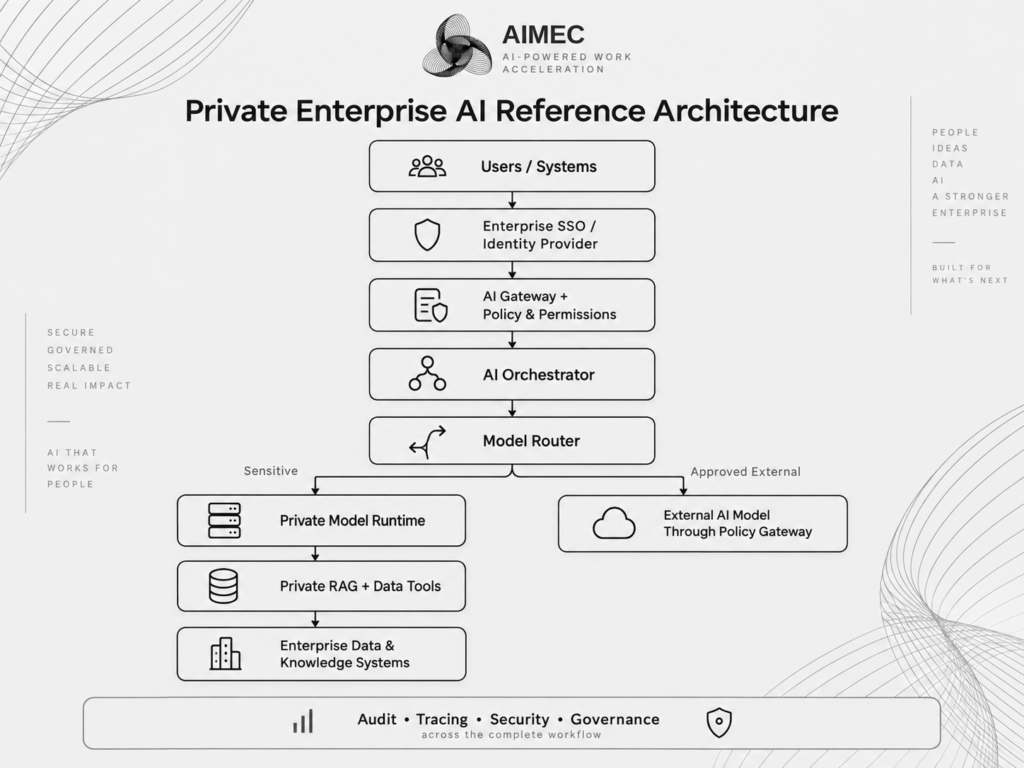
The model is deliberately not placed at the centre of everything. The policy and orchestration layer controls what the model is allowed to see and what it is allowed to do.
This becomes even more important with AI agents because the system may not simply produce text. It may query databases, call APIs, update records or initiate business processes.
Data Classification Should Choose the Architecture
Businesses do not necessarily need the same architecture for every piece of information. A practical classification model might distinguish between highly sensitive, regulated, internal and public data. Highly sensitive information could include trade secrets, privileged documents, credentials or strategic acquisition information.
Those workloads may require private inference, restricted RAG stores and tightly controlled egress.
Regulated or personal information may require additional processing controls depending on the applicable legal and industry requirements.
Internal information may be suitable for private VPC processing under approved configurations.
Public data may present substantially fewer confidentiality concerns and could be eligible for approved external models.
Architecture can then follow data sensitivity, rather than forcing the entire organisation into one deployment model.
Private RAG and Knowledge Access
One of the biggest mistakes in private AI architecture is focusing on model hosting while ignoring RAG. A private company knowledge assistant usually processes significantly more than the user’s final prompt. Documents may first be uploaded and parsed. Text may then be chunked and processed by an embedding model.
Those embeddings may be stored in a vector database.
A retrieval system then searches the vector store and sends selected content into the model context.
Logs and traces may capture parts of the request along the way.
Consequently, private RAG needs to evaluate the complete pipeline:
Document → Parser → Chunking → Embeddings → Vector Store → Retrieval → Prompt Context → Model → Logs
Any external component in that chain can potentially create another data boundary.
Businesses building sensitive knowledge systems should therefore assess the entire on-premise RAG architecture, rather than only asking where the LLM runs.
Security Controls That Matter More Than “Local vs Cloud”
Physical location alone is a weak security model. NIST’s zero-trust guidance specifically moves away from granting implicit trust based on network location. Access decisions should instead be tied to identities, resources and granular policy.
For private AI, that means organisations should consider controls such as strong enterprise identity, least-privilege access, service identities, controlled network egress, secrets management, tool permissions, approval gates, audit trails and explicit retention policies.
For agentic AI, permissions become particularly important. An AI agent that can read a finance database does not necessarily need permission to modify it. An agent capable of creating purchase orders should not automatically be able to approve those orders.
Sensitive actions can require a human approval step even when inference itself happens completely inside a private environment.
That is why private AI for regulated industries is primarily a governance and architecture problem rather than just a model-hosting problem.
Operational Trade-Offs
The strongest privacy architecture is not useful if the organisation cannot operate it reliably.
On-premises AI introduces GPU procurement, capacity planning, hardware maintenance, model deployment, patching, backups, failover and monitoring.
Model demand can also be unpredictable. A system designed around ten concurrent users may behave very differently when deployed to 1,000 employees.
Private cloud architectures can shift part of this operational burden to cloud services and make capacity easier to adjust, but introduce cloud architecture, IAM, network configuration and cost-management requirements.
Hybrid systems introduce another challenge: consistent policy across several environments.
Observability therefore matters regardless of architecture.
Teams should be able to establish which model processed a request, which enterprise resources were retrieved, which tools were called, what policies were applied and whether the request crossed an external boundary.
Cost and Total Cost of Ownership
On-premises AI and private cloud AI have fundamentally different cost structures. On-premises deployments tend to move spending towards hardware, infrastructure and engineering. Cloud deployments move more expenditure towards consumption, reserved capacity and managed services. Hybrid architecture combines both.
The lowest inference price is therefore not automatically the lowest total cost. Businesses should also account for engineering time, idle GPU capacity, power, cooling, networking, monitoring, redundancy, backups, software maintenance and security operations.
For some organisations, owning infrastructure provides predictable utilisation economics. For others, operating hardware that remains idle for long periods can make cloud infrastructure more economical.
Cost should be evaluated against the actual workload rather than architecture ideology.
Which Private AI Architecture Should You Choose?
A useful decision process starts with five questions.
Does sensitive information have to remain inside infrastructure directly controlled by the organisation?
If yes, on-premises or tightly controlled private infrastructure may be appropriate.
Can approved cloud infrastructure meet the organisation’s data, security and governance requirements?
If yes, private VPC architecture may remove significant infrastructure overhead.
Do different workloads have very different sensitivity levels?
If yes, hybrid architecture can provide more flexibility.
Does the organisation have the skills and operational capacity to manage AI infrastructure?
If not, a fully self-managed on-premises deployment may introduce more operational risk than expected.
Does the application require access to several external frontier models?
If yes, hybrid routing can provide controlled access without sending every workload externally.
There is no universally correct answer. A business may even operate all three patterns simultaneously. Research teams may use external models, internal knowledge applications may operate inside a private VPC, and highly sensitive environments may remain on-premises.
Private AI architecture should therefore follow workload requirements rather than forcing every AI use case into the same infrastructure model.
Private AI Is Ultimately About Control Boundaries
The choice between on-premises, private VPC and hybrid AI should not begin with hardware. It should begin with the business’s required control boundary. Then choose infrastructure that enforces those decisions.
For some organisations, that will mean local GPU servers. For others, a well-designed private VPC provides the necessary controls without the operational burden of running physical AI infrastructure. For many enterprises, the eventual architecture will be hybrid: private models and private knowledge systems at the core, with policy-controlled access to external AI where the workload allows it.
That is the more useful way to think about private AI for business.
It is not simply where the model runs.
It is the architecture that determines where information can go, which systems can act on it and who remains in control.
For a broader introduction to this approach, see AIMEC’s guide to Local and Private AI for Business.
Frequently Asked Questions
Does private AI have to run on-premises?
No. Private AI can run on organisation-owned infrastructure, inside a private VPC or cloud environment, or through a hybrid architecture. The important consideration is the level of control over data, network access, models, identity, keys and administration.
Is a private VPC considered private AI?
It can be. A private VPC can provide network isolation, private service connectivity, IAM controls and restricted access while using cloud infrastructure. The exact privacy boundary depends on the services used and their configuration.
Can private AI use external models?
Yes. A hybrid private AI architecture can route approved workloads to external models while keeping sensitive workloads inside a private environment. A policy gateway should determine which information is permitted to cross that boundary.
Is hybrid AI secure?
Hybrid AI can be designed with strong security controls, but security depends on implementation. Identity, classification, network egress, model routing, logging, secrets management and tool permissions all need to be governed.
What data should never leave a private AI environment?
There is no universal list for every organisation. Businesses should classify information according to contractual, regulatory, security and operational requirements. Highly sensitive or restricted information can then be prevented from reaching unapproved models or services.
Is on-premises AI automatically safer than cloud AI?
No. On-premises infrastructure provides additional physical and administrative control, but poor identity management, excessive permissions, insecure networking or inadequate patching can still create significant risk. Security depends on the complete architecture rather than the server location alone.

Steven Walgenbach is an AI Engineer specializing in AI agents, large language models, retrieval-augmented generation and business process automation. He designs and builds practical AI systems that connect with existing tools, data sources and workflows to help businesses reduce manual work, improve decision-making and scale more efficiently.
His work includes developing multi-agent systems, private and locally hosted AI solutions, custom knowledge assistants, SEO automation pipelines and LLM-powered applications using Python, LangGraph, CrewAI, the OpenAI Agents SDK and other modern AI frameworks.
Through AIMEC, Steven helps businesses move beyond AI experimentation and identify practical opportunities where artificial intelligence can deliver measurable operational and commercial value.