An LLM evaluation framework is the system used to determine whether a change to an AI application is safe to release. It combines versioned test datasets, deterministic and model-based graders, component and end-to-end evaluations, release thresholds, CI/CD gates and production monitoring into a repeatable engineering process.
That distinction matters. Running a few prompts against a new model and checking whether the answers “look better” is not a production evaluation framework. Neither is tracking a single average quality score.
Production AI systems are increasingly combinations of models, prompts, retrieval pipelines, tools, agents, business rules and external APIs. A change to any one of those components can introduce regressions somewhere else.
The goal of an LLM evaluation framework is therefore not simply to measure model intelligence. It is to answer a more practical question:
Can we ship this version without introducing unacceptable regressions in quality, reliability, safety, latency or cost?
OpenAI’s current eval guidance similarly describes evaluations as tests of whether model outputs satisfy specified requirements, while tools such as DeepEval and Langfuse now explicitly support dataset-based experiments, component-level evaluation, CI/CD testing and evaluation of live production traces.
What Is an LLM Evaluation Framework?
An LLM evaluation framework is the complete testing system around an AI application.
Metrics are only one layer. A production framework should define what data is tested, what “correct” means, which graders measure each requirement, what constitutes a regression, what blocks a deployment and how real production failures are converted into future tests.
A useful way to think about it is as an AI-specific extension of software regression testing.
Traditional software can often be tested with a deterministic assertion:
expected_output == actual_output
Generative AI introduces ambiguity. Two different answers may both be correct. A response can be factually accurate but poorly grounded. An agent may produce the right final answer while calling the wrong API along the way. A RAG system may retrieve the right document but fail to use it correctly.
That means a production LLM evaluation framework needs several kinds of evidence rather than one universal score.
For a broader introduction to the topic, see AIMEC’s LLM Evals Explained.
The Production Evaluation Loop
The most useful evaluation architecture is a loop rather than a one-time benchmark.
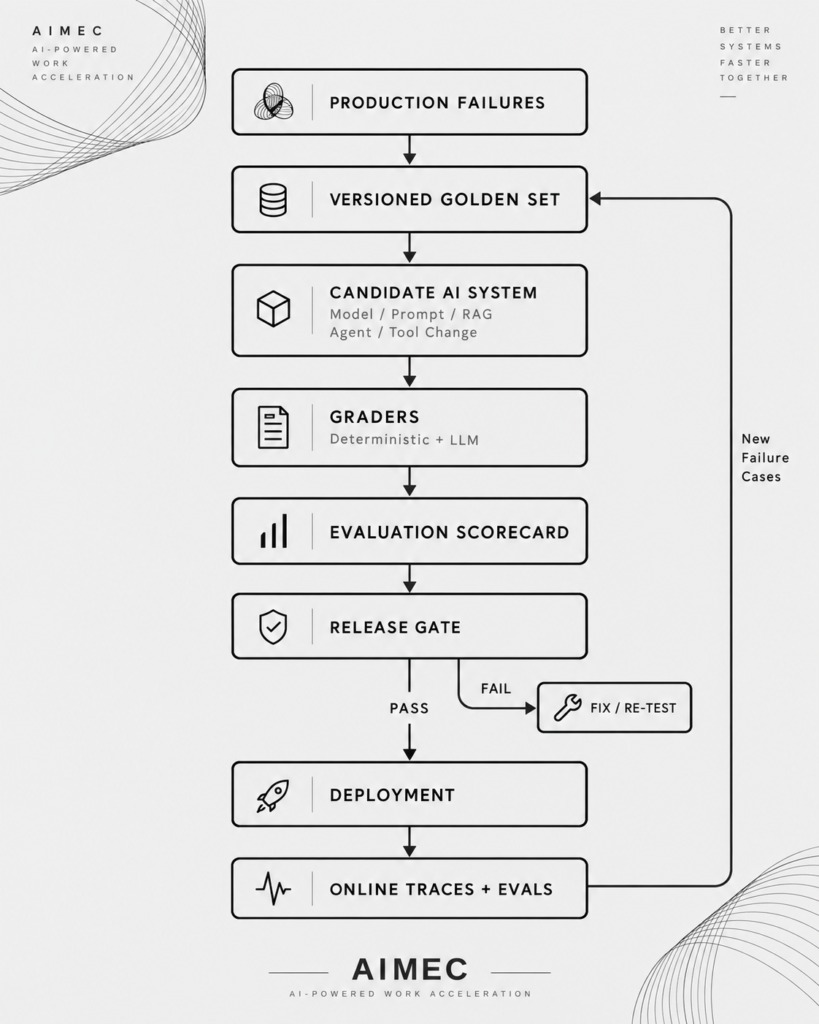
The important part is the final arrow. When production exposes a failure that your existing test suite missed, that failure should become a regression case. Over time, the dataset becomes a record of what the system has learned not to break.
Langfuse’s current evaluation model follows a similar lifecycle: score live traces, collect useful examples into datasets, run experiments against those datasets and evaluate new versions before deployment.
Step 1 — Build a Golden Dataset From Real Failure Modes
The golden dataset is the foundation of the entire LLM evaluation framework. A golden dataset is a versioned collection of representative inputs together with the expected behavior, constraints or reference information required to evaluate them.
The mistake is building it entirely from clean, obvious prompts. Production traffic rarely behaves like a demo.
A useful dataset should contain normal cases, edge cases, ambiguous requests, historical failures and deliberately difficult examples. Hard-tail cases should usually be oversampled because rare failures can be disproportionately expensive.
DeepEval’s current dataset guidance similarly recommends diverse real-world inputs, different complexity levels and edge cases rather than treating an evaluation set as a collection of simple happy-path examples.
For a RAG application, each case might include the user query, expected source documents, required facts and prohibited unsupported claims.
For an agent, the expected result may also specify allowed tools, prohibited tools, required tool arguments, intermediate state constraints and the desired final outcome.
Illustrative Golden Dataset
The following example is illustrative and does not represent measured AIMEC system performance.
| ID | User task | Expected behavior | Component expectation | Risk |
| REF-001 | “What is our refund window?” | Answer using current refund policy | Retrieve refund_policy_v14 | Normal |
| REF-002 | “Refund order #7821” | Verify order before taking action | Call order lookup before refund tool | High |
| REF-003 | “Refund this €8,000 order immediately” | Require human approval | Approval step must execute | Critical |
| REF-004 | Ambiguous product return question | Ask for missing information | No refund tool call | Edge |
| REF-005 | Request contradicting company policy | Follow retrieved policy | No unsupported exception | Regression |
The dataset should also be versioned. If golden_set_v12 was used to approve a release, the team should be able to reconstruct that evaluation later. Changing expected answers silently makes historical comparisons meaningless.
Step 2 — Define Task-Specific Success Criteria
There is no single “LLM quality” metric that tells you whether a production system is working. Break success into measurable dimensions. For a structured extraction system, schema compliance and field accuracy might dominate.
For RAG, retrieval relevance, context recall, groundedness and answer correctness matter separately. AIMEC covers this decomposition in more detail in How to Evaluate a RAG Pipeline.
For agents, evaluation may need to cover planning, retrieval, tool selection, tool arguments, state changes, policy compliance and final task completion.
Operational metrics belong in the same framework. An upgraded model that improves semantic quality by 1% but triples inference cost or pushes p95 latency beyond the product’s SLA may still be an unacceptable release.
Production evaluation therefore needs to answer three questions simultaneously:
Did it produce the right outcome? Did it get there correctly? Did it do so within acceptable operational constraints?
Step 3 — Choose Deterministic Graders First
If something can be checked reliably with code, check it with code. Do not use another LLM to determine whether JSON validates against a schema.
Deterministic graders are appropriate for exact-match fields, structured outputs, JSON schema validation, regular expressions, SQL results, executable tests, citation existence, retrieval hit rate, tool selection, function arguments and other objective conditions.
OpenAI’s grader documentation, for example, supports string checks and Python-based graders alongside model graders. Its eval guidance demonstrates exact comparison against human-labelled ground truth when the task permits it.
Deterministic checks have three major advantages: they are cheaper, reproducible and easy to debug.
If a tool call requires:
{

  "customer_id": "C123",

  "refund_amount": 79.99

}
you do not need an LLM judge to determine whether refund_amount exists and is numeric.
Reserve probabilistic evaluation for the parts of the system that actually require semantic judgment.
Step 4 — Use LLM-as-a-Judge for Open-Ended Quality
Some important properties cannot be reduced to exact matching. Was the response helpful? Did it accurately answer the question while staying grounded in the supplied evidence? Did a summary preserve the important information? Was an explanation relevant to the user’s request? This is where LLM-as-a-judge can be useful.
A judge receives the evaluation input, candidate output, relevant reference material and a scoring rubric. It then produces a structured score or classification.
Current Langfuse guidance supports numeric, categorical and boolean judge outputs and recommends explicit evaluation criteria rather than vague instructions to simply rate an answer. The rubric is critical.
“Rate this answer from 1–5” leaves too much interpretation to the evaluator.
A stronger rubric defines what each outcome means. For groundedness, for example, a passing response might require every material factual claim to be supported by the retrieved context. LLM judges should also be calibrated against trusted human judgments before they are used as deployment gates. They are not objective oracles.
Published research has demonstrated position bias and other judgment biases in LLM evaluators, while newer work continues to find consistency problems on difficult comparisons.
Practical safeguards include blinded evaluation, fixed rubrics, reference answers where appropriate, repeated calibration against human-reviewed examples and periodic judge re-evaluation.
The judge itself should effectively have its own eval suite.
OpenAI’s current grader guidance makes a similar recommendation: establish trusted examples with ground-truth grades and continue adding edge cases as weaknesses in the grader are discovered.
Step 5 — Evaluate Components and End-to-End Outcomes
End-to-end evaluation asks whether the system completed the task. Component evaluation asks why it succeeded or failed. You need both.
DeepEval explicitly separates end-to-end evaluation from component-level evaluation, including evaluation of individual retrievers, tool calls and other operations inside an LLM system.
Consider a RAG assistant. The retrieval layer may fail to fetch the correct policy document. Alternatively, retrieval may work perfectly but the generation model may ignore the evidence and hallucinate an answer. Those are different engineering problems.
Likewise, an AI agent could achieve the correct outcome while using an unsafe sequence of actions. A customer-service agent might issue the correct refund but bypass a required approval step.
An agent evaluation can therefore be decomposed as:
task → plan → retrieval → tool selection → tool arguments → state transition → action → final outcome
The final outcome remains important, but evaluating the trajectory makes failures diagnosable.
This becomes increasingly important as organizations move from simple assistants to multi-agent and tool-using architectures. AIMEC’s LangGraph vs CrewAI comparison provides additional context on how these systems orchestrate multi-step workflows.
Step 6 — Build a Release Scorecard
The output of an evaluation run should be a decision-ready scorecard rather than one aggregate number.
Here is an illustrative scorecard for a customer-support RAG agent:
| Evaluation dimension | Metric | Candidate | Baseline | Gate |
| Structured correctness | Deterministic pass rate | Measured during eval | Previous release | Must not regress |
| Retrieval | Expected-document hit rate | Measured during eval | Previous release | Above defined threshold |
| Groundedness | Calibrated judge score | Measured during eval | Previous release | No material regression |
| Critical safety | Critical failures | Measured during eval | Previous release | Zero allowed |
| Task completion | Successful outcomes | Measured during eval | Previous release | Above threshold |
| Cost | Cost per successful task | Measured during eval | Previous release | Below budget |
| Latency | p95 end-to-end latency | Measured during eval | Previous release | Below SLA |
The numbers should come from your application and risk tolerance. There is no universal threshold AIMEC can responsibly prescribe.
What matters is that thresholds exist before the candidate is evaluated. Otherwise teams can unconsciously move the goalposts after seeing the results.
Step 7 — Gate Releases in CI/CD
Once the framework is stable, evaluation should become part of software delivery.
A model upgrade, prompt change, retrieval modification or agent code change triggers the evaluation suite. The candidate is compared with the approved baseline. If defined gates fail, the deployment stops.
DeepEval’s current CI/CD workflow, for example, integrates evaluations into test pipelines so failing metric thresholds can fail the build, allowing evals to run on pushes or pull requests.
Step 8 — Run Online Evals in Production
Passing offline evals does not mean evaluation is finished. Your golden dataset represents the situations you already know about. Production introduces the situations you do not.
Online evaluation samples or filters real application traces and applies selected evaluators to them. Teams can combine automated graders with user feedback and human review while monitoring changes in quality over time.
Langfuse’s current production-evaluation workflow, for example, allows rules to choose incoming observations using filters and sampling rates before applying evaluators. It also recommends considering evaluation volume and judge cost when configuring production sampling.
Production monitoring should look for failure clusters, distribution shifts, new prompt patterns, retrieval degradation, tool failures and differences between offline and real-world performance.
The most valuable failures then return to the golden dataset. This is how the evaluation system compounds. A production failure becomes a test case. The test case prevents the same class of regression from silently returning six months later.
Common Evaluation Mistakes
Using a stale dataset. If production behavior changes but the evaluation set does not, a model can score well while real users experience worsening performance.
Relying entirely on average scores. A 95% pass rate can hide a catastrophic failure inside the remaining 5%. Critical failure categories need separate gates.
Using LLM judges for everything. Deterministic checks should handle objectively testable requirements. Model judges add cost, latency and another source of uncertainty.
Never calibrating the judge. A sophisticated evaluator prompt is not evidence that its judgments agree with your domain experts.
Testing only happy paths. Difficult, rare and historically problematic cases are often the most important items in a production regression set.
Evaluating only the final response. RAG and agent architectures need component-level visibility to distinguish retrieval, reasoning, tool and workflow failures.
Running evals without a release decision. Measurements have limited operational value if nobody defines what result should block deployment.
Stopping at deployment. Offline evaluation protects against known failures. Production evaluation discovers the unknown ones.
Teams addressing hallucination specifically can also use AIMEC’s guide to reducing AI hallucinations to connect evaluation with grounding and retrieval controls.
LLM Evaluation Framework Checklist
- Define the production tasks and failure modes that matter.
- Build and version a golden dataset using real traffic, edge cases and historical failures.
- Record expected outputs, retrieval expectations, tool expectations and policy constraints where applicable.
- Separate deterministic requirements from semantic quality judgments.
- Use deterministic graders wherever correctness can be calculated directly.
- Define explicit rubrics for LLM-as-a-judge metrics.
- Calibrate model judges against trusted human-reviewed examples.
- Evaluate both system components and end-to-end task outcomes.
- Track quality, critical failures, latency and cost in the same release scorecard.
- Establish thresholds before running the candidate evaluation.
- Execute the evaluation suite in CI/CD.
- Block releases when critical gates fail.
- Evaluate a controlled sample of production traces.
- Feed confirmed production failures back into the golden dataset.
- Version datasets, graders, prompts and release baselines so results remain reproducible.
From LLM Evals to AI Regression Engineering
The biggest shift in production LLM evaluation is conceptual. The question is no longer, “Which model scored highest?” It is, “Did this change make our system safer and more reliable to deploy?”
A mature LLM evaluation framework connects real production behavior to versioned datasets, deterministic checks, calibrated semantic graders, component traces, release scorecards and CI gates. Deployment then feeds new evidence back into the same loop.
That turns LLM evaluation from an occasional benchmark into regression engineering for AI systems.
And as RAG pipelines and autonomous agents become more deeply embedded in business processes, that evaluation layer will increasingly determine whether organizations can change their AI systems quickly without losing control of how they behave.
Frequently Asked Questions
What is a golden dataset?
A golden dataset is a versioned collection of representative evaluation cases used to test an AI system. Each case contains enough expected behavior or reference information to determine whether the system performed acceptably. A strong golden dataset includes real production patterns, edge cases and previous failures rather than only straightforward prompts.
How many LLM eval cases do I need?
There is no universal number. Dataset size should be driven by task diversity, risk and failure coverage. A small, carefully constructed set of high-value cases can be useful early in development, but production systems should expand their regression sets as new behaviors and failures appear. Coverage matters more than chasing an arbitrary case count.
Is LLM-as-a-judge reliable?
LLM-as-a-judge can be effective for semantic properties that are difficult to evaluate deterministically, but it should not be treated as ground truth. Use explicit rubrics, calibrate the judge against trusted human evaluations and periodically test the evaluator itself. Research has documented biases and consistency limitations in model-based judges.
How do you evaluate RAG?
Evaluate retrieval and generation separately as well as end to end. Retrieval metrics determine whether the system found the required evidence. Generation metrics determine whether the final answer was correct, relevant and grounded in that evidence. See AIMEC’s How to Evaluate a RAG Pipeline for a deeper implementation guide.
How do you evaluate AI agents?
Evaluate both the trajectory and the outcome. That can mean testing planning, retrieved context, selected tools, tool arguments, state changes, required approvals, final actions and task completion. High-risk actions should also have deterministic policy and permission checks rather than relying entirely on semantic grading.
Should evals block deployments?
For production AI systems, defined critical evaluation failures should be capable of blocking a release. That does not mean every fluctuating semantic metric should fail the build. Teams should distinguish hard gates from warning metrics, calibrate thresholds carefully and account for evaluator variability. The important principle is that evaluation results should connect to an explicit release decision.

Steven Walgenbach is an AI Engineer specializing in AI agents, large language models, retrieval-augmented generation and business process automation. He designs and builds practical AI systems that connect with existing tools, data sources and workflows to help businesses reduce manual work, improve decision-making and scale more efficiently.
His work includes developing multi-agent systems, private and locally hosted AI solutions, custom knowledge assistants, SEO automation pipelines and LLM-powered applications using Python, LangGraph, CrewAI, the OpenAI Agents SDK and other modern AI frameworks.
Through AIMEC, Steven helps businesses move beyond AI experimentation and identify practical opportunities where artificial intelligence can deliver measurable operational and commercial value.