
When it comes to private AI for regulated industries, it is not simply an AI model running on a server inside your building.
A genuinely private AI environment needs to control the entire path between a user, the data they are allowed to access, the model processing that data, the memory the system creates, the tools it can use, and anything that can leave the environment.
That distinction matters for financial services companies, healthcare providers, legal firms, insurers, government departments and other organizations handling sensitive information.
Running a private LLM may reduce one category of data exposure, but it does not automatically prevent an employee from retrieving another department’s files, an AI agent from calling an unauthorized tool, a vector database from exposing another tenant’s information, or sensitive prompts from appearing in logs.
Private AI is therefore better understood as a controlled AI architecture, rather than a model-hosting decision.
At AIMEC, this is also how we approach our own private and local AI engineering work. Our testing focuses not only on where the model executes, but on tenant isolation, identity, retrieval boundaries, memory, approval requirements and what happens when a user or agent attempts to cross those boundaries.
This guide explains the architecture regulated and data-sensitive organizations should evaluate, what different deployment models actually provide, and where private infrastructure still falls short of compliance on its own.
Important: This article discusses technical architecture and security controls. It is not legal advice, and the controls described here do not by themselves establish regulatory compliance or certification.
What Is Private AI?
Private AI is an AI system in which an organization defines and controls the boundaries around the information, processing, storage and actions involved in using artificial intelligence.
Depending on the organization, that boundary might include:
- The underlying AI model
- Prompts submitted to the model
- Model responses
- Internal source documents
- Embeddings and vector databases
- Retrieval metadata
- Conversation history
- Long-term agent memory
- Application logs and traces
- User identities
- Authentication credentials
- API keys and secrets
- Tool calls
- External system responses
- Audit records
- Backup data
This makes private AI broader than terms such as private LLM, self-hosted AI or on-premise AI.
You can run an LLM entirely inside your own infrastructure and still have an insecure AI application around it.
Conversely, there are cases where an organization may use a managed model service while enforcing strict controls around networking, geography, retention, identity, encryption and application-level authorization.
The correct question is therefore not: Is our LLM local?
It is: Where can information enter, move, persist, be retrieved, trigger an action or leave the system?
That is the private-AI boundary.
Private AI Does Not Simply Mean Running an LLM Locally
Local model hosting solves one specific architecture problem: inference does not necessarily need to be sent to a public model endpoint.
That can be valuable.
It can support stronger data-sovereignty requirements, reduce dependence on an external inference provider and make it possible to operate workloads inside infrastructure controlled by the organization. But the model is only one component.
Consider an internal AI knowledge assistant. A company installs an open-weight model on an internal GPU server. Employees can ask the assistant questions about internal documents. The model itself never sends a prompt to the public internet. At first glance, this appears private.
But what happens if:
- every employee can retrieve documents belonging to every department;
- a vector database contains embeddings from several clients without tenant restrictions;
- the application accepts a tenant ID supplied directly by the browser;
- conversation histories are written to a shared database;
- API keys appear in agent traces;
- a support tool can export a customer record without approval;
- telemetry is forwarded to an external observability service;
- backups are stored in another jurisdiction;
- an agent can make arbitrary outbound HTTP requests?
The LLM can be 100% local while the AI system remains poorly isolated. For this reason, private enterprise AI normally requires controls at several layers.
Identity
The system needs to know who the user, service or agent actually is. Identity should come from a trusted authentication mechanism rather than a user-supplied claim such as:
tenant_id = customer_a
A forged identifier should not be enough to change the security context of a request.
Authorization
Authentication answers, “Who are you?” Authorization answers, “What are you permitted to do?”
The application needs rules determining which documents, tools, actions, databases and workflows each identity may access.
Retrieval permissions
RAG systems create another authorization layer. A user might be authenticated correctly but still receive restricted information if retrieval happens across an index containing documents they should not see.
Permissions therefore need to survive the transition from the source system into the retrieval system.
Memory
AI systems increasingly persist information between interactions. This memory may contain personal information, customer details, internal strategy, previous tool outputs or summaries of confidential documents.
A private model with shared or poorly isolated memory is not a private system.
Tool permissions
AI agents can interact with CRMs, email platforms, ERP systems, databases, payment systems and internal APIs. Tool access should be governed independently of the model’s reasoning.
An LLM deciding that an action is sensible is not the same thing as the organization authorizing that action.
Human approval
Certain actions should require explicit approval. Sending a drafted internal summary is fundamentally different from modifying a customer account, releasing payment, deleting a production record or communicating externally.
Auditability
Organizations need to be able to establish what happened.
That can require recording:
- the authenticated actor;
- the tenant or organizational context;
- the policy decision;
- the information retrieved;
- the model or model version used;
- tools requested;
- approvals granted or denied;
- resulting actions;
- relevant timestamps.
Egress controls
Finally, private AI needs a definition of what is allowed to leave the environment. A model can be local while an agent subsequently sends sensitive information through an unrestricted third-party API.
The privacy boundary needs to extend past inference.
Four Common Private-AI Deployment Models
“Private AI” does not describe a single infrastructure pattern. There are at least four practical deployment models.
| Deployment model | Infrastructure control | Data-control potential | Operational burden | Typical fit |
| Enterprise public/model API | Low to moderate | Can be strong with appropriate provider, contracts and application controls | Low | Lower-risk or approved workloads where managed processing is acceptable |
| Dedicated cloud/VPC/private endpoint | Moderate to high | Strong | Moderate | Enterprises wanting cloud operations with tighter networking/geographic controls |
| On-premises/private infrastructure | High | Very strong if correctly engineered | High | Sensitive workloads requiring infrastructure ownership or strict locality |
| Air-gapped | Very high | Maximum network isolation | Very high | Exceptional environments where external connectivity is prohibited or extremely restricted |
1. Enterprise model APIs
Using an external API does not necessarily mean sending corporate data into a consumer chatbot under consumer data policies. Enterprise AI services can offer substantially different controls.
For example, OpenAI states that data submitted to its business offerings and API platform is not used to train its models by default.
That does not automatically make every API workload suitable for a regulated organization. The organization still needs to investigate applicable processing terms, retention, approved data classes, international transfers, access controls and its own legal obligations.
But it demonstrates why “cloud equals public” is too simplistic.
2. Dedicated cloud, private endpoints or VPC-style architectures
A second option keeps managed infrastructure while tightening where and how workloads are processed.
For example, Microsoft documents that prompts, completions, embeddings and training data for Models sold by Azure are not made available to other customers or underlying model providers and are not used to train generative foundation models without permission. It also documents geography considerations that differ depending on the deployment type selected.
Architectures in this category can combine:
- private networking;
- enterprise identity;
- controlled regions;
- encryption;
- customer-specific resources;
- managed inference;
- centralized logging and policy.
This can provide an attractive middle ground for organizations that do not want to operate GPUs and model-serving infrastructure themselves.
3. On-premises AI
On-premises deployment gives the organization much greater infrastructure control. The model, retrieval system and associated services can operate in an organization’s own data centre, office infrastructure or privately controlled environment. This can be appropriate where data locality or contractual requirements justify it.
However, it transfers significantly more operational responsibility to the organization.
GPU capacity, updates, security patches, model evaluation, backups, redundancy, monitoring and incident response become internal responsibilities.For a concrete example of this deployment model, see our guide to running Llama 3 on-premise for greater data sovereignty and infrastructure control.
4. Air-gapped AI
An air-gapped system operates without ordinary connectivity to external networks. This is the strongest network-isolation option, but it creates operational challenges.
Models, software packages, security patches and datasets need controlled transfer processes. Observability and support become more complicated. Integrations with ordinary cloud SaaS tools may be impossible.
Air gaps should therefore be driven by a genuine threat model rather than used as a marketing label.
A Reference Architecture for Private AI
A useful way to evaluate a private-AI system is to follow one request through every control point.
A simplified architecture looks like this:
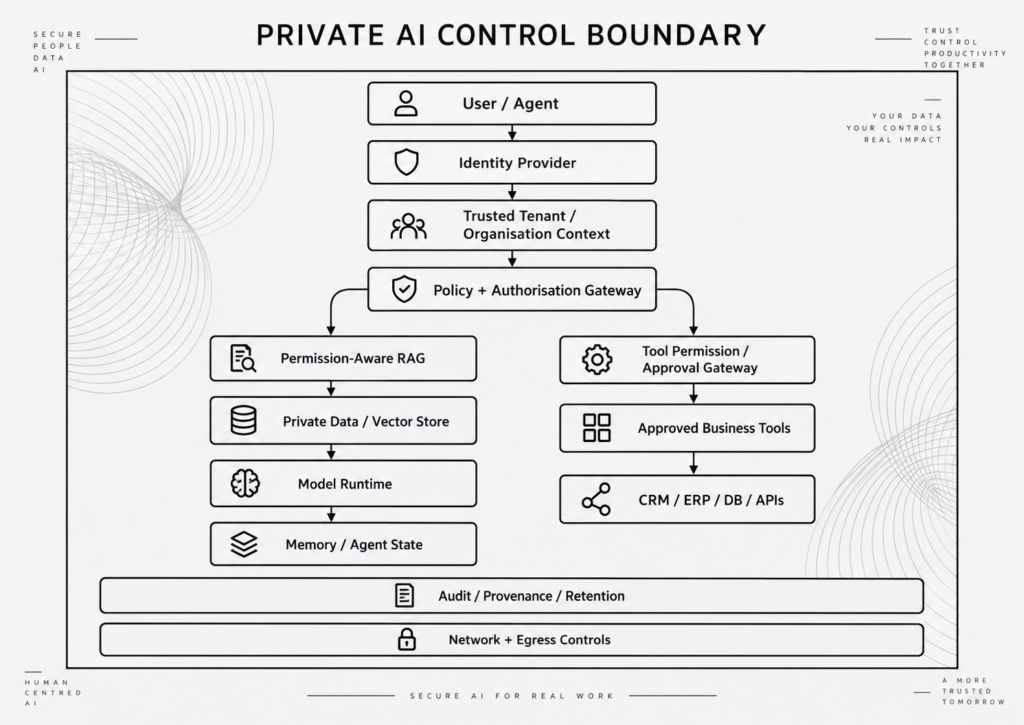
The important architectural principle is that the LLM does not become the security authority. The model may propose an action. The surrounding application must determine whether that action is allowed.
Similarly, a model should not decide which tenant a user belongs to. Trusted identity and policy infrastructure should establish that context before retrieval or execution takes place.
That separation also makes the system easier to test.
You can deliberately attempt to violate each boundary and verify whether the application fails closed.
What Data Must Remain Inside the Private-AI Boundary?
Source documents are only the most obvious sensitive asset. Organizations assessing AI data sovereignty should explicitly classify every artifact created by the application.
Source documents
These may include customer records, contracts, financial information, case files, medical records, research, correspondence or internal documentation.
Embeddings and vector metadata
An embedding is not simply meaningless infrastructure data.
The vector index may expose relationships between sensitive documents, while metadata attached to chunks can contain filenames, customer identifiers, department names, access labels or original text.
Prompts
A prompt often contains more sensitive information than expected because users naturally paste context into AI systems.
Model outputs
An output can reproduce, transform or summarize protected information.
Treating prompts as sensitive but responses as harmless creates an incomplete boundary.
Conversation and long-term memory
Memory can contain a condensed representation of everything an AI system has learned about a user, project or customer.
That makes memory a potentially high-value data asset.
Logs and traces
Detailed AI traces can include prompts, model responses, retrieved passages, tool arguments and errors.
Logging everything “for debugging” can quietly create a second copy of sensitive information outside the primary security model.
Credentials
Agent systems require credentials to access tools.
API keys, OAuth tokens, service accounts and database credentials should be handled through dedicated secret-management mechanisms rather than injected into unrestricted prompts or persisted in memory.
Tool results
Once agents can use external systems, the results of those calls also enter the private boundary.
A private LLM calling a CRM may retrieve sensitive customer information that then appears in the agent state or logs.
The Controls Regulated and Data-Sensitive Businesses Actually Need
A security review for private enterprise AI should therefore extend well beyond model infrastructure.
RBAC and ABAC
Role-based access control can assign permissions according to roles such as analyst, doctor, case manager or administrator.
Attribute-based access control can go further by evaluating characteristics such as:
- user;
- department;
- tenant;
- resource classification;
- geography;
- purpose;
- risk level.
Many enterprise AI systems will require a combination.
Immutable tenant context
Multi-tenant AI applications should not trust the user or LLM to choose their security context.
Tenant identity should be derived from an authenticated and verified source and propagated through the application.
Encryption
Sensitive information may require protection both at rest and in transit.
Organizations should also consider how encryption keys are controlled and whether backups, vector indexes and observability stores receive equivalent protection.
Permission-aware retrieval
Retrieval should enforce source permissions rather than flattening all company knowledge into one universally searchable index.
Provenance
The application should retain enough information to explain where an answer came from.
This can assist both quality evaluation and security investigations.
Human approval
High-impact actions should be routed through approval boundaries.
The approval system should exist outside the LLM so that a model cannot simply persuade itself that an action has been authorized.
Retention and deletion
If data is deleted from a primary system, organizations need to consider derivative artifacts.
Could the same information remain inside:
- a vector index;
- conversation history;
- long-term memory;
- a cache;
- logs;
- a backup?
Redaction
Certain workflows may not require raw sensitive information at all.
Redaction or tokenization before model processing can reduce the data exposed even inside an approved environment.
Egress control
Network rules should define which external systems an AI application may contact.
Agent architectures make this increasingly important because an agent may dynamically choose tools rather than following one fixed integration path.
AIMEC Lab: Testing Tenant Isolation, Revocation and Human Approval
To test how private-AI controls behave in practice, AIMEC ran a synthetic isolation experiment against the Local Agent Harness. The purpose was not to certify the system or claim that every possible attack is prevented. Instead, we wanted to test specific architectural boundaries that matter when AI systems operate across regulated or sensitive data.
The experiment used synthetic Tenant A and Tenant B records containing unique canary values. No production or customer data was used. This made cross-tenant leakage directly detectable: if a Tenant B marker appeared in a Tenant A retrieval, the isolation control had failed.
We separately exercised persisted enterprise memory, Qdrant vector retrieval, revocation behavior, cross-tenant policy enforcement and human-approval controls.
The complete experiment was executed five times. Across those five runs, 10 tested controls passed consistently, zero controls produced inconsistent or failing results, and one known API-boundary limitation remained reproducible across all five runs.
Results
| Test | What we tested | Observed result | Result |
| Same-tenant memory retrieval | Could Tenant A retrieve its own synthetic record? | Tenant A successfully retrieved its own record. | PASS — 5/5 |
| Cross-tenant memory retrieval | Could Tenant A retrieve Tenant B’s marker? | Tenant B’s marker was not returned through Tenant A retrieval. | PASS — 5/5 |
| Cross-tenant write spoof | Could a Tenant B candidate be written through Tenant A’s persistence boundary? | The mismatched candidate was rejected. | PASS — 5/5 |
| Memory revocation | Did previously visible memory remain retrievable after revocation? | The record was visible before revocation and absent from active retrieval afterwards. | PASS — 5/5 |
| HTTP identity-to-subject binding | Is an authenticated caller authoritatively bound to the requested subject_id? | The current route accepts subject_id directly; this binding is not yet demonstrated. | KNOWN LIMITATION — 5/5 |
| Qdrant tenant isolation | Could Tenant A retrieve Tenant B vectors from a shared collection? | Tenant B’s vector existed in the collection but was excluded from Tenant A search. | PASS — 5/5 |
| Vector revocation | Did a deleted vector source remain retrievable? | Deleted Tenant A content produced no subsequent vector matches. | PASS — 5/5 |
| Cross-tenant export | Would policy permit an explicit cross-tenant export? | The policy returned DENY. | PASS — 5/5 |
| Restricted action without approval | Would a high-risk production change run automatically? | The action entered a pending approval state instead. | PASS — 5/5 |
| Approval subject binding | Could an approval issued for Tenant A authorize Tenant B? | The token was rejected when presented as Tenant B. | PASS — 5/5 |
| Approval replay protection | Could an already-used approval token be reused? | First authorization succeeded; replay was rejected. | PASS — 5/5 |
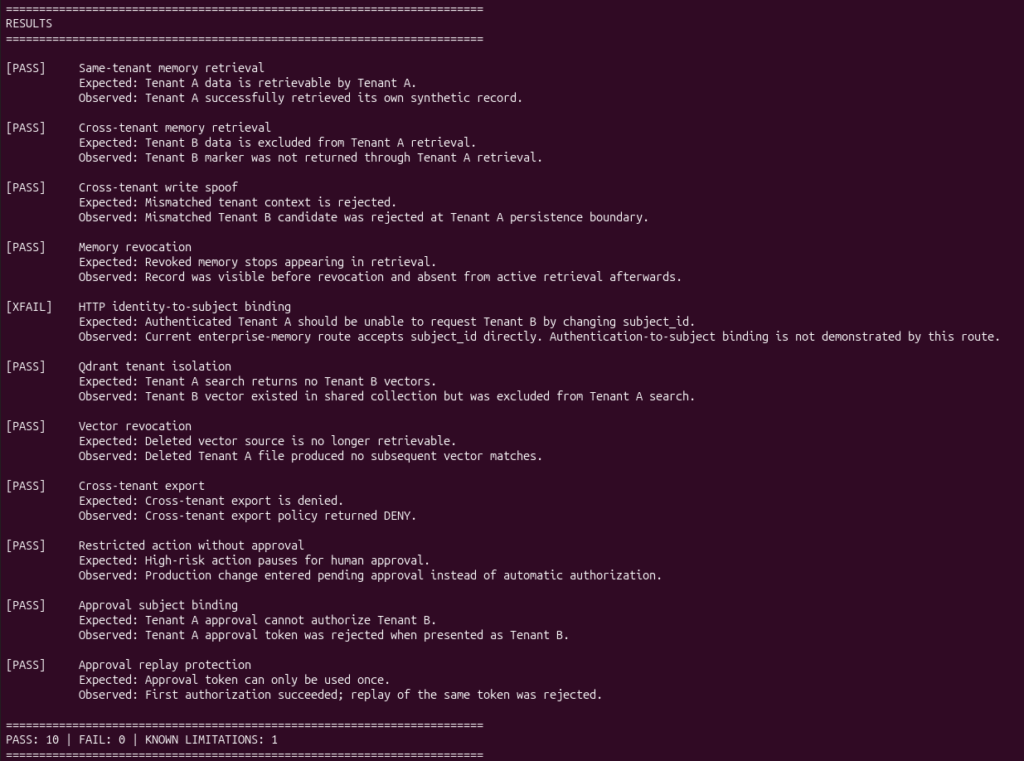
AIMEC private-AI lab result. Ten tested controls passed with no failures, while one API identity-to-subject binding limitation was explicitly retained rather than being counted as a pass. The same outcome was reproduced across five synthetic runs.
What the tenant-isolation tests showed
The memory tests demonstrated two different controls.
First, legitimate same-tenant retrieval worked. Tenant A could retrieve its own synthetic information, which matters because an isolation mechanism that simply prevents all retrieval would technically block leakage while making the system useless.
Second, when retrieval was scoped to Tenant A, the unique Tenant B marker was absent. A deliberate attempt to submit a Tenant B memory candidate through Tenant A’s persistence boundary was also rejected.
This distinction matters in private AI architecture. Effective isolation requires both:
Authorized access
Tenant A → Tenant A → ALLOW
Unauthorized access
Tenant A → Tenant B → BLOCK
The experiment produced the expected behavior in both tested persistence paths across all five runs.
Vector isolation was tested separately
Vector databases deserve separate scrutiny because private RAG systems can enforce database permissions correctly while still leaking information through an incorrectly filtered semantic search layer.
For this reason, AIMEC deliberately stored synthetic vectors belonging to both tenants in the same test Qdrant collection.
The Tenant B vector was first confirmed to exist in the underlying collection. A search was then performed under Tenant A’s subject scope.
Tenant A’s search did not return Tenant B’s vector.
This is an important distinction. The successful result was not caused by Tenant B data being absent from the vector database. The foreign vector existed, but the subject-scoped retrieval filter excluded it.
Across five runs, this behavior was consistent.
Revocation was tested at both memory and vector layers
Revoking access also needs to affect retrieval rather than merely changing a permission flag somewhere else in the application.
For persisted enterprise memory, AIMEC first verified that a synthetic restricted record was retrievable. The record was then revoked by changing its validity boundary. Subsequent active retrieval did not return it.
A separate vector test indexed a synthetic file, confirmed it could be retrieved, deleted the subject-scoped vector source, and queried again. No subsequent vector match was returned.
These tests support a narrower and more useful claim than saying that data was “completely deleted.”
They demonstrate that the revoked information stopped appearing through the tested active retrieval paths. They do not prove physical deletion from every historical backup, log, cache or storage layer.
Human approval behaved as a policy boundary
The lab also tested whether approval was simply a UI concept or whether authorization state was actually enforced.
A synthetic production_change was classified as a high-risk action. Without approval, it did not receive automatic authorization. Instead, the request entered a pending approval state.
A legitimate approval was then subjected to two attacks.
First, an approval issued for Tenant A was presented as authorization for Tenant B. The request was rejected because the approval was subject-bound.
Second, an approved token was successfully consumed once and then presented again. The replay attempt was rejected.
The cross-tenant export category was even stricter: it returned DENY rather than entering the approval workflow.
Together, these tests show why human approval should be implemented as an authorization control rather than simply displaying a confirmation dialog.
The experiment also exposed a limitation
One result should not be presented as a pass.
The current enterprise-memory HTTP route accepts a subject_id as part of the request path. In the version tested, the experiment did not demonstrate an authoritative binding between an authenticated caller identity and that requested subject.
In other words, AIMEC tested and observed tenant enforcement at the persistence and retrieval layers, but the experiment does not yet demonstrate complete API-level protection against a caller attempting to substitute another tenant’s subject identifier.
We therefore recorded this as a known limitation in all five runs rather than treating it as a successful control.
A stronger architecture would establish the subject context from authenticated identity or authorization state before reaching the data layer:
Authenticated identity

        │

        ▼

Authoritative tenant context

        │

        ├── requested tenant matches → continue

        │

        └── requested tenant differs → reject

        ▼

Policy gateway

        ▼

Memory / RAG / tools
This is also an example of why “our vector database has tenant filters” is not enough to establish private-AI isolation. The privacy boundary begins before retrieval.
What these results do — and do not — demonstrate
The AIMEC experiment provides evidence that, in the specific paths tested:
- tenant-scoped enterprise-memory retrieval excluded the other tenant;
- mismatched cross-tenant writes were rejected;
- Qdrant retrieval applied tenant isolation even with both tenants represented in the same collection;
- revoked memory and vector sources stopped appearing through subsequent active retrieval;
- explicit cross-tenant export was denied;
- high-risk actions required approval;
- approval authorization was subject-bound; and
- consumed approval tokens could not be replayed.
The experiment does not establish that the entire application is secure, prove compliance with POPIA or another regulatory framework, replace penetration testing, verify every API endpoint, or demonstrate deletion from every backup and historical storage layer.
That distinction is central to responsible private-AI engineering. Tests can provide evidence about specific controls. They should not be converted into broader compliance or security guarantees that the experiment did not actually establish.
Private RAG: Permissions Must Survive Retrieval
RAG creates one of the most easily overlooked private-AI risks. The source system may already have excellent permissions. A document management platform might know that a particular employee can read Folder A but cannot read Folder B. Then the company builds an AI assistant.
Documents from both folders are chunked, embedded and inserted into one vector database.
If the retrieval query searches all chunks regardless of source permissions, the original access-control model has effectively disappeared.
The AI may now retrieve information the user could never have opened directly.
Permission-aware RAG should operate at several stages
During ingestion
Associate documents and chunks with the permissions or attributes required for access.
During retrieval
Filter candidate results according to the authenticated user’s permitted scope.
After retrieval
Revalidate authorization where appropriate before information enters model context.
Before execution
If retrieved information leads to an action, evaluate that action through its own policy and approval layer.
Permissions should not be assumed to remain valid forever either.
If an employee moves department or a customer withdraws access, the AI retrieval layer needs to reflect the change.
This is why revocation testing belongs in the acceptance suite.
AI Memory Is Also Sensitive Data
Memory is becoming one of the most important differences between an ordinary chatbot and a persistent AI agent. A chatbot may process one conversation and forget it. An agent can accumulate knowledge over weeks or months.
It may remember:
- a customer’s requirements;
- an employee’s previous requests;
- project history;
- internal business decisions;
- previous documents;
- summaries of meetings;
- actions taken;
- preferences;
- unresolved tasks.
This can improve usefulness dramatically. It also creates a new information store.
Organizations therefore need to ask:
- Who owns a memory?
- Which tenant can retrieve it?
- How was it created?
- What source information was summarized into it?
- How long should it exist?
- Can a user inspect it?
- Can it be corrected?
- Can it be deleted?
- What happens if the underlying access rights change?
- Does deleting the source also require deleting derivative memory?
A private LLM with cross-tenant long-term memory would undermine the privacy architecture around the model.
This is why AIMEC’s architecture work treats memory boundaries and tenant identity as first-class engineering concerns rather than convenience features.
Can Regulated Businesses Still Use Cloud AI APIs?
Yes, potentially. “Regulated” does not automatically mean “all AI must operate on premises.”
The correct deployment depends on the organization’s obligations, information classification, contractual commitments, risk appetite and the technical characteristics of the service involved.
Major enterprise AI platforms now provide controls that are materially different from ordinary consumer AI usage.
OpenAI, for example, states that its business products and API platform do not use organizational inputs and outputs for model training by default. Microsoft similarly documents enterprise data-isolation, processing and geography controls for its managed model service. AWS documents that Amazon Bedrock does not use customer content to train models and describes protections including encryption and customer isolation.
Those assurances can form part of a deployment assessment. They do not eliminate the need for one.For a broader comparison of these deployment choices, see our guide to private AI vs cloud AI for businesses, including the trade-offs around control, infrastructure ownership and operational responsibility.
An organization should still determine:
- what classes of data may be submitted;
- where processing occurs;
- what retention applies;
- whether information can cross borders;
- who acts as an operator or processor;
- what contractual protections exist;
- what abuse-monitoring or support processes apply;
- what networking options are available;
- how credentials and identities are controlled;
- whether the service meets sector-specific obligations.
When managed AI may make sense
A managed API or private-cloud deployment may be reasonable when:
- the relevant data classification permits external processing;
- appropriate agreements are in place;
- the service’s geographic and privacy controls satisfy the organization’s requirements;
- infrastructure ownership is not itself a requirement;
- the organization wants to avoid the operational burden of running model infrastructure.
When local or on-premises AI becomes more compelling
Local infrastructure may be justified when:
- information cannot leave a defined environment;
- contractual obligations require local processing;
- external connectivity is restricted;
- highly sensitive workloads require stronger infrastructure control;
- latency or availability requirements favour local inference;
- the organization has the operational capability to maintain the system.
There is no universal winner. The deployment should follow the threat model and requirements.
Self-Hosting Does Not Equal Compliance
This distinction deserves its own section because it is one of the most dangerous shortcuts in discussions about private AI. Compliance is not an infrastructure location.
Buying a GPU server and installing an LLM does not establish:
- lawful processing;
- appropriate data collection;
- purpose limitation;
- authorization;
- access governance;
- retention policies;
- security monitoring;
- incident response;
- accountability;
- audit processes;
- appropriate automated-decision controls.
NIST’s AI Risk Management Framework illustrates the broader governance problem well.
Its AI RMF uses the functions Govern, Map, Measure and Manage, and specifically describes governance, documentation, risk assessment and ongoing management as lifecycle activities rather than a one-time technical deployment.
That same principle applies to private AI. Technical architecture can support a compliance programme. It cannot replace one.
How Private AI Requirements Change by Sector
The architecture remains broadly similar, but the risks differ by industry.
| Sector | Example AI use case | Primary risk | Important control |
| Financial services | Internal analyst or customer assistant | Exposure of financial/customer data; consequential decisions | Strong identity, retrieval permissions, audit, approval |
| Healthcare | Clinical knowledge or administrative assistant | Sensitive patient information | Segmented data, strict authorization, audit and retention controls |
| Legal services | Matter/document assistant | Client confidentiality and matter separation | Matter-level isolation, provenance and restricted retrieval |
| Insurance | Claims analysis | Personal information and consequential decisions | Data minimization, human review and decision audit |
| Government | Internal policy or case assistant | Sensitive citizen/state information | Sovereignty, strict access controls, controlled networking and logging |
Financial services
Financial institutions may have large quantities of data that are valuable for AI but inappropriate for broad access.
A private knowledge assistant therefore needs to understand not only which bank or institution a user belongs to, but possibly the division, role, client portfolio and task they are authorized to perform.
Healthcare
Healthcare use cases can involve especially sensitive information.
A retrieval system should not treat every medical record as part of one general knowledge base simply because the model runs privately.
Legal and professional services
Tenant and matter isolation are particularly relevant here.
A system serving several customers or legal matters should not retrieve information from another matter simply because semantically similar text exists in the vector database.
Insurance
AI may support claims workflows, document analysis and customer communication.
As systems become more autonomous, human-review and decision-governance requirements become increasingly important.
Government
Government environments may have particularly strict infrastructure, sovereignty and network requirements.
Some use cases may justify on-premises or heavily isolated deployments even where a managed service would be operationally simpler.
The Cost and Operational Trade-Offs of Private AI
Maximum infrastructure control has a price. Self-hosting does not merely replace an API bill with a server.
Organizations may need to fund and operate:
- GPUs or accelerator hardware;
- compute capacity;
- model-serving infrastructure;
- secure storage;
- vector databases;
- networking;
- backups;
- observability;
- patching;
- model upgrades;
- evaluation;
- incident response;
- engineering support;
- power and cooling for physical infrastructure.
The relevant calculation is therefore total cost of ownership rather than inference price. A cloud API may cost more per token but substantially less to operate. An on-premises environment may provide greater control but impose permanent engineering and infrastructure obligations. A private-cloud architecture may sit between the two.
Security requirements should lead the architecture, but organizations should be realistic about their ability to operate what they build.
A badly maintained private environment is not automatically safer than a mature managed platform.
Private AI Decision Checklist
The deployment decision can be reduced to a sequence of practical questions.
1. Does the workload contain information that cannot be processed by an external AI provider?
If yes, investigate on-premises, private infrastructure or a sufficiently isolated approved managed environment.
If no, continue.
2. Are there geographic or sovereignty requirements governing where processing can occur?
If yes, eliminate deployment options that cannot provide the required processing location and contractual controls.
3. Do you know every type of data the AI application creates?
Include prompts, outputs, embeddings, memory, logs and tool responses.
If no, map the data architecture before selecting infrastructure.
4. Can your identity system establish a trusted tenant, organization and user context?
If no, fix identity before connecting sensitive knowledge.
5. Can retrieval enforce the same permissions as the source data?
If no, the RAG architecture is not ready for restricted information.
6. Can high-risk actions be blocked independently of the LLM?
If no, introduce deterministic policy and approval controls.
7. Can access changes propagate into retrieval, tools and memory?
If no, design and test revocation behaviour.
8. Can you prove what happened after an AI interaction?
If no, add audit and provenance appropriate to the risk of the workflow.
9. Does your organization have the capability to maintain self-hosted AI infrastructure?
If no, a managed private-cloud or enterprise API architecture may be safer operationally than self-hosting.
10. Have legal, compliance, information-security and operational stakeholders reviewed the intended use?
If no, architecture selection is premature for a high-risk deployment.
When Private AI Is the Wrong Solution
Private AI should not become a requirement in search of a problem. There are cases where an organization should not build a large private AI environment.
A fully self-hosted architecture may be unnecessary when:
- the workload contains low-sensitivity information;
- an approved enterprise provider already satisfies the organization’s requirements;
- the AI project is an early proof of concept;
- the organization lacks the personnel required to maintain the infrastructure;
- model quality requirements cannot currently be met by the models it can host;
- the operational burden is greater than the risk reduction.
There are also situations where the correct decision is not to deploy the AI workflow at all.
If an organization cannot establish lawful processing, appropriate authorization or acceptable risk for a consequential automated decision, changing where the LLM runs does not solve the underlying problem.
The Real Private-AI Boundary Is the Application, Not the Model
The biggest misconception about private AI is that privacy can be solved at the model-hosting layer. It cannot.
A production AI system is a chain of identities, policies, data stores, retrieval processes, models, memories, integrations, tools, approvals and logs.
Any one of those components can become the route through which sensitive information crosses a boundary.
For regulated and data-sensitive organizations, the most useful architecture question is therefore not whether an LLM is local, private cloud or public cloud.
It is whether the organization can define its permitted information flows and then demonstrate that the application enforces them.
That means testing and asking:
- Can Tenant A retrieve Tenant B’s data?
- Can a user forge their tenant context?
- What happens when access is revoked?
- Can an agent execute a restricted action without human approval?
- Do logs or memories reveal information that the primary API correctly blocks?
- Where does information travel when an external tool is called?
Those tests provide considerably more security insight than a diagram with the word “on-premise” written around the model.
AIMEC’s own engineering work is moving in this direction: treating private AI as a system of enforceable identity, tenant, retrieval, memory and execution boundaries rather than simply installing an LLM locally.
For organizations assessing private AI, that is a useful standard to apply to any architecture—ours included.
Do not ask only where the model runs. Ask where the data can go, who can retrieve it, what the AI can do with it and what happens when someone tries to cross the boundary.
That is where private AI begins.
Frequently Asked Questions
What is private AI?
Private AI is an AI architecture designed to keep defined data, processing and actions within security and governance boundaries controlled by an organization. It can include model inference, prompts, outputs, RAG data, embeddings, memory, logs, credentials and AI agent tool calls. Private AI is therefore broader than simply running an LLM locally.
Is on-premises AI automatically compliant?
No. On-premises infrastructure can support data sovereignty and greater infrastructure control, but compliance also depends on matters including lawful processing, access controls, governance, security safeguards, retention, auditability and organizational processes. Self-hosting should not be described as compliant by default.
What data needs to stay private in a private-AI system?
Organizations should consider source documents, prompts, model responses, embeddings, vector metadata, conversation history, long-term memory, agent state, logs, traces, credentials, tool inputs and tool outputs. The exact boundary should follow the organization’s information classification and regulatory requirements.
What is private RAG?
Private RAG is a retrieval-augmented generation architecture in which access to source information remains governed when documents are indexed and retrieved for an AI model. A secure private RAG system should enforce identity-aware document, row or chunk permissions rather than exposing the entire vector index to every authenticated user.
Can a regulated company use cloud LLMs?
Potentially. A regulated business may be able to use an enterprise model API, dedicated cloud or private-cloud AI service where the provider’s contractual, privacy, security, geographic and operational controls satisfy the organization’s requirements. Other workloads may require on-premises or more isolated infrastructure. The decision should follow the specific data, applicable obligations and risk assessment rather than assuming that either cloud or on-premises deployment is universally compliant.

Steven Walgenbach is an AI Engineer specializing in AI agents, large language models, retrieval-augmented generation and business process automation. He designs and builds practical AI systems that connect with existing tools, data sources and workflows to help businesses reduce manual work, improve decision-making and scale more efficiently.
His work includes developing multi-agent systems, private and locally hosted AI solutions, custom knowledge assistants, SEO automation pipelines and LLM-powered applications using Python, LangGraph, CrewAI, the OpenAI Agents SDK and other modern AI frameworks.
Through AIMEC, Steven helps businesses move beyond AI experimentation and identify practical opportunities where artificial intelligence can deliver measurable operational and commercial value.