
TL;DR
- AI is powerful but not plug-and-play: While it can accelerate development and automate complex tasks, current limitations—like poor scalability, context constraints, and debugging challenges—mean it still requires human oversight and technical guidance.
- Biggest value comes from augmentation, not replacement: AI delivers the highest ROI when used as a tool alongside humans (e.g., automating SEO workflows or analyzing large datasets), rather than trying to fully replace developers or teams.
- Costs, risks, and infrastructure matter: Hidden expenses (API usage, hardware), data privacy concerns, and accuracy issues mean businesses must carefully plan adoption—ideally using local models, human-in-the-loop systems, and clear guardrails.
AI has been mentioned pretty much everywhere in the past few months, with businesses across multiple industries making a push to introduce an agentic layer into their workforce.
Since ChatGPT launched towards the end of 2022, AI has gone from being just a sophisticated text prediction and generation engine to something more powerful and useful, especially with the advent of tools, skills and technologies such as OpenClaw and Claude Code.
Over the last 3 years as an AI developer and founder of AIMEC, I’ve moved from manual coding to orchestrating agentic layers. I’ve seen the 3:00 AM debugging sessions that ‘vibe coding’ creates firsthand.”
I have also had the opportunity to see what the reality is of trying to bring AI agents into the workplace, including some of the challenges that nobody really talks about.
With the post-hype reality we now find ourselves in, I often hear the question “is AI worth it?” Or is it just another passing trend?
The Vibe Coding Trap: When Speed Sacrifices Scale
Perhaps the one area where businesses of all shapes and sizes are using AI the most is in coding applications.
For the first time ever, you can now give instructions in written English to code to create applications for you. Excited at this prospect, businesses and entrepreneurs have turned to applications such as Lovable, Replit and others to turn their visions for applications into a reality. This has gone on to become what is known as “vibe coding.”
I have also used vibe coding with the belief that this would cut the time it takes for me to develop and ship production-scale applications. However, there are some downsides to this approach that people only realize once they have spent more money on API tokens than they would have spent on actually hiring a developer. Here’s some of the main issues I have seen when it comes to vibe coding.
The “Infancy” Barrier: Why Non-Technical Users Hit a Ceiling
While AI can code applications for you, the vibe coding movement is still in its infancy. As such, the agents still need guidance on what approach to take when coding.
We’re not yet at the stage where you can just tell a large language model (LLM) an application idea and it can just choose the right stack, code a working application with multiple moving parts, and then deploy it and effectively manage scaling and the necessary resources all while sticking to a budget. Do I think we will eventually get to this point? Yes, absolutely! But the key word is “eventually,” and I am not sure how long it will take to get to this point.
Working with clients over the years, I’m often tasked with cleaning up a codebase that was generated by AI to get it functional. After the cleanup is done, the client realizes that they just spent hundreds, sometimes even thousands, of dollars for an AI agent to code an application that doesn’t even work and then took on an additional cost for a human developer like myself to go over the code base and fix it. This is when clients generally revert back to using human developers who use AI tools, which I normally argue is the ideal way to achieve that balance of speed, cost, and support.
On the rare occasions that clients do manage to get an AI to code an entire application for them, they often struggle with the next stage: deploying the application to serve clients. The problem here is the current limitations around AI context windows. Simply put, these context windows refer to how many tokens or words an AI can keep track of while you prompt it. While many models have context window sizes that are more than adequate for general and many complex text tasks, they’re often not large enough for an application’s entire code base.
Reading AI Code is Harder Than Writing It
Not only do non-technical users struggle to get an application coded with AI, software developers often battle as well.
There is no doubt that AI can write code at machine speeds. But there are problems with development teams handing the wheel over to AI to take control, which usually surface after the code has been written.
After the AI has outputted code based on a carefully formulated plan and well thought-out prompt, developers still need to verify that the code was written correctly. That is, that the code was written in accordance with the organization’s best coding practices.
What’s more, the time saved by letting the AI write code is usually spent auditing the agent’s code and fixing bugs. It’s not uncommon for developers to spend hours after the fact fixing code issues from the AI that has the tendency to hallucinate.
I have had my own personal struggles with understanding what an AI has coded, especially when it makes multiple changes across a code base and I have to verify everything. For one project I was involved in when I started using LLMs to assist me in coding, I gave the agent a plan of how the code should be written, what changes should be made, and even told it how to do it. Even then, the agent made mistakes.
That was a valuable lesson at the time. I realized that the true power is for developers to become orchestrators and delegate small chunks of work to AI agents to carry out the coding. This is where businesses and teams start to see the highest return on investment with AI in coding.
High-ROI Zones for AI Integration
It’s not all bad when it comes to AI and agents. In addition to LLMs being able to help developers write code in small chunks at a time, there are definitely areas where AI leads to unprecedented levels of efficiency. Below are some of the industries where I have personally seen AI do incredible work.
Automating Authority: SEO Workflows with n8n and Ollama
Since I blog and manage a few of my own websites (including this one), I thought it’s only right that I mention SEO as an area where AI can help.
I used to manually check keyword traffic and ranking information for my websites. Not only that, I would also have to do manual competitor analysis and then come up with content structures and keep in mind certain things that are helping competitors rank when I draft and refine my content for blogs.
Since AI has entered the picture, I have automated much of that analytics work.
For the analysis, I love using n8n. Not only is it free and can run on my local setup, I can also create a workflow to do pretty much everything. With my role as an AI engineer, I use n8n frequently and then plug the n8n workflows as tools for an AI agent. This has helped me create a more generic agentic assistant that is capable of doing so much!
If you want to get started with n8n or just want to get a better understanding of what it is, take a look at this guide.
In fact, much of this blog’s analytics is performed using n8n and a locally running Ollama model.
Here is the workflow I use to perform some of the basic checks that give me a good overview of what’s trending in the AI industry, what people are asking about AI, as well as general traffic analysis and opportunity identification:
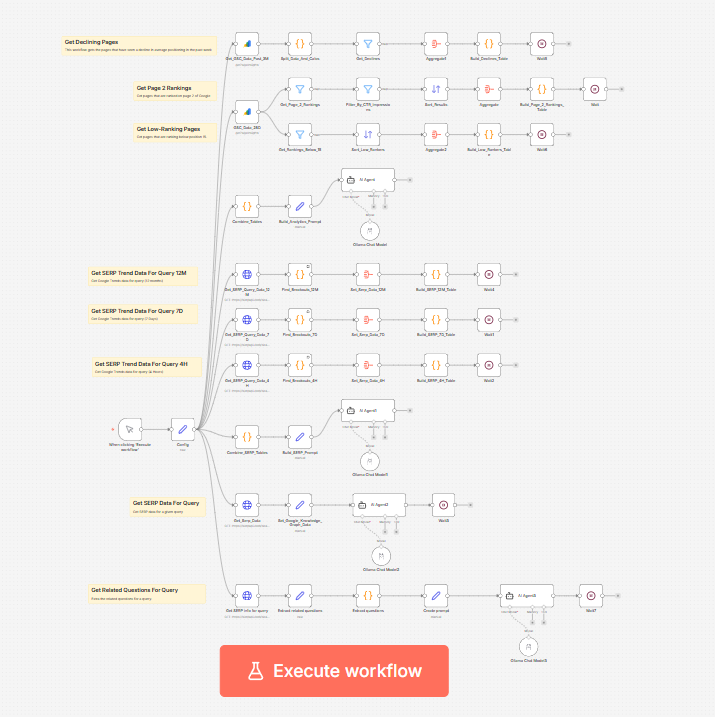
Screenshot of n8n workflow I use to perform this blog’s analysis (Source: n8n)
It’s not just my personal blogs where I have seen the true SEO power of agentic AI. In one study around the performance impact of an AI-driven SEO system I had built, I found that a workflow that took less than an hour to run had performed tasks that would have taken a team of 5 people 68 hours to do. This is just one example of how much efficiency AI can bring to SEO.
AI Agents in Quantitative Asset Management
Another industry where I have seen AI make a difference is in the asset management sector. Consuming large amounts of market data including OHLC data, market sentiment, and more is one of the strengths of AI and automated systems.
A few years ago, I was part of a team that built out an AI market analysis agent. We had gone as far as to partner with a regulated financial insitution to manage clients’ funds using the analytics from the agent that we had built to trade a variety of markets. We were able to watch almost every market, including equities, commodities, and cryptos with just a team of two people.
The system would pull market data during each market’s open, make a decision on what move to take (open trade, close already-open trade, keep open trade open). It generated signals for over 20 trading pairs in each market in a matter of minutes. It also gave us the top picks that gave the strongest signals.
After receiving a signal from the market analytics agent, we then passed them onto a portfolio allocation agent before getting the final report of what moves to make (with human input of course). We managed to generate a profit for clients.
Although the project was not able to gain traction in the market, we did have several meetings with asset managers before partnering with the one. The main appeal to them back then was that our system was able to analyze so many markets with so little human intervention. This speaks to one of the most powerful aspects of agentic systems in my opinion, which is the ability to process datasets that are too large for a single human to look at, and also deliver an accurate result quickly.
Other Notable Mentions
Other industries also stand to gain from AI, especially where the consumption of large data is not unusual. Think of the legal industry.
The Practitioner’s Guardrails: Security, Cost, and Accuracy
Now that you have seen examples of where AI can make a difference, I want to flag some considerations to keep in mind before you decide to develop agents for your specific use case or business.
Why Local LLMs are Non-Negotiable
This was one of the first things I realized a couple of years ago when I went into a company to introduce AI agents into their workforce. Of course, you don’t want to just hand over your client and customer information and details to a third-party AI via an API. This is a lawsuit waiting to happen.
To address the data privacy issue, I tell clients and teams that I work with that their best option is to run an LLM or multiple models locally. This way they can ring-fence their data while still tapping into the benefits of AI and agents.
However, using a local LLM does come with slower processing. In addition to local solutions taking longer to generate a response for queries, these models sometimes also come with lower levels of accuracy. There are instances where local models come with smaller context windows as well.
Despite those limitations, the overall efficiency loss is minimal compared to the legal ramifications of exposing client data.
The Hidden Line Item: Managing API and Infrastructure Overhead
This is perhaps one of the most overlooked adoption barriers for AI. Even if you want to run a local LLM for a business use case, the hardware will still cost a couple thousands of dollars.
Don’t get me wrong, I believe that a time will come that we will each be able to run a hobby LLM the size of ChatGPT on a personal computer. But this will likely take at least two years.
For software developers using AI, something to keep in mind is that each request to an AI connected to your IDE costs money. These costs tend to rack up pretty quickly when a developer gets stuck on a project’s codebase. I have seen my monthly API costs spike from time to time, and have learned the hard way to keep a better eye on the costs.
Using Editor Agents and Human-in-the-Loop
AI is not perfect. There is still the pescy hallucinations that tend to pop up from time to time. These usually make an appearance when you least want it, like when you have to demo to a client…
In my role as an AI engineer, me favorite approach to address the hallucinations is to have an editor agent that has one goal and one goal only: ensure that the output from another agent that was given the task matches what the user expects. This has helped me achieve more stable results in a production setting. Where possible, I also encourage teams and businesses to include a human in the loop (this is one of my favorite AI recipes). You can take a look at other strategies to reduce hallucinations in this guide.
Final Verdict: The Shift from AI as a Crutch to AI as a Multiplier
There you have it, I hope this article gave you some better insights that can help you anwer the question of whether AI is worth it. Of course, the answer to the question depends on your use case.
For the majority of the time, AI is without a doubt worth it! Speaking from my personal experiences using agents over the years, I have managed to increase my coding output by 300% while still being able to keep costs low. I have helped businesses and teams across a wide variety of industries do the same too.
One thing I want to say is that AI’s true value is evident when it is used as a tool, not a crutch.
Stop Paying for “Vibe Coding” Mistakes
Is your AI-generated codebase costing more in API tokens and debugging than it’s worth? Don’t let a “hallucination” tank your ROI.
I help businesses move past the hype to build stable, human-in-the-loop agentic systems that actually scale. Book a 15-minute AI Infrastructure Audit and let’s turn your AI from a crutch into a multiplier.
Frequently Asked Questions
Is AI worth going into?
Pursuing a career in AI remains a highly valuable path due to the massive integration of automation across global industries. According to various tech analysts, entering the AI field can help you: Secure high-demand roles in machine learning, develop expertise in neural networks, and lead digital transformation initiatives within large-scale organizations.
Is It Worth Taking an AI Course?
Enrolling in an AI program is a strategic decision for professionals aiming to future-proof their careers. According to industry experts, these courses can help you: Master the art of prompt engineering, streamline business operations through automated workflows, and critically audit the accuracy of machine-generated data.
Which 3 jobs will survive AI?
Microsoft co-founder Bill Gates suggests a very narrow group of sectors will remain resilient against total automation. He identifies energy, biology, and programming/IT as the primary fields that will stay relevant. These industries, he notes, rely on complex human judgment, ethical decision-making, and high-level problem-solving that AI is currently unable to duplicate.
Is AI actually useful?
Artificial Intelligence provides practical value by optimizing daily logistics, such as streamlining commute times and managing personal calendars via smart assistants. By refining search algorithms and personalizing user experiences, AI technology is making modern life more productive, seamless, and integrated.
What are 5 disadvantages of AI?
While powerful, AI presents several significant challenges for modern society:
- Employment Displacement: The automation of routine tasks can result in the elimination of traditional job roles.
- Algorithmic Bias: Systems may produce unfair outcomes based on prejudiced training data.
- Data Privacy: The massive collection of personal information raises concerns regarding surveillance.
- Ethical Concerns: The use of AI in sensitive areas creates complex moral dilemmas.
- Security Vulnerabilities: AI tools can be exploited by bad actors to launch sophisticated cyberattacks.
What 5 jobs will AI not replace?
Certain professions remain insulated from automation due to their requirement for deep empathy and physical dexterity:
- Healthcare Professionals: Nurses and doctors who provide essential bedside care.
- Mental Health Practitioners: Therapists and counselors who navigate complex human emotions.
- Education Specialists: Teachers who focus on early childhood development and mentorship.
- Skilled Trades: Technicians like plumbers and electricians who perform intricate physical labor.
- Creative Leaders: Strategists and authors who generate original, high-level conceptual ideas.

Steven Walgenbach is an AI Engineer specializing in AI agents, large language models, retrieval-augmented generation and business process automation. He designs and builds practical AI systems that connect with existing tools, data sources and workflows to help businesses reduce manual work, improve decision-making and scale more efficiently.
His work includes developing multi-agent systems, private and locally hosted AI solutions, custom knowledge assistants, SEO automation pipelines and LLM-powered applications using Python, LangGraph, CrewAI, the OpenAI Agents SDK and other modern AI frameworks.
Through AIMEC, Steven helps businesses move beyond AI experimentation and identify practical opportunities where artificial intelligence can deliver measurable operational and commercial value.