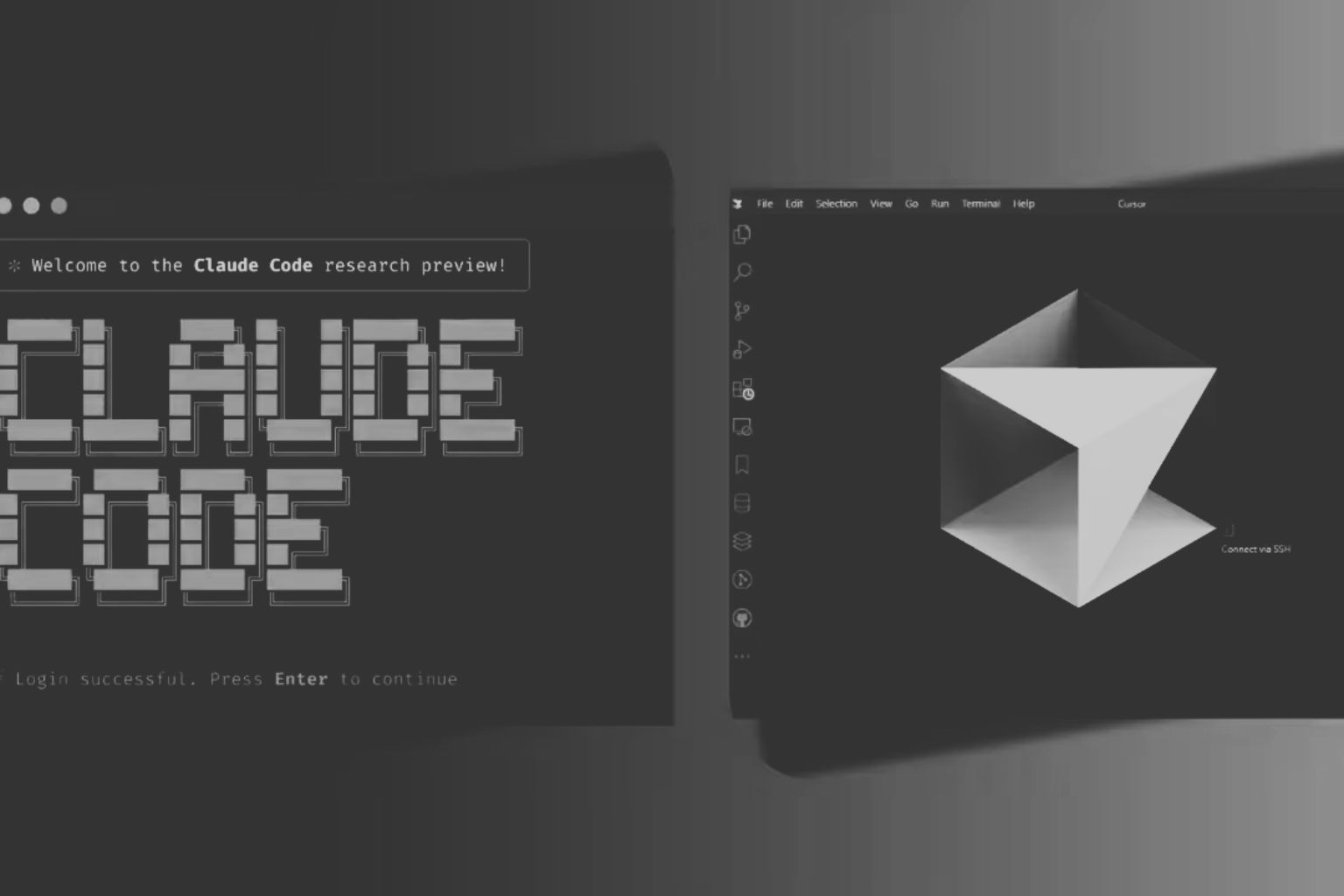
AI coding tools have evolved from simple autocomplete assistants into fully autonomous software engineering agents. Today, developers can ask an AI to create features, refactor entire codebases, generate tests, fix bugs, and even navigate large repositories with minimal human intervention.
Two tools currently dominating the conversation are Claude Code and Cursor. If you’ve spent any time on X, Reddit, GitHub, or developer Discord communities recently, you’ve probably seen passionate debates about which tool is better. Some developers swear by Claude Code’s reasoning abilities, while others refuse to leave Cursor because of its polished IDE experience.
As someone who works extensively with AI systems and software development, I personally use Cursor for most of my projects. However, many of the developers I work with regularly rave about Claude Code when it is paired directly with Anthropic’s latest models. Both tools are incredibly capable, but they approach AI-assisted development in very different ways.
In this guide, we’ll compare Claude Code vs Cursor across pricing, benchmarks, reliability, ease of use, and real-world developer workflows so you can decide which platform fits your development style.
What Is Claude Code?
Claude Code is Anthropic’s agentic coding environment that allows developers to interact with their codebase through a terminal-style workflow.
Instead of functioning primarily as an IDE, Claude Code acts more like an autonomous software engineering agent. It can inspect repositories, run commands, modify files, execute tests, and perform complex multi-step development tasks with minimal intervention.
The biggest selling point is that Claude Code is built directly around Anthropic’s Claude models, which many developers consider among the strongest coding and reasoning models currently available.
Rather than helping you write code line-by-line, Claude Code often feels like you’re assigning tasks to another engineer.
What Is Cursor?
Cursor is an AI-powered code editor built on top of Visual Studio Code.
Unlike Claude Code’s terminal-first approach, Cursor feels familiar to most developers from the moment they install it. It combines AI assistance directly into the editor experience while adding advanced agentic capabilities that allow the AI to understand and modify multiple files throughout a project.
Cursor supports several leading AI models, including Anthropic Claude models, OpenAI models, and other frontier systems. This flexibility allows developers to switch between providers without changing tools.
For many software engineers, Cursor feels like the natural evolution of VS Code rather than an entirely new workflow. This is one of the reasons I love working with Cursor!
Claude Code vs Cursor: Quick Comparison
| Feature | Claude Code | Cursor |
| Primary Interface | Terminal-based agent | Visual IDE |
| Learning Curve | Moderate | Low |
| Best For | Autonomous coding tasks | Daily development |
| Model Access | Anthropic models | Multiple model providers |
| Custom Workflows | Excellent | Excellent |
| IDE Experience | Limited | Outstanding |
| Context Management | Very Strong | Very Strong |
| Team Adoption | Growing rapidly | Already widespread |
For most developers, the decision comes down to whether they want an AI agent that feels like an engineer operating from the terminal or an AI-enhanced IDE that integrates naturally into existing workflows.
Pricing Comparison
Pricing is one of the biggest factors developers consider when comparing Claude Code and Cursor.
Both platforms offer entry-level plans around $20 per month, but costs can rise significantly as usage increases. This has been seen across the software development industry and within tech companies, who have all started to clamp down on API usage to keep costs down.
Cursor uses a credit-based system, while Claude Code primarily relies on usage limits and higher-tier plans for heavy users. Serious users often end up spending between $60 and $200 per month on either platform.
API Pricing Comparison
One of the biggest differences between Claude Code and Cursor is how pricing works.
Claude Code users often pay directly for model usage through Anthropic’s API, while Cursor bundles model access into subscription tiers and usage credits. For developers building agentic workflows, understanding the underlying API costs can help explain why some Claude Code sessions become expensive so quickly.
| Metric | Claude Sonnet 4.6 | Claude Opus 4.8 | Cursor Pro |
| Monthly Cost | Pay per token | Pay per token | $20/month |
| Input Token Cost | $3 per million tokens | $5 per million tokens | Included in usage credits |
| Output Token Cost | $15 per million tokens | $25 per million tokens | Included in usage credits |
| Context Window | Up to 1 million tokens | Up to 1 million tokens | Depends on selected model |
| Best Use Case | Everyday coding and agents | Complex reasoning and large codebases | General software development |
| Cost Predictability | Medium | Low for heavy users | High |
| Typical Heavy User Cost | $20–$100+/month | $100–$250+/month | Usually fixed plan plus overages |
Anthropic’s official pricing currently places Claude Sonnet 4.6 at $3 per million input tokens and $15 per million output tokens, while Claude Opus 4.8 costs $5 per million input tokens and $25 per million output tokens. These costs can be reduced through prompt caching and batch processing. In a recent blog post, I also covered how companies and developers can keep AI costs low.
Cursor takes a different approach. The Pro plan costs $20 per month and includes access to frontier models alongside a monthly usage allocation. Higher tiers such as Pro+ and Ultra provide significantly larger usage budgets for developers running agents throughout the day.
In practice, this is why many developers report “burning through” Claude usage. When an AI agent needs to inspect dozens of files, understand architecture decisions, generate code, run tests, and verify outputs, it may consume millions of tokens in a single development session.
You can take a look at this blog post to see what tokens are.
The cost isn’t necessarily a flaw in Claude Code itself—it’s often a byproduct of giving an AI enough context to operate like a software engineer rather than a simple code completion tool. Recent reporting suggests active enterprise users can consume between $150 and $250 worth of Claude Code usage per month when using advanced models heavily.
Cursor Pricing
Cursor’s pricing structure is generally easier for developers to understand because usage is tied to credits. More advanced models consume more credits, which makes costs relatively predictable.
For developers working on personal projects, startups, or smaller applications, Cursor’s pricing often feels easier to manage.
Claude Code Pricing
Claude Code can become expensive for heavy users because of the sheer amount of context and tokens consumed during autonomous coding sessions. Many developers online report burning through usage allowances surprisingly quickly. This isn’t necessarily a flaw in Claude Code. It’s largely a consequence of how agentic coding works.
To give you an idea of how many tokens coding agents use, I once ran out of tokens on Cursor and connected the IDE to my personal Ollama Cloud account to continue using the IDE. This way I could run frontier models with several billion parameters without having to manage the compute myself. Now, for general writing tasks the weekly and daily budgets that Ollama Cloud offered me were more than enough. I never touched these limits when using Ollama Cloud models for writing and editing tasks for my blog.
But when I switched over to coding tasks, all of a sudden I hit my daily and weekly limits within a couple of hours. This makes sense when looking under the hood at how agents look at and update code.
When an AI agent explores a repository, reads multiple files, understands dependencies, evaluates architecture decisions, writes code, runs tests, and validates outputs, it consumes a massive number of tokens. The better the AI understands your codebase, the more context it must process. As a result, heavy Claude Code users often move to higher-tier plans costing $100 to $200 per month.
Coding Benchmarks and Performance
Benchmark comparisons are tricky because the model and the agent framework both influence results.
Interestingly, research increasingly shows that the agent architecture itself matters almost as much as the underlying AI model. The same model can produce dramatically different outcomes depending on how the coding agent manages context, planning, and execution.
Several independent evaluations have shown Claude Code achieving around 72.5% resolution rates on SWE-bench Verified tasks, while Cursor implementations using similar Claude models often score somewhat lower. This suggests that Anthropic’s agent framework contributes meaningful performance improvements beyond the model itself.
Academic studies have also found that Claude Code performs particularly well on documentation and feature-development tasks, while Cursor demonstrates strong results for software fixes and bug-resolution workflows.
In practical development work, the difference often feels less dramatic than benchmark numbers suggest.
Both tools can:
- Generate new features
- Refactor large codebases
- Create tests
- Fix bugs
- Explain architecture
- Navigate repositories
- Update documentation
The quality gap usually appears during larger, more complex engineering tasks that require deep reasoning across dozens of files.
Reliability and Outages
Reliability is an often-overlooked factor when choosing an AI coding assistant. Because Claude Code depends heavily on Anthropic’s infrastructure, service interruptions can have a direct impact on developer productivity.
Anthropic’s public status reports show Claude API uptime generally exceeding 99%, although several notable outages and degraded-performance incidents occurred throughout 2026. The Claude API reported approximately 99.27% uptime over a recent 90-day period, while Claude Code itself reported roughly 99.13% uptime. There were also multiple documented outages affecting Claude services, including periods where Claude.ai and Claude Code became temporarily unavailable.
Cursor experiences outages as well, but because it supports multiple model providers, developers can often switch models when one provider is having issues. This flexibility can be valuable for teams working under tight deadlines.
Ease of Use
This is where I believe Cursor currently has a significant advantage. Most developers already spend their day inside VS Code or a similar IDE. Cursor feels familiar immediately because it extends a workflow developers already understand.
You install it, open a project, and start coding. Claude Code requires a different mindset. Instead of editing files directly while collaborating with an AI, you’re often delegating larger tasks to an autonomous agent. Some developers love this because it feels like having another engineer on the team. Others find it less intuitive than working inside a traditional editor.
If you’re introducing AI-assisted development to a team for the first time, Cursor generally has a shorter learning curve.
Context Handling
Both tools are excellent at understanding large repositories, but they approach context differently. Claude Code tends to be more aggressive about exploring repositories and gathering information before taking action. This often leads to stronger reasoning and better architectural decisions, but it can also increase token consumption.
Cursor focuses on maintaining developer control while still providing strong repository awareness. For many day-to-day development tasks, the difference is relatively small. For extremely large projects with complicated dependencies, Claude Code’s deeper context gathering can sometimes produce better outcomes.
Which Tool Do Developers Prefer?
The answer depends heavily on workflow preferences.
Developers who prefer:
- Terminal workflows
- Autonomous agents
- Maximum reasoning ability
- Deep repository understanding
often gravitate toward Claude Code.
Developers who prefer:
- Traditional IDE workflows
- Faster onboarding
- Visual interfaces
- Flexible model selection
often choose Cursor.
This is why many engineering teams end up using both.
My Take
For my own projects, I still reach for Cursor first. The VS Code experience is familiar, the workflow is smooth, and it integrates naturally into how I already build software.
That said, I constantly hear developers praise Claude Code’s capabilities when paired directly with Anthropic’s latest models. Some of the feature development, refactoring, and architectural work people are accomplishing with Claude Code is genuinely impressive.
I also regularly see developers online complaining about how quickly they burn through Claude usage limits. In many cases, this isn’t because Claude Code is inefficient. It’s because understanding a large codebase, planning changes, executing tasks, and validating results requires an enormous amount of context processing.
Agentic coding is powerful, but powerful AI agents consume tokens.
Final Verdict
If you’re looking for the easiest way to integrate AI into your daily software development workflow, Cursor is probably the better starting point. If you’re chasing the strongest autonomous coding experience available today and don’t mind a terminal-centric workflow, Claude Code may give you an edge on complex engineering tasks.
For many professional developers, the real answer isn’t Claude Code vs Cursor. It’s Claude Code and Cursor. Cursor excels as a daily development environment, while Claude Code shines when you need an AI agent capable of handling larger and more complex software engineering tasks.
As AI coding agents continue evolving, the gap between these tools will likely become less about model quality and more about workflow design, context management, and developer experience.
Frequently Asked Questions
Is Claude Code better than Cursor?
Neither tool is universally better. Claude Code tends to excel at autonomous, repository-wide engineering tasks that involve reasoning across multiple files, running commands, and validating changes. Cursor shines as a day-to-day development environment with a polished IDE experience, visual code review, and support for multiple AI model providers. The best choice depends on your workflow and how you prefer to interact with AI.
Can Cursor use Claude models?
Yes. Cursor supports multiple AI providers, including Anthropic’s Claude models, OpenAI models, and others. However, using Claude inside Cursor is not the same as using Claude Code. The underlying model may be similar, but the workflow, tooling, context management, and user experience are very different.
Which tool is easier for beginners?
Cursor is generally easier to learn because it is built on top of Visual Studio Code and feels familiar to most developers. Claude Code introduces a more agent-centric, terminal-based workflow that can require a mindset shift for developers who are accustomed to traditional IDEs.
Which tool is better for large codebases?
Claude Code often performs exceptionally well on large repositories because it aggressively gathers context, explores dependencies, and reasons across multiple files before making changes. This deeper analysis can improve outcomes on complex engineering tasks, although it may consume more tokens and increase costs.
Why do some developers complain about Claude Code’s cost?
Claude Code can become expensive because autonomous coding agents process large amounts of context. Reading files, understanding architecture, generating code, running tests, and validating outputs all consume tokens. The more autonomy you give the agent, the more context it typically needs to process.
Does Cursor have an advantage in pricing?
For many developers, Cursor’s subscription and credit-based model feels more predictable than paying directly for API usage. Teams can often estimate costs more easily, while Claude Code users may see costs fluctuate based on how much context and reasoning their tasks require.
Which tool is better for refactoring projects?
Both tools handle refactoring well, but Claude Code is often preferred for large, multi-file refactors that require architectural reasoning. Cursor is particularly effective when developers want to remain closely involved in reviewing and guiding each change through the IDE.
Can I use Claude Code and Cursor together?
Absolutely. Many professional developers use both. Cursor serves as the primary development environment for coding, reviewing, and debugging, while Claude Code is used for larger delegated tasks such as major refactors, repository analysis, test generation, and feature implementation.
Are AI coding assistants replacing software developers?
No. While modern AI coding agents can generate code, create tests, and automate many development tasks, they still require human oversight. Developers remain responsible for architecture decisions, security reviews, business logic validation, and ensuring that generated code meets production standards.
Which tool should I choose in 2026?
Choose Cursor if you want an AI-enhanced IDE that fits naturally into your existing development workflow. Choose Claude Code if you want a highly autonomous coding agent that can handle complex engineering tasks from the terminal. Many teams ultimately find that the most productive setup is using both tools together, leveraging each where it performs best.

Steven Walgenbach is an AI Engineer specializing in AI agents, large language models, retrieval-augmented generation and business process automation. He designs and builds practical AI systems that connect with existing tools, data sources and workflows to help businesses reduce manual work, improve decision-making and scale more efficiently.
His work includes developing multi-agent systems, private and locally hosted AI solutions, custom knowledge assistants, SEO automation pipelines and LLM-powered applications using Python, LangGraph, CrewAI, the OpenAI Agents SDK and other modern AI frameworks.
Through AIMEC, Steven helps businesses move beyond AI experimentation and identify practical opportunities where artificial intelligence can deliver measurable operational and commercial value.