AI agents can do far more than answer questions, summarise documents, or generate content. When they are properly connected to business systems, they can monitor information, make limited decisions, use tools, complete multi-step workflows, communicate with other systems, and escalate issues to employees when human judgement is required.
For a business, the most useful way to understand AI agents is not through technical terminology such as tool calling, memory, orchestration, or retrieval. Those capabilities matter, but decision-makers usually want to know what an AI agent can actually do inside a marketing department, sales team, support operation, finance function, or software development workflow.
An AI agent can monitor search performance for a marketing team, research and qualify prospects for sales, classify support requests, identify operational bottlenecks, prepare financial reports, or help developers write and test code. The larger opportunity appears when these agents stop operating as isolated assistants and begin working together as part of a coordinated business system.
At AIMEC, I have been experimenting with this model by building an agent north star that multiple agents can subscribe to and communicate through. The north star acts as a shared source of truth for business goals, priorities, constraints, and performance expectations.
Instead of allowing every agent to pursue its own interpretation of success, the system gives specialised agents a common strategic direction. An SEO agent, lead generation agent, coding agent, research agent, and coordinator agent can all access the same business priorities while still handling their own responsibilities.
This article explains what AI agents can do for a business, how their capabilities translate into departmental workflows, and why coordination becomes increasingly important as more agents are introduced.
What Is an AI Agent in Business?
An AI agent is a software system that can receive a goal, interpret the available context, decide what action to take, use approved tools, and return or execute a result. A standard chatbot normally waits for a question and generates a response. An AI agent can go further by interacting with external systems.
For example, a chatbot might explain how to prepare a weekly marketing report. An AI agent could retrieve data from Google Analytics, Google Search Console, a CRM, and an advertising platform, compare the results with previous periods, write the report, save it in the correct location, and notify the relevant manager.
The key difference is that the agent is not limited to conversation. It can take action.
| Capability | Standard chatbot | AI agent |
| Answers questions | Yes | Yes |
| Generates content | Yes | Yes |
| Uses business tools | Limited | Yes |
| Completes multi-step tasks | Limited | Yes |
| Maintains task context | Sometimes | Yes |
| Monitors systems continuously | No | Yes |
| Triggers external workflows | Usually not | Yes |
| Coordinates with other agents | No | Yes |
| Escalates issues based on rules | Limited | Yes |
An AI agent does not need unrestricted control over a company’s systems. In most cases, it should operate within carefully defined boundaries. It may be allowed to read analytics data, prepare a report, and create a task, while being prevented from publishing content, deleting records, spending money, or changing strategic objectives without approval.
What an AI Agent Can Do for a Business
An AI agent can support work that involves repeated decisions, information gathering, monitoring, prioritisation, communication, and tool usage. It can collect information from several platforms, interpret what the information means, decide whether action is required, and pass the result into another workflow.
This is particularly useful in businesses where employees spend large amounts of time moving data between systems, checking dashboards, preparing summaries, or manually deciding what should happen next.
| Business capability | What the agent does | Typical outcome |
| Monitoring | Watches systems, metrics, queues, or events | Faster issue detection |
| Research | Collects and organises relevant information | Less manual investigation |
| Classification | Categorises leads, tickets, documents, or requests | Faster routing |
| Analysis | Compares data and identifies patterns | Better decision support |
| Tool use | Interacts with software, APIs, and databases | Reduced administration |
| Workflow execution | Completes multi-step digital processes | Faster delivery |
| Communication | Sends updates or creates tasks | Better coordination |
| Escalation | Identifies when human input is needed | Lower operational risk |
The value of an AI agent depends on the workflow it supports. A well-designed agent should not merely generate more output. It should reduce delays, improve consistency, create visibility, or help the business make better decisions.
AI Agents for Marketing

Marketing teams often work across many disconnected platforms. A typical team may use analytics software, advertising dashboards, a content management system, email tools, social networks, keyword platforms, and spreadsheets.
An AI marketing agent can help connect those systems and turn fragmented data into work that the team can act on.
SEO Monitoring and Content Management
An SEO agent can monitor rankings, organic traffic, indexing changes, crawl errors, keyword movement, content decay, and internal linking opportunities. Instead of requiring an employee to check several platforms manually, the agent can pull the data into one workflow and evaluate what has changed.
For AIMEC, I have been working on an SEO agent that can use information from Google Analytics, Google Search Console, Bing Webmaster Tools, WordPress, and search results. It uses an N8N workflow that has multiple webhooks connected to tools. These webhooks have a tool schema, which defines what should be inputted. Below is a screenshot of the workflow tool.
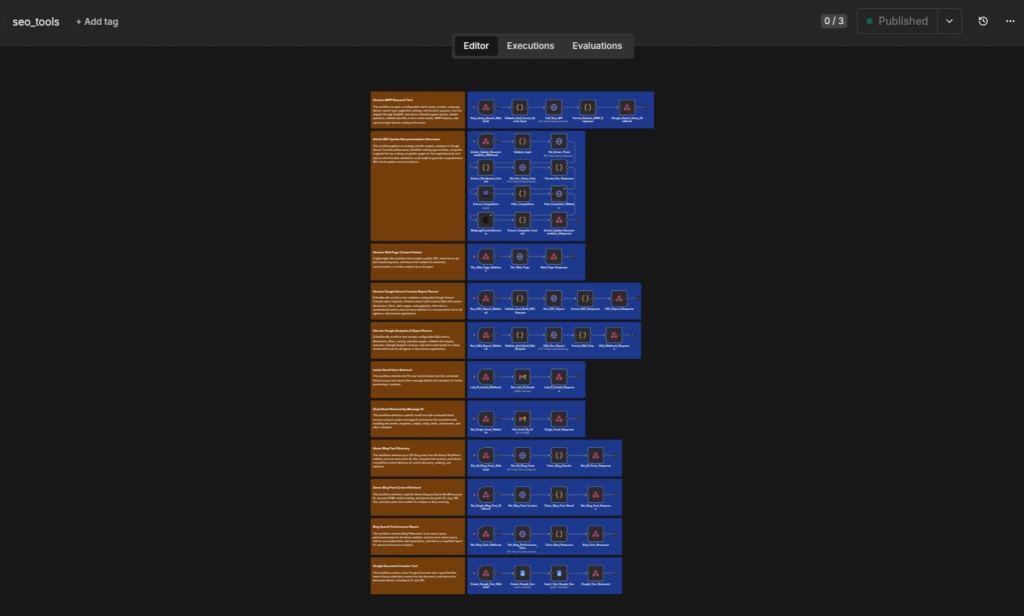
Screenshot of my SEO workflow tools
The objective is not only to gather data. The agent should interpret the data in relation to the company’s wider goals. For example, the agent may identify a keyword that is generating a large number of impressions but very few clicks. It can compare the ranking page with competing content, identify missing sections, recommend a new title, and create a content update task.
However, it should also check whether the opportunity supports the company’s commercial strategy. A keyword may have high search volume but little relevance to the services AIMEC wants to sell. This is where the agent north star becomes important. It gives the SEO agent a framework for deciding which opportunities deserve attention.
| SEO workflow | Agent action | Human role |
| Performance monitoring | Pulls traffic, ranking, and query data | Reviews major trends |
| Content decay detection | Finds pages losing clicks or impressions | Approves refresh priorities |
| Keyword research | Identifies relevant search opportunities | Validates commercial relevance |
| Content briefing | Produces outlines and topic recommendations | Adds experience and expertise |
| Internal linking | Finds relevant pages and link opportunities | Reviews important changes |
| Technical monitoring | Detects crawl, indexing, or 404 issues | Resolves infrastructure problems |
| Reporting | Creates weekly or monthly summaries | Makes strategic decisions |
Content Research and Production
A content agent can support research, planning, drafting, optimisation, and performance monitoring. It can identify gaps in an existing content cluster, analyse how competing pages cover a topic, prepare an outline, and recommend which internal pages should be linked.
The agent can also help maintain editorial continuity. If a company has already published several articles about AI implementation, the agent can avoid suggesting duplicate topics and instead identify supporting questions that have not yet been answered.
This becomes particularly useful as a website grows. Content planning becomes harder when information is spread across a sitemap, analytics tools, search data, spreadsheets, and editorial documents.
A content agent can help maintain a structured view of what has already been published, what needs updating, and what should be created next. A human editor remains essential. The editor contributes first-hand experience, verifies claims, improves the argument, and ensures that the article reflects the company’s actual expertise.
The agent should reduce the research and administrative burden around content production rather than simply producing generic articles at scale.
Social Media Workflows
A social media agent can convert company updates, technical experiments, product releases, and new articles into platform-specific posts. A detailed blog article may become a professional LinkedIn post, a concise X thread, a short company update, and a set of follow-up posts exploring individual ideas.
The agent can also monitor which themes generate engagement and use that information to recommend future posts. It should not simply copy the same message across every platform. Each network has different audience expectations, content lengths, and communication styles.
| Social workflow | Possible agent responsibility |
| Article promotion | Converts an article into social posts |
| Post repurposing | Creates several angles from one source |
| Engagement analysis | Identifies themes that perform well |
| Content scheduling | Prepares a publishing queue |
| Brand consistency | Checks tone and terminology |
| Comment monitoring | Flags important responses for a human |
AI Agents for Sales
Sales teams frequently spend more time on administration and research than on actual conversations with potential customers. They need to identify suitable companies, understand their needs, qualify opportunities, personalise outreach, update CRM records, and follow up at the correct time. An AI sales agent can support each stage of that workflow.
Lead Generation
A lead generation agent can search for companies that match a defined ideal customer profile and identify signals that they may need the company’s services. For an AI consultancy, these signals could include hiring for automation or AI roles, discussing digital transformation, operating complex manual workflows, investing in data infrastructure, or expanding a customer support function.
The agent can gather information from public sources, explain why the company may be relevant, and save the opportunity in a structured database or spreadsheet. This is more useful than simply producing a list of company names. A salesperson needs context. The agent should be able to explain what signal it found, why the company matches the target profile, and what service may be relevant.
| Lead generation stage | Agent contribution |
| Market scanning | Searches for relevant companies and signals |
| Company research | Collects size, industry, location, and activity |
| Opportunity scoring | Compares the lead with qualification rules |
| Context creation | Explains why the lead may need the service |
| Record creation | Adds the lead to the CRM or lead sheet |
| Follow-up tracking | Monitors whether action has been taken |
Lead Qualification
An AI agent can compare each opportunity with predefined criteria such as company size, industry, geography, likely budget, technical maturity, urgency, and strategic fit. This can help the sales team focus on leads that are more likely to convert. The agent should not rely on a single score without explanation. It should show which criteria were met and where uncertainty remains.
A lead may appear attractive because the company is large, but it may not be operating in a region the business can serve. Another may be smaller but have a highly urgent need and strong alignment with the available service. The agent should support judgement rather than hide it behind an unexplained number.
Sales Outreach and Follow-Up
A sales agent can prepare personalised outreach based on the prospect’s business, recent activity, and likely needs. It can draft an email, suggest a conversation angle, create a follow-up task, and update the CRM after a response.
Fully automated outreach requires caution. Poorly controlled agents can generate generic messages, contact unsuitable prospects, or send communications that damage the company’s reputation. A stronger approach is to let the agent research, qualify, and prepare the communication while a person reviews important outreach.
AI Agents for Customer Service

Customer service is one of the clearest areas where AI agents can deliver value because many requests follow repeatable patterns. A support agent can answer questions, retrieve account information, check order status, create tickets, update customer details, and escalate complex cases.
The difference between a basic support bot and a support agent is access to context and tools. A basic bot may provide a link to an order tracking page. An agent may retrieve the specific order, identify that the delivery has been delayed, open a support case, and notify the customer.
| Customer request | Possible agent action |
| Order status | Retrieves delivery information |
| Invoice request | Finds and sends the correct document |
| Password issue | Starts an approved reset workflow |
| Product availability | Checks live inventory |
| Technical problem | Collects details and creates a ticket |
| Complaint | Assesses urgency and escalates |
| Address change | Validates and updates the record |
| Cancellation request | Routes to the correct retention process |
Support Triage
An AI support agent can classify incoming requests by topic, urgency, sentiment, customer value, or technical complexity. A billing issue may be routed to finance. A software bug may go to engineering. A cancellation threat from an important client may be escalated to an account manager. This reduces the delay between receiving a request and getting it to the right person.
Context-Aware Conversations
An effective support agent should remember relevant context. It should know what the customer previously asked, which actions have already been taken, what products they use, and whether the issue is still unresolved.
This is especially important in channels such as WhatsApp, where a conversation may continue over several hours or days. I have been working on agent-based messaging systems that combine session context, user preferences, order history, and queued tasks. The goal is to prevent every new message from being treated as an isolated interaction.
AI Agents for Operations
Operations teams are responsible for making sure that work moves through the business correctly. They monitor tasks, orders, approvals, supply chains, integrations, staff responsibilities, and delivery timelines.
An operations agent can watch these processes continuously and identify when something has stalled or deviated from the expected workflow.
Workflow Monitoring
An operations agent may identify delayed tasks, missing information, failed integrations, repeated errors, unusual processing times, unassigned work, or bottlenecks between departments.
It can then notify the responsible employee, create a corrective task, or escalate the problem to a manager.
| Operational issue | Agent response |
| Task overdue | Notifies the owner and updates the coordinator |
| Missing customer information | Requests the missing fields |
| Failed integration | Logs the failure and creates a technical task |
| Order delay | Checks the cause and alerts operations |
| Unassigned request | Routes it to the appropriate team |
| Repeated process failure | Flags the workflow for review |
| Approval bottleneck | Reminds the approver or escalates |
Process Automation
An AI agent can complete the parts of a process that involve interpreting information and deciding which predefined workflow should be used.
For example, a client onboarding agent could receive a new customer record, check whether the required information is complete, create the appropriate folders, prepare onboarding documents, assign tasks, and track outstanding requirements.
The agent does not need to control every step. Traditional workflow automation can handle predictable actions, while the AI agent handles interpretation and exceptions.
Inventory and Order Management
In a B2B ordering workflow, an agent could interpret a customer’s message, identify the requested products, match them to a catalogue, validate quantities, check availability, and prepare the order for approval.
If the order contains ambiguity, such as an incomplete product name or an unusual quantity, the agent can ask for clarification rather than forcing the request through the system.
AI Agents for Finance
Finance departments deal with structured data, repeatable reporting, document extraction, reconciliations, approvals, and anomaly detection.
These are strong use cases for agents, but they also require strict controls. A finance agent should usually be allowed to collect data, prepare reports, flag discrepancies, and recommend actions. High-risk actions such as releasing payments or changing financial records should require approval.
Invoice Processing
An AI agent can extract supplier details, invoice numbers, tax information, line items, payment terms, and totals from invoices. It can compare the invoice with a purchase order, identify discrepancies, and route the document to the correct approver.
Financial Reporting
A finance agent can retrieve information from accounting systems, payment platforms, spreadsheets, and internal databases. It can prepare a report comparing revenue, spending, cash flow, overdue invoices, product profitability, and forecast performance.
| Finance workflow | Agent responsibility | Approval requirement |
| Invoice extraction | Reads and structures invoice data | Low |
| Purchase order matching | Flags mismatched totals or items | Medium |
| Expense classification | Suggests categories | Medium |
| Budget reporting | Compares budget with actual spending | Low |
| Cash-flow summary | Prepares current position | Low |
| Payment preparation | Creates payment instructions | High |
| Payment execution | Releases funds | Very high |
| Anomaly detection | Flags unusual transactions | Medium |
Fraud and Anomaly Detection
An agent can monitor financial activity for transactions that fall outside normal patterns. It might identify duplicate invoices, unusual payment values, new supplier details, unexpected account changes, or spending outside agreed limits.
The agent should provide evidence and context for the alert rather than making an irreversible decision by itself.
AI Agents for Human Resources
HR departments manage recruitment, onboarding, employee documentation, policy questions, training, and internal communication. An AI agent can support many of these workflows, particularly where the work involves repeated questions or document handling.
Recruitment Support
A recruitment agent can compare applications with role requirements, summarise candidate experience, coordinate interviews, and prepare structured candidate comparisons.
However, hiring decisions should remain subject to human judgement. Recruitment systems can amplify bias if the evaluation criteria or historical data are poorly designed. The agent should assist with organisation and evidence gathering rather than become the final decision-maker.
Employee Onboarding
An onboarding agent can prepare documents, assign training, request system access, schedule introductory meetings, and track which onboarding steps remain incomplete. This reduces the administrative burden on HR and helps create a more consistent experience for new employees.
Internal HR Assistant
Employees can use an internal agent to ask questions about leave, expenses, benefits, policies, training, and workplace procedures. The agent can retrieve the correct policy and explain how it applies to the employee’s question.
AI Agents for Software Development

Software development agents are often associated with code generation, but their potential role is broader. A coding agent can inspect an existing codebase, understand a feature request, break it into tasks, write code, generate tests, run those tests, identify failures, and propose fixes.
I have been experimenting with coding agents that operate as part of a self-development loop. The goal is for the agent to receive a task, inspect the project, make a change, test the result, and correct problems where possible.
The challenge is not simply writing code. The agent needs enough context to understand the architecture, existing conventions, dependencies, constraints, and business purpose of the change.
| Development task | Agent capability |
| Codebase analysis | Locates relevant files and dependencies |
| Feature planning | Breaks a request into implementation steps |
| Code generation | Produces or modifies code |
| Test creation | Writes unit or integration tests |
| Test execution | Runs checks and captures failures |
| Debugging | Identifies likely causes of errors |
| Documentation | Updates technical documentation |
| Review support | Flags risks or inconsistent changes |
| Monitoring | Reviews logs and error patterns |
A coding agent becomes more useful when it can access the same north star as the other business agents. If a requested feature does not support a current business priority, the agent or coordinator can flag that misalignment before development time is spent.
Building an Agent North Star
One of the biggest challenges in a multi-agent business is coordination. It is relatively easy to build one agent that performs one isolated task. It is much harder to build several agents that all contribute to the same business outcome.
Without shared direction, an SEO agent may optimise for traffic, a content agent may optimise for publishing volume, a lead generation agent may prioritise company size, and a coding agent may focus on technically interesting features. Each agent may appear productive while the business as a whole moves in several different directions. To address this, I have been building an agent north star.
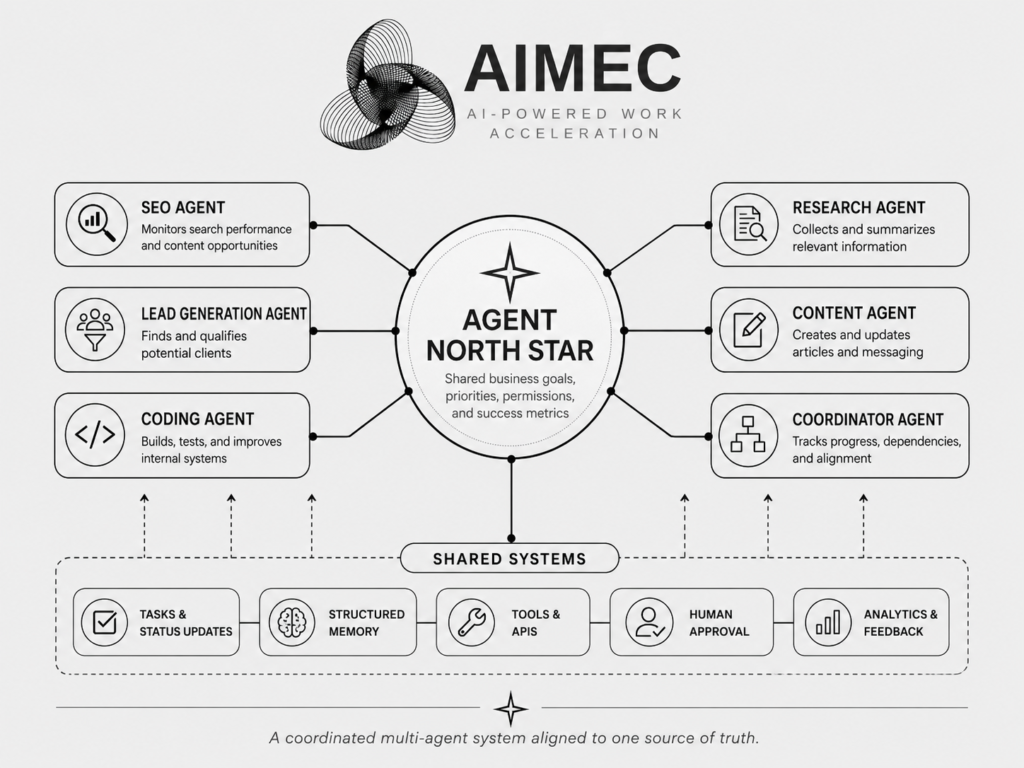
Diagram of agent north star I have been building
The north star acts as a shared source of truth that describes what the business is trying to achieve and how agents should evaluate their work.
| North star component | Purpose |
| Business objectives | Defines what the company is trying to achieve |
| Current priorities | Tells agents what matters now |
| Target customers | Keeps sales and marketing aligned |
| Strategic constraints | Defines what agents should avoid |
| Performance indicators | Shows how success is measured |
| Tool permissions | Defines which systems agents may use |
| Escalation rules | Shows when humans must become involved |
| Department responsibilities | Reduces duplicated work |
| Short-term goals | Guides immediate actions |
| Long-term direction | Prevents short-term optimisation from taking over |
Multiple agents can subscribe to the north star. When an agent receives a task, it can check whether the work supports a current business objective. For example, an SEO agent may identify a high-volume topic. Before prioritising it, the agent can evaluate whether the subject supports AIMEC’s target services and intended audience.
A lead generation agent can use the same framework to determine which companies fit the ideal customer profile. A coding agent can use it to decide which product improvements are strategically important. A coordinator agent can use it to compare the work of all other agents against the same priorities.
How Multiple AI Agents Can Communicate
A multi-agent system needs a structured way for agents to exchange information. This does not mean every agent should read every conversation or every piece of company data. That would increase context requirements, cost, and confusion.
Instead, agents can communicate through structured tasks, shared memory, system events, status updates, and defined outputs. A typical content workflow could work like this:
| Stage | Responsible agent | Output |
| Opportunity detection | SEO agent | Topic opportunity |
| Background research | Research agent | Evidence summary |
| Content creation | Content agent | Article draft |
| Search review | SEO agent | Optimisation recommendations |
| Approval | Human editor | Approved content |
| Publication | Workflow automation | Published article |
| Performance tracking | Analytics agent | Traffic and conversion report |
| Strategic review | Coordinator agent | Alignment and next actions |
Each agent receives only the information it needs to complete its task. The shared system can store the task owner, objective, relevant context, current status, result, and next action. This makes the multi-agent environment easier to understand and maintain.
Why a Coordinator Agent Is Important
A collection of agents is not automatically an effective multi-agent system. Someone or something needs to manage dependencies, identify failures, prevent duplicate work, and review whether the agents are actually contributing to the business.
A coordinator agent can assign tasks, monitor progress, review outputs, create follow-up tasks, and escalate unresolved issues. In my own agentic enterprise experiment, I am exploring a model where specialised agents manage SEO, lead generation, research, coding, content, and system improvement.
The north star provides the shared strategy, while the coordinator agent monitors how the other agents act on it.
| Coordinator responsibility | Why it matters |
| Task assignment | Ensures work has a clear owner |
| Status monitoring | Identifies stalled work |
| Dependency management | Prevents one agent from blocking another |
| Output review | Detects incomplete or poor results |
| Duplicate prevention | Stops agents repeating the same work |
| Strategic alignment | Compares tasks with business priorities |
| Escalation | Brings humans into high-risk decisions |
| Follow-up creation | Converts findings into further action |
The coordinator should not necessarily make every strategic decision. Its main role is to keep the system organised, visible, and aligned.
Which Business Processes Are Best Suited to AI Agents?
The strongest candidates for AI agent implementation are repeated digital workflows with clear objectives and measurable outcomes. A process is particularly suitable when the necessary information is available, the agent’s actions can be monitored, and mistakes can be reversed or escalated.
| Workflow characteristic | Why it suits an agent |
| Repeated frequently | Creates meaningful time savings |
| Uses digital systems | Gives the agent accessible tools |
| Requires information gathering | Agents can research and summarise |
| Includes classification | Agents can interpret variable inputs |
| Has clear success criteria | Performance can be measured |
| Contains reversible actions | Reduces implementation risk |
| Has known exceptions | Enables escalation rules |
| Requires cross-system work | Agents can coordinate tools |
| Creates administrative burden | Frees employees for higher-value work |
Businesses should avoid automating a process that is already poorly understood. An agent cannot reliably fix unclear ownership, inconsistent data, missing rules, or contradictory objectives. In many cases, the process should first be simplified and documented.
What AI Agents Should Not Do Without Oversight
AI agents should not receive unlimited access to business systems. The level of autonomy should depend on the risk of the action. Reading data, preparing a summary, or creating a draft is relatively low risk. Deleting production data, releasing payments, publishing sensitive statements, or changing strategic goals is high risk.
| Action | Suggested control level |
| Read analytics data | Automatic |
| Prepare a report | Automatic |
| Create an internal task | Automatic |
| Draft an email | Review recommended |
| Contact a qualified lead | Human approval |
| Publish public content | Human approval |
| Modify customer records | Restricted |
| Release a payment | Mandatory approval |
| Delete production data | Mandatory approval |
| Change business goals | Executive approval |
In the north star system I am building, agents should not be able to rewrite the company’s core goals simply because they believe another direction is better.
They may identify a problem and recommend a change. The final strategic decision remains with a person.
The Importance of Memory and Context
An agent’s usefulness depends heavily on the context it can access. A sales agent needs to know which prospects have already been contacted. A support agent needs access to the customer’s previous issue. A coding agent needs to understand the application’s architecture. A coordinator needs visibility into active and completed tasks.
However, giving every agent access to every piece of company information is inefficient and risky. A better approach is to maintain structured memory and retrieve only the information that is relevant to the current task.
Structured memory can reduce unnecessary context usage and make agent behaviour more consistent. It also allows information to be shared between agents without requiring them to process full conversations or large document histories.
How to Start Using AI Agents in a Business
A business does not need to begin with a complicated network of autonomous agents. The best starting point is usually one narrow workflow with clear inputs, limited risk, and a measurable result. A company could begin with an agent that monitors website errors, researches sales leads, categorises support requests, prepares weekly reports, or tracks overdue tasks.
Once the first agent is reliable, the business can add more capabilities around it. As the number of agents grows, the need for a north star, coordinator, shared memory, and structured task system becomes more important.
Questions to Ask Before Building an AI Agent
Before building an agent, a business should define the agent’s responsibility, tools, data access, permissions, success criteria, and escalation path. It should also decide how the agent’s work supports the wider strategy.
| Question | Why it matters |
| What is the agent responsible for? | Prevents unclear ownership |
| What tools does it need? | Defines integration requirements |
| What information can it access? | Controls privacy and security |
| What can it do automatically? | Sets autonomy boundaries |
| What requires approval? | Reduces risk |
| How will success be measured? | Enables performance evaluation |
| What happens when it fails? | Creates a recovery process |
| Who reviews its work? | Maintains accountability |
| How are decisions logged? | Supports auditing |
| Which business goal does it support? | Prevents meaningless automation |
The final question is one of the most important. An agent can complete its assigned tasks successfully while still producing little business value. It may optimise the wrong metric, target the wrong audience, or create work that does not support a commercial objective. That is why the agent north star is more than a technical feature. It connects agent activity to business direction.
Final Thoughts
So, what can an AI agent do for a business? It can research, monitor, analyse, classify, communicate, recommend, and complete work across almost every department.
A standalone agent may save time on one isolated process. A coordinated network of agents can support a much larger operating model. That is the goal behind the agent north star I am building for AIMEC: to give multiple agents a shared understanding of business objectives while allowing them to communicate, create tasks, report progress, and coordinate their activities.
The technology behind AI agents is advancing quickly, but successful implementation will still depend on clear processes, controlled access, structured memory, measurable outcomes, and strategic alignment.
The businesses that gain the most value from AI agents will not necessarily be the companies with the greatest number of agents. They will be the businesses whose agents understand what they are responsible for, what they are allowed to do, how they should communicate, and why their work matters.
Frequently Asked Questions
What can an AI agent automate in a business?
An AI agent can automate or support research, reporting, monitoring, customer service, lead qualification, workflow coordination, content planning, data extraction, document processing, and tool-based tasks. Its exact capabilities depend on the systems it can access and the permissions it receives.
What is the difference between an AI agent and a chatbot?
A chatbot mainly responds to messages. An AI agent can interpret goals, use tools, complete multi-step workflows, retain relevant context, and take actions in external systems.
Can AI agents work across different departments?
Yes. AI agents can support marketing, sales, customer service, operations, finance, HR, software development, and management. Specialised agents can also communicate through shared tasks, memory, and coordination systems.
What is a multi-agent system?
A multi-agent system is a network of specialised AI agents that work on different tasks while sharing goals, information, or workflows. A coordinator agent may assign work, monitor progress, and evaluate whether the agents are contributing to the same business objectives.
What is an agent north star?
An agent north star is a shared source of truth that defines business goals, priorities, constraints, target customers, permissions, and success metrics. Agents use it to align their decisions with the wider strategy of the company.
Do AI agents replace employees?
AI agents are more likely to change how employees work than replace every role. They can handle repetitive research, monitoring, administration, and digital workflows while employees focus on judgement, relationships, strategy, and complex decisions.
Are AI agents safe for business use?
AI agents can be used safely when they have restricted permissions, clear instructions, activity logging, approval requirements, and escalation processes. High-risk actions should remain under human control.
How should a business choose its first AI agent project?
The first project should be a repeated digital workflow with clear inputs, measurable outcomes, available data, and limited risk. Monitoring, reporting, research, qualification, and internal support workflows are often strong starting points.

Steven Walgenbach is an AI Engineer specializing in AI agents, large language models, retrieval-augmented generation and business process automation. He designs and builds practical AI systems that connect with existing tools, data sources and workflows to help businesses reduce manual work, improve decision-making and scale more efficiently.
His work includes developing multi-agent systems, private and locally hosted AI solutions, custom knowledge assistants, SEO automation pipelines and LLM-powered applications using Python, LangGraph, CrewAI, the OpenAI Agents SDK and other modern AI frameworks.
Through AIMEC, Steven helps businesses move beyond AI experimentation and identify practical opportunities where artificial intelligence can deliver measurable operational and commercial value.