If you’ve ever wondered “what are AI agents?” or searched for “AI agents explained simply”, you’re in the right place.
In this article, we’ll break down what AI agents are, how they work, the different types out there, and where you might encounter them in everyday life.
What Are AI Agents?
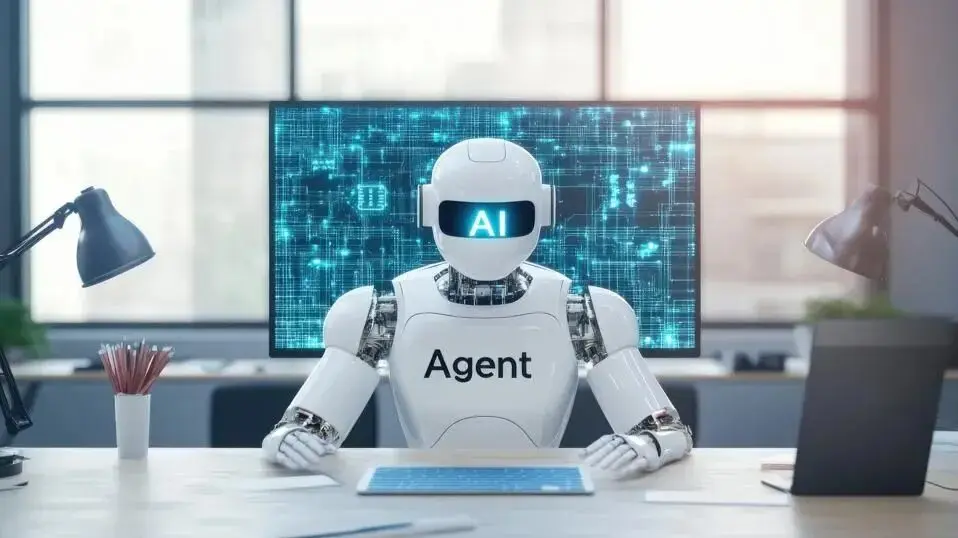
An artificial intelligence (AI) agent is essentially a software (or sometimes robotic) system that can act on its own to achieve goals.
In simple terms, an AI agent observes what’s going on, thinks about what it needs to do, and then takes action without a person explicitly telling it each step.
Humans usually set the overall goal or task, but the agent decides how to get it done. For example, imagine a customer service AI that’s given the goal “help the user reset their password.” The AI agent will independently follow steps to ask the user questions, lookup information, and guide the reset process without a human scripting every response.
One key idea is that AI agents can sense their environment and affect it. In classic AI terms, an agent perceives its environment through sensors and acts upon that environment through actuators.
Think of a simple household robot: its sensors (like cameras or touch sensors) let it know what’s around, and its actuators (wheels, arms, or software outputs) let it take action based on what it perceives. AI agents use these perceptions to decide what to do next, aiming to make the best decisions to reach their given goal.
Another important aspect is autonomy. Traditional computer programs only do exactly what they’re explicitly coded to do, step by step. An AI agent, however, is built to make choices on its own within its domain.
It doesn’t require constant human direction; it can adjust its behavior based on input or changes in the environment. For instance, an AI scheduling agent might keep checking your calendar and incoming emails and on its own reschedule meetings if a conflict arises, without you manually intervening each time.
AI agents come in many forms and levels of complexity. Some are very simple (like a thermostat that just monitors temperature and turns the heater on or off – that’s arguably an extremely simple reflex agent). Others are very complex, like self-driving car systems that take in camera/LiDAR data, make real-time driving decisions, and control the vehicle. In all cases, what makes them “agents” is this cycle of perceiving, deciding, and acting towards a goal.
How Do AI Agents Work?
At a high level, an AI agent works in a sense–think–act loop. It continuously perceives the environment, reasons about what it perceives in the context of its goals, and then acts accordingly. This loop repeats, allowing the agent to respond to changes and move closer to its objective. Here’s a breakdown of the process:
- Perception: The agent gathers data about the world. This could be through physical sensors (camera, microphone, etc.) or digital inputs (API calls, reading databases, user input text). The agent updates its internal understanding of “what the world is like now” based on these percepts.
- Decision/Reasoning: The agent’s “brain” (an algorithm or model) processes the information and decides what to do. It might follow predefined rules, learned models, or a combination of both to choose an action. This is where AI techniques come in – from simple condition-checks (if X, then do Y) to complex machine learning models that predict the best action. The agent evaluates options and determines “what action should I do now?” to move toward its goal.
- Action: Finally, the agent takes action to affect the environment. In a physical agent, this means sending signals to actuators (motors, speakers, etc.) to do something in the real world. In a software agent, an action could be calling an API, sending a message, showing a response to a user, and so on. These actions then change the state of the environment (even if that “environment” is just a software system or the user’s knowledge state), and the loop begins again with new perceptions of the updated state.
To illustrate, consider a self-driving car as an AI agent. Its sensors (cameras, radar, etc.) perceive the road, other cars, and obstacles in real time. Its on-board AI “brain” takes all that data and decides “what should I do next?” (brake, steer, accelerate, etc.) to reach the destination safely – that’s the reasoning step.
Then it sends signals to the car’s actuators (steering motor, throttle, brake) to take the action. It does this repeatedly multiple times per second, constantly adjusting to new information (a car cuts in front, a traffic light turns red, etc.). The human passenger just set the destination (goal); the AI agent figures out the rest on its own.
Crucially, many AI agents also incorporate learning and memory. They can remember past interactions or outcomes and use that to improve future decisions. This means over time an agent might get better at its task.
For example, a voice assistant agent (like Siri) can learn your speech patterns or preferences, so it gets more accurate and personalized with use.
Not all agents learn (some are fixed), but the more advanced “intelligent agents” have the ability to adjust based on experience, which is a game-changer compared to static software.
Key Characteristics of AI Agents
AI agents have a few defining characteristics that set them apart from regular programs. Here are some of the key traits:
- Autonomy: AI agents operate without constant human oversight. They can make decisions on their own in real time. Unlike a traditional script that does only what it’s told at each step, an autonomous agent identifies the next appropriate action based on the situation, and executes it by itself. (Think of an email filter automatically sorting spam – you aren’t dragging each spam email to the folder; the agent learned to do it on its own.)
- Goal-Oriented and Rational Behavior: AI agents are driven by objectives. They don’t just carry out a fixed sequence of steps; they actively pursue a defined goal or maximize a “performance metric”.
A navigation agent, for instance, has the goal of finding the shortest or fastest route; it will evaluate different actions (turn left vs. right) by how well each moves toward that goal.
Agents are often designed to choose actions that are rational – meaning the actions are expected to achieve the best outcome for their goal given what they know.
- Perception of Environment: An AI agent is aware of its environment (in a broad sense) and reacts to changes. They gather data through sensors or inputs and update their internal state accordingly.
That could be a physical environment (for a robot) or an information environment (like the state of a game or a user’s request in a chatbot). For example, a stock-trading agent “perceives” market data streams and uses that to inform its decisions.
- Adaptability and Learning: Many AI agents can learn from experience and improve over time. They might start with initial rules or models, but by observing what works and what doesn’t, they adapt their strategy. This continuous learning makes them more flexible than static programs. For instance, a recommendation agent on Netflix gets better at suggesting movies as it learns more about your watching habits.
- Proactiveness: Beyond just reacting, AI agents can be proactive – they anticipate future needs or problems and act in advance. A proactive customer service agent might not wait for you to ask for help; it could detect you’re struggling on a website and proactively offer assistance. Similarly, a predictive maintenance agent in a factory might schedule service for a machine before it breaks down, because it forecasted an issue from sensor data.
- Social Ability (Collaboration): Some agents are designed to communicate and collaborate with humans or other agents. They might share information, negotiate, or work in teams (multi-agent systems) to achieve complex goals. For example, in a multi-agent game, several AI agents might team up and coordinate strategies, or a personal assistant agent might defer to another specialized agent (like handing off a complex question to a different agent better suited to answer).
Those characteristics help AI agents handle dynamic, unpredictable scenarios in a way that traditional hard-coded software would struggle with.
An AI agent reacts to the situation and decides the next step, rather than just following a predetermined script. This makes agents especially powerful for complex tasks like driving, conversation, or managing business processes, where there are lots of changing factors and no single fixed sequence of actions will always work.
Types of AI Agents

Not all AI agents are created equal – there are different architectures or types of agents, each with varying levels of sophistication. AI researchers often categorize agents based on how they make decisions and whether they can learn or remember. Here are the main types of AI agents (from simplest to most advanced):
- Simple Reflex Agents: These are the most basic agents that act only on the current percept (the here-and-now input) and a set of predefined rules. They do not have memory of past states.
They basically apply condition-action rules like “if X happens, do Y,” and that’s it. If the environment is something they weren’t programmed to handle, they simply can’t cope.
Example: a thermostat can be seen as a simple reflex agent – if temperature is below 18°C, then turn the heater on. It doesn’t need to remember anything or plan ahead; it just reacts to the current temperature with a fixed rule.
- Model-Based Reflex Agents: These agents still follow rules but also maintain some internal state or model of the world based on past perceptions. Because they have memory, they can handle partially observable environments by remembering information that isn’t immediately in the current percept.
They update their internal model as new data comes in and make decisions based on “what the world is like now” plus an understanding of how the world evolves.
Example: a robotic vacuum cleaner that keeps track of which areas it has cleaned is model-based. It remembers a map of the room (internal model) so it doesn’t redo the same spot over and over.
- Goal-Based Agents: These agents go a step further by considering goals. In addition to a model of the world, they know the desired outcome and can plan sequences of actions to achieve their goal.
This often involves searching through possible action sequences to find one that reaches the goal. They are more flexible than simple reflex agents because they can choose actions not just based on a local condition, but on whether an action will lead to the goal.
Example: a GPS navigation AI is goal-based – given the goal “get to destination X,” it will evaluate different routes and actions (turn left, turn right, etc.) to find one that achieves the goal fastest.
- Utility-Based Agents: These agents have goals but also a utility function to measure which state or action is preferable when there are multiple ways to reach the goal. Instead of just “find a way to succeed,” they evaluate which way is best according to some metric (utility).
The utility could be a combination of factors or preferences (like time, cost, safety, etc.), and the agent will try to maximize this utility.
Example: if our navigation agent is utility-based, it might consider not just reaching the destination, but also factors like travel time, distance, toll costs, and fuel usage – then choose the route that gives the best overall trade-off (e.g., fastest with least cost).
- Learning Agents: A learning agent is one that can improve its performance over timze through experience. It usually has all the elements of the above agent types (can have memory, goals, utility, etc.) but with the added capability to adjust its behavior.
A learning agent typically has components like a learning element (which refines the agent’s knowledge), a performance element (which uses the knowledge to make decisions), a critic (which gives feedback on how well the agent is doing relative to some ideal), and sometimes a problem generator (which suggests exploratory actions so the agent can discover better strategies).
Example: many modern agents, from recommendation systems to game-playing AIs, are learning agents. A recommendation agent on an e-commerce site learns from each user interaction to update its model of your preferences, so it can make better product suggestions next time.
Those categories aren’t mutually exclusive – an agent can be both goal-based and learning, for instance. But they provide a helpful way to think about increasing levels of sophistication.
A simple reflex agent is rigid but fast and works in very predictable scenarios. A goal/utility-based agent is more flexible and can handle complex decision-making. A learning agent can start to handle the unknown and get better with time.
It’s also worth noting multi-agent systems as a concept: sometimes you don’t just have one AI agent, but many agents working in an environment, potentially collaborating or competing with each other.
For example, in traffic management, each self-driving car is an agent, but together they form a multi-agent system that can coordinate (directly or indirectly) to reduce congestion. Multi-agent systems can solve problems that are too big for a single agent by dividing tasks or bringing different expertise from specialized agents.
However, coordinating multiple agents introduces its own challenges (communication, trust, etc.), so it’s an advanced area of AI research.
Examples of AI Agents in Everyday Life
AI agents might sound abstract, but chances are you’ve interacted with them or benefited from them without realizing it.
Here are some common examples of AI agents around us:
- Virtual Assistants and Chatbots: Voice assistants like Apple’s Siri, Amazon’s Alexa, Google Assistant, and chatbots on websites are prime examples of AI agents.
They interpret your voice or text input (perceive), figure out what you’re asking for (reason), and then take action or respond. For instance, if you say “Siri, remind me to call Mom on Sunday,” the assistant agent will parse your request, perhaps ask a follow-up if needed, and then create a reminder event for you. These agents use natural language processing to understand you and can integrate with various tools (calendar, phone, web search) to carry out tasks autonomously on your behalf.
- Recommendation Systems: When Netflix suggests a show you might like or Amazon recommends a product, there’s an AI agent at work under the hood. Recommendation agents analyze your past behavior and preferences (what you watched or bought, how you rated things) and the behavior of other users, and decide what content to show you next to maximize your satisfaction.
They continuously learn from what you consume or ignore. The goal of these agents is to keep you engaged by predicting what you’ll find valuable. Over time, as they get more data, their suggestions ideally become more accurate for your tastes.
- Autonomous Vehicles: Self-driving cars, drones, and robot vacuums all fall under the category of autonomous agent.
A self-driving car is an AI agent that perceives its surroundings with sensors, uses AI models to make driving decisions, and controls the vehicle’s steering, acceleration, and braking accordingly.
Similarly, a drone with autopilot can be told “inspect this building” and then it figures out the path and maneuvers to achieve that, avoiding obstacles on its own. These are high-profile examples of agents operating in the physical world.
- Robotic Systems: Beyond cars, many robots in industry and homes are AI agents. For example, a warehouse robot that moves shelves or packages around is often an AI agent – it perceives markers or uses a map of the warehouse, plans a path to the target item, and moves it to where it’s needed. Industrial robotic arms on manufacturing lines might have vision systems to detect parts and make decisions on how to orient or assemble them.
Even a smart vacuum cleaner like a Roomba uses simple agent principles: it senses obstacles and dirty spots, decides where to go next, and actuates its wheels and brushes to clean the floor (often with a bit of randomness and learning for coverage).
- Game-Playing Agents: In video games and AI research, game-playing agents are everywhere. NPCs (non-player characters) in games are agents – for instance, the ghosts in Pac-Man observe the player’s position and make decisions on where to move. Modern games have much more complex AI agents controlling enemy behavior or allies. In the realm of AI research, agents like AlphaGo or AlphaZero (which learned to play Go and Chess at superhuman levels) are famous – they perceive the game state, use deep learning and planning to decide on a move, and take action by placing a stone or moving a piece.
Even a chess AI on your phone is an agent that looks at the board and computes a move that maximizes its chance of winning.
Those examples show how broad the concept of “AI agent” really is – it spans from software you interact with on your phone, to behind-the-scenes algorithms personalizing your feed, to physical robots moving around in the world.
The common thread is that in each case, the system is perceiving inputs, making a decision, and acting to fulfill a goal (whether that goal is answering your question, getting you to watch another video, or driving you safely to work).
Autonomous AI Agents and Recent Advances
You might have heard the buzz about “autonomous AI agents” in the last couple of years (especially around 2024–2025). This refers to a new wave of AI systems that are able to operate with very minimal human intervention, often chaining together tasks to achieve an objective. These agents are often powered by advanced AI models like large language models (LLMs) and are sometimes called “agentic AI”.
The big difference with these next-gen agents is that they combine several capabilities: natural language understanding, planning, tool use, and learning, all in one loop.
They don’t even always need a human prompt for every step – once you give them a high-level goal, they can break it down into sub-tasks and figure out how to execute each part autonomously.
For example, consider an AI agent of this kind tasked with “Plan my two-week vacation to Europe within a $5,000 budget”. A modern autonomous agent could potentially search the web for flights, check visa requirements, find hotel options, compare itineraries, and come back with a detailed travel plan – calling APIs or other services as needed – without you guiding each step of the process.
Several frameworks and prototypes emerged to demonstrate this concept. One of the most famous is AutoGPT, an open-source project that links an LLM (like GPT-4) with the ability to set its own sub-goals and use tools like web browsing or database lookups to fulfill a user’s request.
Essentially, AutoGPT and similar agentic tools treat the AI as an “agent” that can decide “I need information on X, let me call a web search; now I have results, let me analyze them; now I’ll generate a plan; oh I need to save this file, I’ll use a file-writing tool,” and so on, until the goal is achieved. This is a step beyond a single-turn chatbot that only responds to one prompt at a time.
Tech companies have also jumped on this trend: for instance, IBM’s Watsonx Agents, Microsoft’s “Copilot” agents, OpenAI’s experimental Agent APIs, and many start-ups are building platforms for these autonomous agents.
These systems often incorporate a memory (to remember context across steps), a planning or reflection mechanism, and the ability to integrate external tools or plugins (like retrieving real-time data, executing code, or even invoking other specialized AI models). By 2025, the ecosystem for agentic AI grew significantly – there are agent frameworks (LangChain, AutoGen, etc.) and even marketplaces of pre-built agents for various tasks.
It’s worth noting that the term “AI agent” itself is broad, and some people in the tech community started using “agent” to specifically mean these autonomous task-oriented LLM-based systems. There isn’t a single standard definition of an AI agent in this context. But generally, when someone says “autonomous AI agent” today, they imply a system that can dynamically react and plan in a complex environment (often using natural language) without needing step-by-step instructions from humans.
A pop culture analogy would be J.A.R.V.I.S. from Iron Man – an AI that you can tell “handle my schedule and security” and it figures out all the intermediate steps. We’re not quite at JARVIS level yet, but that’s the direction these systems are headed.
Why the recent buzz? The big driver has been improvements in AI models (like GPT-3, GPT-4 and other LLMs) that give agents powerful reasoning and language abilities, combined with the API/plugin ecosystems that let an AI agent do things in the real world (like controlling a web browser or a smart home device).
The convergence around 2023–2024 suddenly made it feasible to build agents that feel much more autonomous and useful. It’s an exciting frontier: people are experimenting with agents that can, say, manage your email inbox, automate complex business workflows, or even act as a research assistant that goes off and gathers information for you while you sleep.
Of course, with great power comes great responsibility – these advanced agents raise new questions about reliability, decision-making transparency, and control (after all, if an AI agent can make independent decisions, we want to ensure it’s making good ones aligned with user intent and ethical norms). But many believe that autonomous AI agents are the future of AI applications, enabling software that’s far more adaptive and helpful than static programs.
Frequently Asked Questions
What is an AI agent in simple terms?
An AI agent is basically an AI-driven program or robot that can act on its own to complete tasks. It observes what’s happening (through input sensors or data), makes decisions using AI algorithms, and then takes action – all aimed at achieving a goal set for it.
Unlike a regular program that just follows a fixed script, an AI agent has a degree of freedom to decide “what’s the best move right now” based on the situation. In everyday terms, it’s like a little digital helper that you give an objective to, and it figures out the how.
For example, if you tell an AI agent “schedule a meeting for me next week with Bob,” it will check calendars, find a slot, and send an invite, without you manually doing each step.
What is an autonomous AI agent?
An “autonomous AI agent” is an AI agent that operates with minimal human guidance or intervention.
Once you give it a goal, it can carry out multiple steps on its own, even formulating sub-goals, until it accomplishes the objective. It uses its own reasoning to handle unexpected situations along the way.
Autonomous agents can learn and adapt as they go, making them more flexible than simpler bots. For instance, an autonomous customer service agent might handle an entire support call from start to finish – understanding the issue, looking up information, solving the problem – without a human rep stepping in unless it gets truly stumped. (Of course, “autonomous” doesn’t mean magical – the agent still operates within whatever capabilities and boundaries it was designed with. It also might know when to hand off to a human if it encounters something outside its scope.)
Are AI agents the same as chatbots or are they different?
A chatbot is a type of AI agent, but not all AI agents are chatbots. The term “chatbot” usually refers to an agent designed specifically to have conversations (via text or voice) with users, often following scripts or doing simple Q&A.
Traditional chatbots were pretty rigid – they followed predefined dialogue flows. AI agents, especially autonomous ones, are more flexible and powerful. They don’t just chat; they can take actions.
For example, a modern AI agent might not only answer your question in a chat, but also perform a task (like booking a flight or updating a database) as part of that interaction. In short, today’s AI agents are like chatbots on steroids: they understand language like chatbots do, but also have more autonomy to decide and act, not just speak.
A good way to see it: all chatbots are AI agents (focused on conversation), but an AI agent could also be a driverless car or a recommendation system – things that aren’t about chatting at all.