
Artificial intelligence can improve productivity, reduce operating costs and help businesses make better decisions. However, successful implementation requires more than subscribing to an AI tool and asking employees to start using it. Businesses need a structured AI implementation roadmap that connects the technology to a measurable operational problem.
For most business owners, the best starting point is not a company-wide AI transformation. It is a focused 90-day pilot designed to prove that AI can deliver a useful result in one clearly defined process.
A successful first pilot should answer four questions:
- Can AI reliably improve this process?
- Will employees actually use the solution?
- Can it integrate with the company’s existing systems?
- Does the financial benefit justify further investment?
This guide provides a practical 90-day AI implementation roadmap that takes a business from initial discovery to a working pilot, measurable results and a decision about what to scale next.
What Is an AI Implementation Roadmap?
An AI implementation roadmap is a structured plan for identifying, designing, testing and deploying artificial intelligence within a business.
It defines:
- The business problem AI will address
- The data and systems required
- The people responsible for implementation
- The controls needed to manage risk
- The metrics used to evaluate success
- The timeline for moving from concept to deployment
A roadmap prevents businesses from investing in AI without a clear operational purpose.
Instead of beginning with a question such as, “Which AI platform should we buy?”, the roadmap begins with a more useful question: Which business process should we improve, and how will we measure the result?
That change in perspective is important. AI should be treated as business infrastructure rather than an isolated technology experiment.
Why Start With a 90-Day AI Pilot?
A 90-day pilot is long enough to build and test something meaningful, but short enough to maintain urgency and limit financial exposure. It also gives the business enough time to:
- Select a high-value use case
- Review available data
- Design a controlled solution
- Integrate the solution into an existing workflow
- Test it with real users
- Measure its effect on performance
- Identify technical and operational risks
Trying to transform several departments simultaneously usually creates unnecessary complexity. The first pilot should instead establish a repeatable implementation process that can later be applied to other use cases.
The goal is not to build the company’s final AI system in 90 days. The goal is to prove that AI can create measurable value in a controlled environment.
The 90-Day AI Implementation Roadmap
The roadmap is divided into four phases:
- Days 1–15: Discovery and pilot selection
- Days 16–30: Solution design and preparation
- Days 31–60: Build, integration and testing
- Days 61–90: Controlled deployment and evaluation
Each phase should end with a clear decision before the company commits additional resources.
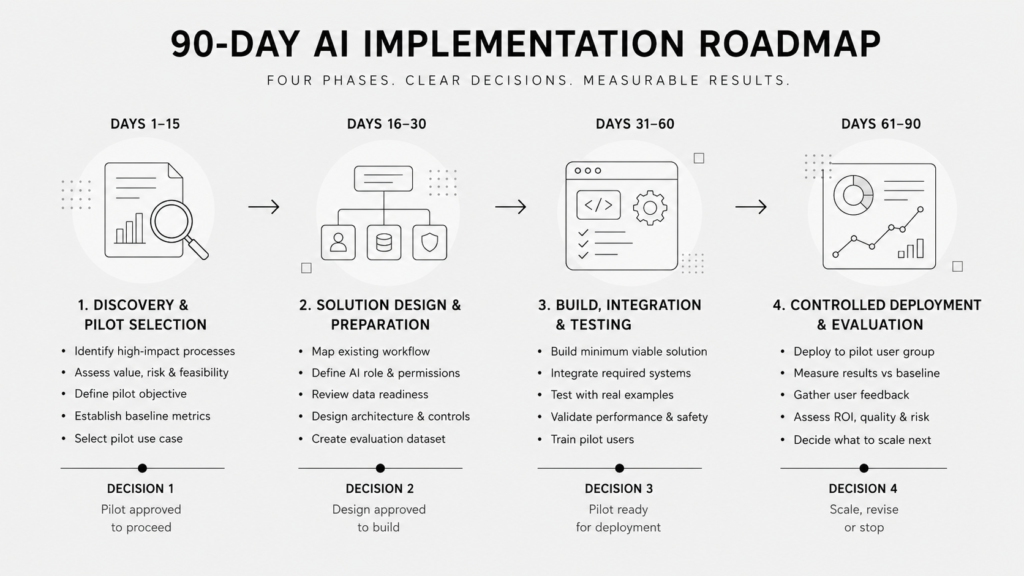
The 90-day AI implementation roadmap overview
Days 1–15: Identify the Right AI Pilot
The first two weeks should focus on understanding the business problem rather than selecting technology.
Step 1: List Repetitive or Expensive Processes
Start by identifying processes that consume significant time, create bottlenecks or depend on repetitive manual work.
Potential candidates include:
- Responding to frequently asked customer questions
- Extracting information from invoices or documents
- Preparing recurring management reports
- Classifying support tickets
- Drafting sales proposals
- Reviewing contracts against predefined criteria
- Summarizing internal documents
- Routing leads to the correct salesperson
- Checking orders for missing information
- Searching company policies and knowledge bases
Business owners should speak directly with the employees who perform these tasks. Management may see the final output, but frontline employees usually understand where the delays and errors occur.
Step 2: Score Each Use Case
Not every inefficient process is a good first AI project. Score each potential use case according to five factors:
| Factor | Question |
| Business value | Would improving this process materially reduce costs, increase revenue or improve service? |
| Repetition | Does the task occur frequently enough to justify automation? |
| Data availability | Does the business have the information needed to complete the task? |
| Risk level | Can mistakes be detected and corrected before causing serious harm? |
| Implementation difficulty | Can the pilot be completed without rebuilding several systems? |
The strongest first pilot usually has high business value, frequent usage, accessible data and manageable consequences when the AI makes a mistake.
Step 3: Avoid High-Risk First Projects
The first pilot should not make irreversible decisions without human oversight.
Avoid beginning with use cases that involve:
- Final hiring or dismissal decisions
- Unsupervised legal conclusions
- Medical recommendations
- Large financial transactions
- Autonomous access to sensitive production systems
- Decisions that affect regulatory compliance
- Public communication without approval
A lower-risk process allows the business to learn how the technology behaves before granting it greater authority.
Step 4: Define the Pilot Objective
The pilot objective must be measurable.
Weak objective:
Use AI to improve customer service.
Stronger objective:
Reduce the average time required to prepare an approved response to a customer support ticket from 12 minutes to 5 minutes while maintaining a quality score of at least 90%.
The objective should define:
- The process being improved
- The current baseline
- The desired improvement
- The acceptable quality level
- The users involved
- The pilot period
Deliverables by Day 15
By the end of the discovery phase, the business should have:
- One selected pilot use case
- A documented current workflow
- Baseline performance measurements
- A pilot owner
- A list of required systems and data
- Initial success criteria
- A preliminary risk assessment
Days 16–30: Design the AI Solution
The second phase converts the business objective into a practical system design.
Step 1: Map the Existing Workflow
Document how the process currently works from beginning to end.
For each stage, identify:
- Who performs the task
- What information they receive
- Which software they use
- What decisions they make
- Where delays occur
- What happens when information is missing
- Who approves the final output
This workflow map helps determine where AI should operate. In some cases, AI may complete the entire task. In others, it may only assist an employee by retrieving information, drafting an answer or recommending the next action.
Step 2: Decide the AI’s Role
The business should define exactly what the AI is permitted to do.
Common roles include:
Assistant: The AI produces a draft, summary or recommendation for a person to review.
Classifier: The AI categorizes information and sends it to the correct workflow.
Retriever: The AI searches internal data and returns relevant information.
Operator: The AI uses approved tools to complete actions across business systems.
Agent: The AI plans and executes several steps toward a defined objective.
For a first pilot, an assistant, classifier or retrieval system is often easier to control than a fully autonomous agent.
Step 3: Review Data Readiness
AI performance depends heavily on the quality and accessibility of company information.
The implementation team should determine:
- Where the required data is stored
- Whether records are complete and current
- Whether documents follow consistent formats
- Which employees may access the information
- Whether personal or confidential information is involved
- How the AI will receive updates
- Whether source documents can be cited or traced
A business may discover that its first AI challenge is not model selection but fragmented data.
If policies are scattered across emails, shared drives and outdated documents, the pilot may require a knowledge-cleanup phase before reliable retrieval is possible.
Step 4: Choose the Technical Approach
The appropriate architecture depends on the use case.
A simple pilot may use:
- An existing AI platform
- A workflow automation tool
- An application programming interface
- A secure company knowledge base
- A human approval step
A more advanced pilot may require:
- A retrieval-augmented generation system
- Custom integrations
- Tool-calling capabilities
- A permissions layer
- An evaluation framework
- A private or on-premise model
- Logging and monitoring infrastructure
Businesses should avoid unnecessary complexity. The objective is to solve the selected problem, not to build the most technically impressive system.
Step 5: Establish Permissions and Controls
The AI should receive only the access required to complete the pilot.
Define:
- Which data sources it may read
- Which systems it may update
- Which actions require approval
- Which users may access the pilot
- How credentials will be stored
- How activity will be logged
- How access can be revoked
For example, an AI sales assistant may be allowed to read product information and customer notes but prohibited from changing prices or sending proposals without approval.
Step 6: Create an Evaluation Dataset
Before development begins, collect examples of the task being performed correctly.
An evaluation dataset might include:
- Historical customer questions and approved answers
- Sample invoices and correctly extracted fields
- Past support tickets and correct classifications
- Company documents and expected search results
- Contracts and previously identified clauses
- Sales leads and the correct routing decisions
These examples provide a consistent way to test whether the AI is improving.
Deliverables by Day 30
By the end of the design phase, the company should have:
- A documented solution architecture
- Defined AI permissions
- A data-access plan
- Human approval points
- A representative evaluation dataset
- Security and privacy requirements
- A build plan for the next 30 days
Days 31–60: Build, Integrate and Test the Pilot
The next month focuses on creating the working pilot and connecting it to the business process.
Step 1: Build the Smallest Useful Version
The pilot should include only the functionality required to test the business hypothesis. For example, the first version of an internal knowledge assistant may:
- Search a limited collection of approved documents
- Answer questions from a small user group
- Cite the source of each answer
- Allow users to report incorrect responses
- Log questions and results
It does not initially need to connect to every department, support every document type or automate follow-up actions. Reducing scope makes it easier to identify why the pilot succeeds or fails.
Step 2: Connect the Required Business Systems
An AI system becomes useful when it can work with the tools employees already use.
Depending on the use case, integrations may include:
- Customer relationship management software
- Help desk platforms
- Accounting systems
- Document repositories
- Enterprise resource planning software
- E-commerce platforms
- Internal databases
- Communication tools
Integration should be controlled through clear permissions. The pilot should not receive broad administrative access simply because it is convenient during development.
Step 3: Test Against Real Examples
Run the pilot against the evaluation dataset created during the design phase.
Measure:
- Accuracy
- Completeness
- Consistency
- Response time
- Cost per task
- Failure rate
- Escalation rate
- Source reliability
Testing should include difficult examples, incomplete inputs and unusual situations—not only straightforward cases.
Step 4: Test Failure Scenarios
The team should deliberately test what happens when:
- Required information is missing
- The user asks an unrelated question
- Two data sources conflict
- The AI cannot access a system
- A tool returns an error
- The model generates unsupported information
- A user attempts to access restricted data
- The requested action exceeds the AI’s permissions
A reliable AI system is not one that never fails. It is one that fails safely, visibly and predictably.
Step 5: Add Human Review
Human review should be placed where the consequences of an error are highest.
A review workflow may require employees to:
- Approve AI-generated customer messages
- Confirm extracted financial figures
- Review recommendations before system updates
- Verify legal or compliance-related outputs
- Escalate low-confidence results
- Correct answers and provide feedback
The review process should not be treated as temporary friction. It generates valuable information about where the system needs improvement.
Step 6: Train the Pilot Users
Employees need to understand both the capabilities and limitations of the pilot.
Training should cover:
- What the AI is designed to do
- What it is not authorized to do
- How to provide effective input
- How to review outputs
- How to report errors
- When to ignore the AI and use the existing process
- How sensitive information should be handled
Poor adoption is often blamed on resistance to AI when the real problem is unclear workflow design.
Deliverables by Day 60
By the end of the build and testing phase, the business should have:
- A functioning pilot
- Required integrations
- Documented permissions
- Test results against the evaluation dataset
- A human-review workflow
- Error logging and feedback mechanisms
- A trained pilot group
Days 61–90: Deploy, Measure and Decide What to Scale
The final 30 days move the pilot into a controlled production environment.
Step 1: Begin With a Small User Group
The pilot should initially be used by a limited group of employees who understand the process and are willing to provide detailed feedback.
A controlled rollout reduces risk and makes it easier to identify:
- Incorrect outputs
- Workflow bottlenecks
- Missing information
- Integration failures
- Training gaps
- Unexpected user behaviour
- Security concerns
The pilot group should include both experienced employees and typical end users. Experts can evaluate quality, while regular users reveal whether the tool is practical.
Step 2: Compare Results With the Baseline
The business should compare pilot performance with the measurements collected during the first phase.
Relevant metrics may include:
- Time saved per task
- Cost per completed task
- Number of tasks completed
- Error rate
- Employee review time
- Customer response time
- Conversion rate
- Revenue generated
- Escalation rate
- User adoption
- User satisfaction
For example, suppose a business processes 2,000 support requests per month. If the pilot saves six minutes per request, it saves approximately 200 staff hours each month.
The financial calculation should also include the cost of:
- AI model usage
- Hosting
- Integrations
- Development
- Monitoring
- Human review
- Maintenance
- Security controls
The goal is to calculate the cost per successful business outcome—not merely the cost per AI request.
Step 3: Review Quality, Not Only Speed
A pilot that completes a process faster but creates more errors may not provide genuine value.
Quality measurements should examine:
- Whether the output is factually correct
- Whether company rules were followed
- Whether the result is complete
- Whether the source can be verified
- Whether employees frequently rewrite the output
- Whether customers notice a decline in service quality
AI should improve the overall process rather than simply shifting work from creation to correction.
Step 4: Gather Employee Feedback
Employees should be asked practical questions:
- Which tasks became easier?
- Which outputs required significant correction?
- When did employees stop trusting the system?
- Which information was frequently missing?
- Did the AI fit naturally into the workflow?
- What should be changed before broader deployment?
This feedback can reveal problems that performance dashboards do not capture. For example, the AI may produce accurate answers but require employees to copy information between several systems. The technical output may be correct while the user experience remains inefficient.
Step 5: Make a Scale, Revise or Stop Decision
At the end of 90 days, the company should make one of three decisions.
Scale
Scale the pilot when it demonstrates measurable value, acceptable quality, strong adoption and manageable risk.
The next phase may include:
- Adding more users
- Expanding the available data
- Automating additional steps
- Connecting more systems
- Reducing manual review for low-risk cases
- Applying the architecture to another department
Revise
Revise the pilot when the use case remains valuable but the implementation needs improvement.
Common reasons for revision include:
- Poor data quality
- Incomplete integrations
- Confusing user workflows
- Weak model performance
- Excessive manual review
- Inaccurate success criteria
The pilot may need a narrower scope or better source information rather than complete abandonment.
Stop
Stop the pilot when the measurable value does not justify its cost or risk. Ending an unsuccessful pilot is not necessarily a failure. The company has learned where AI is unsuitable, which assumptions were incorrect and what must change before another attempt. The purpose of a pilot is to create evidence before making a larger investment.
Suggested 90-Day AI Pilot Timeline
| Period | Main objective | Key output |
| Days 1–7 | Identify process problems | Initial use-case list |
| Days 8–15 | Select and define the pilot | Business case and baseline |
| Days 16–23 | Map workflows and data | Process and data requirements |
| Days 24–30 | Design the solution | Architecture and control plan |
| Days 31–45 | Build the first version | Functional prototype |
| Days 46–60 | Integrate and test | Tested pilot and trained users |
| Days 61–75 | Controlled deployment | Real-world usage data |
| Days 76–90 | Evaluate results | Scale, revise or stop decision |
How to Choose the Right First AI Use Case
The best first use case is rarely the largest or most ambitious opportunity.
A strong pilot usually has the following characteristics:
- A clear owner
- A measurable baseline
- Frequent task volume
- Accessible data
- A limited number of integrations
- Reversible actions
- Human reviewers
- A visible financial or operational benefit
One useful way to evaluate a pilot is:
Pilot priority = expected business value × implementation feasibility × data readiness
A project may have high theoretical value but still be a poor first pilot if it requires data from several disconnected systems or carries significant regulatory risk.
Who Should Be Involved in the AI Pilot?
Even a small AI implementation requires more than a technical team.
The pilot should usually involve:
Executive sponsor: Provides authority, budget and strategic direction.
Business process owner: Understands the workflow and is accountable for the result.
Technical lead: Builds or configures the solution and manages integrations.
Data owner: Approves access to the required information.
Security or compliance representative: Reviews permissions, privacy and operational risk.
End users: Test the solution in real working conditions.
A common mistake is allowing the technical team to define success without enough input from the people who perform the work. The business process owner should remain responsible for the outcome, even when an external AI consultant or agency builds the system.
How Much Should a First AI Pilot Cost?
The cost of a first pilot depends on its complexity. A basic pilot using an existing AI platform and limited workflow automation will cost less than a custom system involving several integrations, proprietary data and strict security controls.
The budget may need to cover:
- Discovery and process mapping
- Data preparation
- Software subscriptions
- Model or API usage
- Development
- System integration
- Testing
- Security controls
- Employee training
- Monitoring
- Ongoing support
Business owners should avoid evaluating the project based only on model usage fees. The model is often a relatively small part of the overall AI implementation budget. Integration, testing, permissions, evaluation and ongoing maintenance frequently determine whether the system becomes reliable enough for operational use.
Common AI Implementation Roadmap Mistakes
Starting With the Technology
Choosing a model or platform before defining the business problem often produces a solution looking for a use case. Begin with the workflow, baseline and expected outcome.
Attempting Too Much in the First Pilot
Trying to automate an entire department makes it difficult to identify which part of the system is creating value. Start with one process and one measurable objective.
Ignoring Data Quality
AI cannot consistently produce reliable results from outdated, contradictory or inaccessible information. Data readiness should be reviewed before development begins.
Giving the AI Excessive Access
Broad system permissions increase security and operational risk. Apply least-privilege access and require approval for consequential actions.
Measuring Activity Instead of Value
The number of prompts, users or generated documents does not prove business value. Measure time saved, revenue generated, cost reduced, quality maintained and successful outcomes completed.
Removing Humans Too Early
Human review provides both risk control and training data. Automation levels should increase only after the system demonstrates consistent performance.
Treating Deployment as the End
AI systems require ongoing evaluation because company information, user behaviour, software integrations and model performance can change. Monitoring and maintenance should be included in the roadmap from the beginning.
What Happens After the First 90 Days?
Once the pilot proves its value, the next stage is to build repeatable AI infrastructure.
This may include:
- Centralized identity and permissions
- Standard integration patterns
- Shared company knowledge
- Approved model providers
- AI usage policies
- Evaluation datasets
- Monitoring dashboards
- Cost controls
- Audit logs
- Reusable agent tools
- Employee training programmes
The company can then prioritize additional use cases based on the lessons from the pilot. A successful pilot may also reveal that several business processes depend on the same underlying capability.
For example, a reliable internal knowledge system could later support:
- Customer service
- Employee onboarding
- Sales enablement
- Compliance checks
- Technical support
- Management reporting
This is how a focused pilot can become the foundation for a broader AI strategy.
AI Implementation Roadmap Checklist
Before starting the pilot, confirm that the business can answer the following questions:
- What specific process are we improving?
- What is the current performance baseline?
- What result should the pilot produce?
- Who owns the business outcome?
- Which data does the AI require?
- Is that data complete and accessible?
- Which systems must be integrated?
- What is the AI allowed to do?
- Which actions require human approval?
- How will accuracy be tested?
- How will employees report errors?
- What will the pilot cost?
- How will financial value be measured?
- What conditions must be met before scaling?
If these questions cannot be answered, the business is not yet ready to begin development.
Build Evidence Before Expanding AI
The most effective AI implementation roadmap does not begin with a company-wide transformation. It begins with one operational problem, one accountable owner and one measurable objective.
Over 90 days, the business can identify a suitable use case, prepare its data, build a controlled pilot, test the system with real users and determine whether the result justifies further investment.
This approach reduces risk while creating something more valuable than a demonstration: evidence. Once the company understands what AI can reliably do within its own systems, data and workflows, it can expand with greater confidence.
AIMEC helps businesses identify high-value AI opportunities, design secure implementation roadmaps and build custom AI systems that integrate with existing operations. Start with a focused pilot, prove the business case and create a foundation that can scale.
Frequently Asked Questions
How long does AI implementation take?
A focused first pilot can often be designed, built and evaluated within approximately 90 days. More complex systems involving several integrations, sensitive data or autonomous actions may require a longer implementation timeline.
What is the first step in an AI implementation roadmap?
The first step is identifying a specific business process that AI may improve. The business should document the current workflow, establish a performance baseline and define a measurable pilot objective before selecting technology.
Which AI project should a business implement first?
The first project should have clear business value, frequent usage, accessible data and manageable risk. Document processing, internal knowledge retrieval, support-ticket classification and employee-assistance tools are often more suitable than high-risk autonomous decision-making.
Does a business need an AI strategy before starting a pilot?
A business needs clear principles around objectives, data, permissions and risk. However, it does not need to design its entire future AI architecture before testing one focused use case. A successful pilot can provide the evidence needed to develop a broader strategy.
How should AI pilot success be measured?
Success should be measured using operational and financial outcomes such as time saved, cost reduced, revenue generated, errors avoided, response times, adoption and output quality. Usage alone does not prove that the pilot created value.
Should a business build or buy its first AI solution?
The decision depends on the use case. Existing software may be sufficient for a standard workflow with limited customization. A custom solution may be more appropriate when the process depends on proprietary data, unique business rules, several integrations or strict privacy requirements.
When should an AI pilot be scaled?
A pilot should be scaled when it produces measurable business value, meets the required quality threshold, operates within acceptable risk limits and fits the employees’ workflow. Scaling should occur gradually, with monitoring and permissions maintained.

Steven Walgenbach is an AI Engineer specializing in AI agents, large language models, retrieval-augmented generation and business process automation. He designs and builds practical AI systems that connect with existing tools, data sources and workflows to help businesses reduce manual work, improve decision-making and scale more efficiently.
His work includes developing multi-agent systems, private and locally hosted AI solutions, custom knowledge assistants, SEO automation pipelines and LLM-powered applications using Python, LangGraph, CrewAI, the OpenAI Agents SDK and other modern AI frameworks.
Through AIMEC, Steven helps businesses move beyond AI experimentation and identify practical opportunities where artificial intelligence can deliver measurable operational and commercial value.