
For the past two decades, websites have largely been built around one primary user: humans. We optimized navigation for people. We designed product pages for people. We improved page speed, accessibility, and user experience because real users were browsing our websites, clicking buttons, and completing purchases. But what happens when AI agents become the users?
As an AI engineer and someone who has spent years building websites, automation systems, and content platforms, this question has been sitting in the back of my mind for months. It’s also something I’ve been discussing more frequently with clients as Google continues pushing deeper into AI.
When I first heard that Google had added an Agentic Browsing category to Lighthouse, I wanted to see whether it was simply another experimental feature or a genuine signal about where the web is heading.
So I downloaded Chrome Canary, ran the audit on my own website (AIMEC.io), and spent time digging through what Google was actually measuring.
What I discovered wasn’t just another performance report. It looked like a blueprint for how websites may need to operate in an AI-driven future.
Google added a new experimental “Agentic Browsing” audit to Lighthouse. While most website owners probably haven’t noticed it yet, I believe this could end up becoming one of the most important developments in technical SEO and ecommerce infrastructure over the next few years.
What’s particularly interesting is that the feature wasn’t available through my standard Chrome DevTools setup when I first tested it. To access it, I had to download Chrome Canary, Google’s experimental version of Chrome where upcoming features often appear before rolling out to the broader public.
The moment I saw “Agentic Browsing” sitting alongside Performance, Accessibility, SEO, and Best Practices inside Lighthouse, it became clear that Google is preparing for something much larger than another ranking update. They’re preparing for a web where AI agents interact directly with websites.
How I Tested Google’s Agentic Browsing Audit
If you’re curious to try it yourself, the process is relatively straightforward, although it did require using experimental software when I first tested it.
The first step was downloading Chrome Canary. Canary is essentially Google’s testing ground where new browser capabilities are introduced before eventually making their way into stable releases. You can download Chrome Canary here.
Once Chrome Canary was installed, I opened DevTools and navigated to the Lighthouse tab. That’s when the new category appeared.
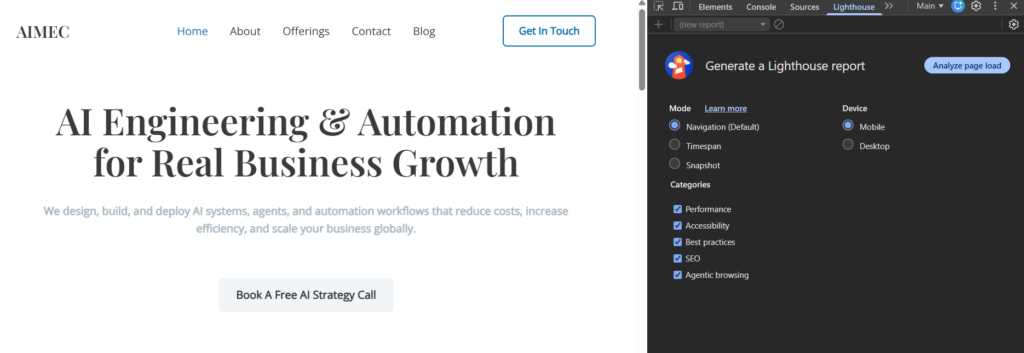
Screenshot of Lighthouse tab with new “Agentic Browsing” option
Alongside the familiar Lighthouse sections was a new audit focused entirely on agent readiness and machine interaction. Google describes the category as a way to evaluate how well a website is constructed for machine interaction rather than traditional human browsing alone.
One thing worth mentioning is that the Agentic Browsing audit was not selected by default in my setup. I had to manually select it before running the analysis.
After selecting the category, I clicked the “Analyze page load” button and allowed Lighthouse to begin the audit.
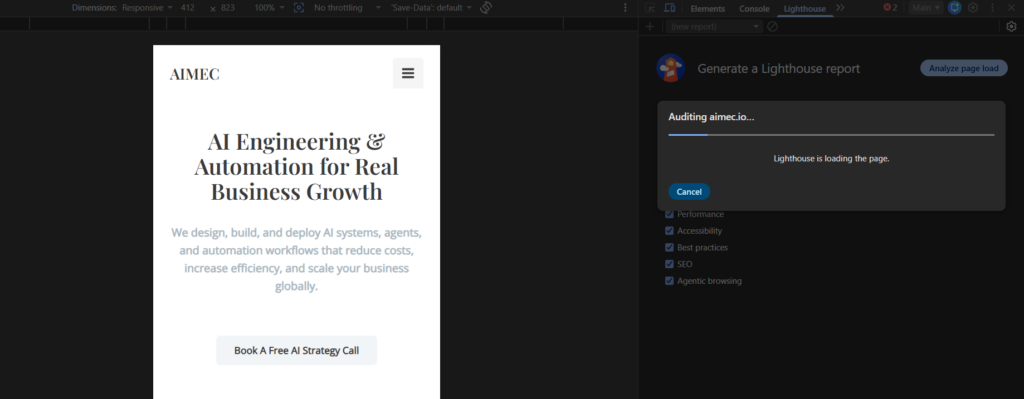
Screenshot of Agentic Browsing analysis running
The audit itself didn’t take very long. In my case, it completed in less than a minute. However, I suspect the duration will vary depending on the size and complexity of the website being analyzed.
Since AIMEC.io is still relatively new and doesn’t yet contain thousands of pages, the process was quite fast.
What AIMEC’s Results Revealed
Once the audit completed, I saw the familiar Lighthouse metrics that most website owners already recognize. However, there was one significant difference. A new Agentic Browsing score had appeared alongside the traditional Lighthouse categories.
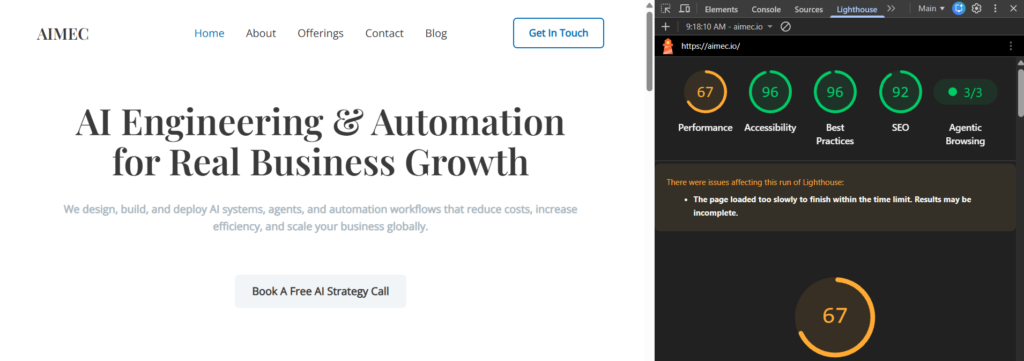
Screenshot of completed Lighthouse audit results
The results were fascinating. AIMEC received a Performance score of 67, which admittedly isn’t where I’d ultimately like it to be. However, the site performed very well across Accessibility, Best Practices, and SEO.
More importantly, it achieved a perfect 3/3 score for Agentic Browsing. At first glance, that may not seem particularly noteworthy. What stood out to me was that the Agentic Browsing score did not appear to correlate directly with traditional performance metrics.
In other words, Google appears to be evaluating something fundamentally different. Performance measures how efficiently a page loads. Agentic Browsing appears to measure whether an AI can successfully interact with that page. That distinction could become incredibly important over the next few years.
One Unexpected Discovery During Testing
One thing I noticed during testing was that browser extensions had a surprisingly large impact on the audit results. My initial scores were noticeably lower than expected. After some troubleshooting, I switched to Chrome’s Incognito Mode and reran the audit without extensions interfering in the background.
The results immediately improved. This is worth remembering if you’re planning to test your own website. If you’re evaluating agent readiness, you want to eliminate as many external variables as possible. Otherwise, you may end up troubleshooting issues caused by your browser environment rather than your website itself.
It’s a small detail, but it’s exactly the kind of thing that can lead to misleading results if you’re not aware of it.
What Surprised Me About the Lighthouse Agentic Browsing Results
When I first ran the audit, I expected Google to focus heavily on traditional technical SEO signals. Instead, the audit seemed far more concerned with whether an AI agent could reliably interact with the website.
The most interesting part wasn’t the 3/3 score. It was the categories Google chose to evaluate. The audit wasn’t asking: “Can Google rank this page?”
It was asking: “Can an AI successfully use this page?” That distinction may seem small today, but I suspect it will become increasingly important as AI agents move closer to mainstream adoption.
For years we’ve focused on helping search engines understand our content. Now Google appears to be asking whether autonomous systems can actually use our websites.
The Rise of the Agentic Web
The phrase “agentic web” is appearing more frequently across Google’s developer documentation, AI research discussions, and browser development projects.
The idea is simple in theory. Instead of humans manually navigating websites, AI agents increasingly perform tasks on their behalf.
Imagine telling an AI: “Find me the best gaming laptop under $1,500.” Or: “Book the cheapest flight for next weekend.” Or: “Order replacement inventory for my business.”
Rather than displaying links and asking users to complete every step themselves, AI agents could navigate websites, compare products, fill out forms, and complete actions automatically.
This is where things become particularly relevant for ecommerce businesses. If AI agents become responsible for product discovery, comparison shopping, and purchasing decisions, websites must become understandable not just to people, but to machines as well.
That appears to be exactly what Google is preparing for.
Why WebMCP Could Become the Most Important Technology Nobody Is Talking About
While reviewing the audit criteria and broader discussions around agentic browsing, one term kept appearing repeatedly: WebMCP. For ecommerce businesses, this may ultimately become the most important component of the entire agentic web movement.
WebMCP, or Web Model Context Protocol, is designed to help websites expose structured capabilities directly to AI systems. Imagine asking Gemini: “Buy me the cheapest replacement printer cartridge for my office.”
Without WebMCP, the AI has to visually inspect the website. It needs to identify buttons, forms, navigation elements, inventory indicators, and checkout workflows.
In other words, it has to behave much like a human user. With WebMCP, websites can expose those capabilities directly. Instead of trying to locate an “Add to Cart” button, the AI can trigger a structured action. Instead of visually checking inventory availability, it can request that information directly. Instead of guessing how a checkout process works, it can interact with predefined workflows.
It’s the difference between navigating a city using a paper map and using GPS coordinates. One requires interpretation. The other provides certainty. This is where agentic commerce starts becoming a very real possibility.
What Google’s Audit Is Actually Looking For
One of the most talked-about components of the audit involves a file called llms.txt. Most website owners have probably never heard of it before this year.
Google describes it as an emerging convention that provides a machine-readable summary of a website’s content and purpose. The goal is to help AI systems quickly understand what a site contains without needing to crawl every page individually.
However, it’s important to understand what llms.txt is and what it isn’t. Some people have already started treating it like the next SEO ranking hack.That is almost certainly the wrong approach.
Google’s John Mueller has publicly compared llms.txt to the old meta keywords tag. In other words, it may be useful for AI agents and browser-based systems, but it should not be viewed as a shortcut to ranking higher in Google Search.
The audit also evaluates several other areas that become incredibly important when machines are interacting with websites. Google is looking at accessibility tree quality, layout stability, WebMCP integration, and broader agent accessibility signals.
These may sound like technical concepts, but they all revolve around one central question: Can an AI reliably understand and interact with your website?
Why Layout Stability Suddenly Matters Even More
One interesting thing I noticed while digging deeper into the audit documentation was the emphasis placed on layout stability. At first, this may seem strange. Why would an AI care if a button moves slightly when a page loads? Humans adapt easily. If an advertisement loads and pushes a button 20 pixels lower on the screen, most users won’t even notice.
AI agents operate differently. An agent may identify a target button at one moment and attempt to click it milliseconds later. If the layout shifts during that time, the button may no longer be where the AI expects it to be. The result? The AI clicks the wrong button, triggers the wrong action, or breaks the workflow entirely.
What feels like a minor annoyance for a human can become a complete failure for an autonomous system.
Why Ecommerce Businesses Should Take This Seriously
Many ecommerce brands still view AI through the lens of content generation. They think about ChatGPT writing product descriptions or generating marketing copy. But I think the much bigger shift is happening elsewhere.
The real disruption could come from how products are discovered and purchased. Imagine a customer telling an AI assistant: “Find me the best running shoes under $120 with fast shipping.”
The AI doesn’t necessarily need to send the customer to Google Search. It doesn’t necessarily need to send them to your homepage. It may compare dozens of stores, evaluate products, make recommendations, and eventually complete the purchase on behalf of the user.
If that becomes the dominant behavior, websites that are difficult for AI agents to navigate could become increasingly disadvantaged.
This is why Google’s Agentic Browsing audit feels so significant. It isn’t measuring content quality. It’s measuring machine usability. And this could become an entirely new competitive battleground.
The New SEO May Be Agent Optimization
For years we’ve optimized websites for three audiences:
- Search engines
- Human visitors
- Crawlers
The next decade may introduce a fourth audience: AI agents. An AI agent doesn’t care about flashy animations or clever design tricks.
It cares about predictable interfaces, machine-readable content, reliable workflows, structured actions, and stable layouts. This creates an entirely new optimization layer. Not SEO. Not UX.
Something closer to Agent Experience. Whether the industry eventually adopts that term remains to be seen, but the concept is becoming increasingly difficult to ignore.
What Website Owners Should Be Doing Right Now
There’s no reason to panic. Google has not indicated that Agentic Browsing audits are currently ranking factors, and many of the standards involved remain experimental.
However, I do think smart businesses should begin paying attention. Testing the audit yourself is a good starting point. Website owners should also continue investing in accessibility, semantic HTML, structured content, stable page layouts, machine-readable architecture, and emerging protocols such as WebMCP.
Even if some of today’s standards evolve, the broader direction feels increasingly obvious. AI agents are becoming first-class users of the web. The websites that prepare for that reality early may find themselves ahead of competitors when the technology reaches mainstream adoption.
Final Thoughts
After running Google’s Agentic Browsing audit on AIMEC.io, my biggest takeaway wasn’t the score itself. It was the realization that Google is beginning to evaluate websites from the perspective of a completely new type of user.
Not a human. Not a crawler. An AI agent. The audit is still young. The standards will evolve. Some of the technologies involved may change entirely. But Google’s direction feels increasingly clear.
The company is preparing for a future where AI agents browse, evaluate, compare, and transact across the web on behalf of users. Whether that future arrives in two years or ten years remains to be seen. But after testing the audit firsthand, I am convinced of one thing: The websites that start preparing today will be far better positioned when that future arrives.

Steven Walgenbach is an AI Engineer specializing in AI agents, large language models, retrieval-augmented generation and business process automation. He designs and builds practical AI systems that connect with existing tools, data sources and workflows to help businesses reduce manual work, improve decision-making and scale more efficiently.
His work includes developing multi-agent systems, private and locally hosted AI solutions, custom knowledge assistants, SEO automation pipelines and LLM-powered applications using Python, LangGraph, CrewAI, the OpenAI Agents SDK and other modern AI frameworks.
Through AIMEC, Steven helps businesses move beyond AI experimentation and identify practical opportunities where artificial intelligence can deliver measurable operational and commercial value.