
Artificial intelligence can turbocharge productivity, but C-suite leaders know that speed alone doesn’t equal success. The true business value of AI automation lies in tangible outcomes – stronger profits, higher lead conversion, and improved efficiency – not just doing the same work faster.
In this guide, we’ll explore how CFOs, founders, and operations directors can measure the ROI of AI in real business terms. We’ll move beyond generic “productivity” gains and focus on EBITDA impact, lead generation improvements, and other measurable uplifts that matter to the bottom line.
Let’s dive into frameworks and examples that show how AI automation translates into real dollars-and-cents value, all in an informative (and conversational) tone suited for busy executives.
Beyond Productivity – Defining Modern AI ROI

It’s tempting to evaluate AI simply by how much faster it completes tasks.
However, AI can definitely make work faster, but faster doesn’t mean ROI. In practical terms, modern AI ROI is defined by business uplift – metrics like increased web traffic, more qualified leads, higher conversion rates, and lower cost-per-lead or cost-per-outcome. These indicators tie directly into revenue growth and profitability, which matter far more to a CFO than raw speed.
For example, if an AI-driven sales chatbot generates extra revenue, that’s a clear ROI signal. Similarly, if AI content generation lowers your cost per qualified lead – say, by producing marketing content that attracts the same leads with less spend – those savings hit the EBITDA line by reducing acquisition costs.
In short, executives should frame AI ROI in terms of outcomes that impact the P&L. Did automated processes increase sales conversion by 5%? Did they reduce cost-per-lead by 20%? Are they boosting customer retention or average order value? These are the questions that define modern AI ROI.
Hard ROI refers to measurable business outcomes that can be directly traced to AI – improvements in conversion rates, revenue growth, customer retention, etc. These are tangible results that should be measured with rigor.
By focusing on those metrics (instead of just tasks completed faster), executives can ensure AI investments are aligned with real business value.
The Impact Chaining Framework
Measuring ROI gets tricky when AI’s influence is indirect or spread across a process.
Enter the “impact chaining” framework – a method to trace how a single automated output ripples through to downstream business value. In practice, impact chaining means mapping each step of a process to the next, to see where and how AI adds value along the chain.
How does this look in a real scenario? Imagine an AI tool that automatically drafts sales emails. The first-order impact is time saved for your sales reps. Impact chaining pushes you to follow the thread: those faster emails (first output) lead to quicker follow-ups (next step), which lead to more prospects engaged per week (next outcome), which ultimately could yield more conversions or deals closed (final business value). By charting each link, you can attribute value to the AI at each stage – e.g., AI drafting saved 2 hours of rep time per day, enabling 5 extra client calls per week, resulting in 2 extra deals per month. This chain connects the AI’s action to revenue.
To implement this, companies often use a tagging or attribution framework. For instance, tagging each stage in a workflow as machine-generated vs. human-generated. This way, when analyzing outcomes, you can see which parts were automated and measure the impact of those parts.
Such an approach prevents over- or under-crediting AI for results; it highlights exactly where automation provided a boost and where human input was still essential. For CFOs, this level of attribution is gold – it shows which links in your process chain benefit from AI and quantifies that benefit in business terms.
In summary, the impact chaining framework helps answer the tough question: “How exactly did this AI tool contribute to our bottom line?” By tracing cause-and-effect from an AI output to a business outcome, you create a clear line of sight from automation to ROI. This is crucial for complex processes where AI might be one of many contributors to success.
It ensures nothing falls into a blind spot – if an automated step accelerates the process (say, faster data analysis) which then enables another benefit (faster decisions, leading to cost savings), impact chaining will capture that. For executives, it means AI’s value is transparently accounted for at each step of the value chain.
Calculating Productivity Uplift
One of the most immediate ways AI shows ROI is by boosting employee productivity.
Calculating that gain starts with a simple measurement: How long did a task take before vs. after automation? If an AI tool automates a reporting task that used to take an analyst 5 hours a week, that’s 5 hours regained.
Multiply that by the analyst’s hourly cost, and you have a direct labor cost saving. More strategically, those freed hours can be redirected to higher-value activities (the stuff humans do best), effectively increasing your team’s output without adding headcount.
To quantify productivity gains, consider both time and output. For example, at a law firm that adopted an AI research assistant, attorneys reported roughly 10% more capacity without adding staff – freeing up to 12 hours per lawyer each week that they could spend on billable work or new cases.
That “capacity released” can be converted into ROI by calculating the additional revenue those lawyers generate (or the cost of an additional hire you didn’t need to make). Similarly, if a customer support AI handles routine inquiries, measure how many tickets an agent can handle now versus before. If AI allows each agent to handle 30% more cases, you might need fewer agents for the same volume (cost saving) or can handle more customers with the same team (revenue growth through better service).
Importantly, the gain isn’t just about quantity of work – quality improvements count too. In other words, an AI might save you time and reduce errors or rework (which saves money and boosts customer satisfaction). Fewer errors might mean fewer customer refunds or less time fixing data issues – these are real ROI contributors through cost avoidance.
To robustly calculate the gain, executives should:
- Baseline the manual process: Document how long tasks take and any output metrics (e.g. 10 reports/week, 5 errors/week) before AI.
- Measure the AI-assisted process: After implementation, track the same metrics (now perhaps 15 reports/week, 1 error/week).
- Calculate the delta per FTE: e.g., “AI saves 3 hours per task for our analyst, which at $50/hour is $150 saved per task, and we do 10 tasks a month = $1,500 saved/month per analyst.”
- Convert to business value: Those 3 hours saved could be used on revenue-generating tasks – if they produce an extra $1,500 in value elsewhere, that’s additive. Or if 3 hours saved means an employee can handle 20% more workload, you might avoid hiring an extra person, saving salary costs.
By quantifying time saved, error reduction, and increased throughput, you arrive at a “capacity released per FTE” figure. This directly ties to ROI: time is money, after all.
That neatly encapsulates productivity gain: do the same or more with less. Just remember to widen the lens beyond raw hours – include improvements in quality and speed-to-market (e.g., delivering a project 2 weeks sooner thanks to AI could mean earlier revenue recognition, a value often overlooked). Modern ROI calculations for AI blend efficiency gains with quality gains, since both ultimately improve financial performance.
AI Implementation Costs vs. Long-Term TCO
Of course, ROI isn’t just about benefits – you must account for costs. A common pitfall is underestimating the total cost of ownership (TCO) for AI solutions. Beyond initial development or software fees, AI incurs ongoing costs in infrastructure and oversight that CFOs need to factor into ROI calculations.
What does that include? Everything from integration work, data preparation and labeling, model training fees, cloud compute costs, vendor or API fees, ongoing monitoring, and even the people managing the change. In short, the true cost of an AI project spans the full lifecycle – pilot to production to maintenance.
Let’s break down some key AI cost components you should tally up:
- Infrastructure & Compute: Cloud server costs or on-prem hardware for model training and deployment (AI models, especially large ones, can be computationally intensive – meaning higher cloud bills).
- Data Preparation: The labor (or outsourcing) for cleaning data, labeling datasets, and integrating AI with existing systems. These upfront costs can be significant.
- Software & Model Fees: Subscription costs for AI platforms, API usage fees (e.g. paying per API call or per 1,000 predictions), and license fees if using third-party models. Some vendors charge usage-based fees which scale with volume.
- Human-in-the-Loop Oversight: Salaries or time for staff who review AI outputs, handle exceptions, or maintain the system. For example, if you need a data scientist to tweak models monthly or an editor to review AI-generated content, that’s an ongoing cost.
- Monitoring & Maintenance: Costs for tracking model performance, detecting issues like drift or errors, and retraining models periodically. This could include additional tooling or analytics platforms to monitor AI outcomes.
- Change Management & Training: Investing in training employees to work effectively with the AI, and change management efforts to drive adoption. If employees aren’t using the AI, the ROI will be zero, so driving usage is part of the cost of realizing ROI.
All those pieces roll up into your AI project’s TCO. To accurately measure ROI, subtract the TCO from the total financial benefit realized by the AI.
Some companies use a formula like ROI = (Δ Revenue + Δ Gross Margin + Avoided Cost) – TCO. In plain language: (increase in income + savings from cost cuts) minus all the costs to achieve those gains. A positive result means a net return; negative means you’re underwater.
The risk-adjusted part is interesting – it acknowledges that AI can introduce new risks or quality issues that carry costs. For example, if an AI copywriting tool occasionally produces a blunder that legal or PR teams must intervene on, that intervention time is a cost. Some firms even discount expected ROI by metrics like hallucination rate or error rate to stay realistic. It’s a conservative approach that CFOs appreciate, ensuring the promised ROI isn’t overstated.
Executives should also consider the time horizon and payback period. Many AI projects aim for a quick payback. Most companies we’ve worked with set a payback target under two quarters (6 months) for operational use cases – i.e., they expect the AI’s savings/revenue to recoup its cost within half a year. More strategic, large-scale AI platforms (like developer productivity tools) might get a year to pay back. These timelines are useful benchmarks for planning and for board expectations.
Finally, recognize that AI shifts cost structures in ways that may require new budgeting models. Traditional enterprise software had high upfront development costs but low marginal costs per use.
AI flips that: it can be cheap to start (you can spin up a cloud AI service quickly) but operational costs scale with usage (each additional prediction or user query might incur incremental cost). This has led to new pricing and cost models – for instance, usage-based or outcome-based pricing for AI services, where you pay per transaction or success rather than per seat.
As a leader, when evaluating ROI, consider if an AI project’s cost will grow with usage, and ensure the benefits scale at least as fast as the costs. The key is to avoid getting surprised by ballooning variable costs that erode ROI over time.
In summary, a rigorous ROI analysis for AI must capture the full TCO – including ongoing operational expenses – and weigh them against the realized gains. By doing so, you’ll have a clear view of net value. And if the ROI still looks strong after accounting for everything (often it will, when AI is applied smartly), you can green-light projects with confidence and set proper expectations for returns.
Industry-Specific ROI Benchmarks
AI automation doesn’t deliver value in a vacuum – its ROI can vary by industry and use case. Let’s look at a few industries to see the typical ROI figures businesses are reporting from AI initiatives.
Manufacturing

In manufacturing, AI is driving substantial returns by optimizing operations.
Manufacturers have seen ROI in the range of 200–400% for projects like predictive maintenance, quality inspection, and supply chain optimization.
Specific use cases shine
AI-powered predictive maintenance (using sensors and ML to predict equipment failures) often delivers about 300–500% ROI by slashing unplanned downtime.
Meanwhile, computer vision quality control systems can yield 200–300% ROI through defect reduction and faster throughput (fewer faulty products and less manual inspection). AI-driven inventory and supply chain optimization have been noted to generate 150–250% ROI via leaner inventories, fewer stockouts, and lower carrying costs.
These numbers illustrate that in an industry with slim margins, AI can significantly boost efficiency and cost savings, directly impacting the bottom line.
Legal Services

The legal sector, historically labor-intensive, is seeing AI turn into a force multiplier.
Law firms that embrace AI report ROI that outpaces peers by nearly 4x. Firms with active AI strategies have also achieved 3.9× higher ROI than those without AI. Where do the gains come from? Primarily efficiency in research and drafting.
For example, advanced legal AI assistants can perform document review 63% faster than traditional methods, while also doubling the rate of relevant case discovery for lawyers. This translates into lawyers handling more cases or clients in the same amount of time – effectively scaling revenue without equivalent cost increase.
Indeed, small and mid-sized firms have noted that AI’s “productivity multiplier” lets them take on more work and generate more billings without a proportional rise in overhead. Another concrete stat: one firm’s use of AI research tools freed up 12 hours per week per attorney (previously spent on grinding research) – time that can now go into serving additional clients.
The result is higher revenue and profit per lawyer, yielding clear ROI even after the software costs. For legal ops, AI also reduces mundane admin, potentially cutting support staff hours (or allowing those staff to focus on higher-value activities like client service). All told, the legal industry’s early adopters are proving that AI can significantly improve utilization and firm profitability, which is ROI any partner can appreciate.
Marketing & Sales

Marketing was one of the earliest domains to embrace automation, and AI is taking it to the next level.
The ROI from AI-driven marketing automation is often quantified as return on ad spend or cost per lead improvements. Across industries, companies on average get about $5.44 in revenue for every $1 spent on marketing automation – a 444% ROI in broad terms. AI enhances this by making campaigns smarter and more targeted.
For instance, personalization algorithms can boost customer engagement and sales – personalized content recommendations can increase revenue by 10–15% according to industry data.
At the same time, AI tools for lead scoring and ad optimization help marketing teams focus on the best prospects, resulting in higher conversion rates and less waste. Businesses using AI in marketing have reported dramatic efficiency gains, such as significantly lowering the cost per customer acquisition (one report noted cost per prospect reduced on the order of 4×) while improving lead quality by 40%.
Additionally, automation of routine marketing tasks (email sends, social media scheduling, basic customer inquiries via chatbots) can save 20+ hours per week for team members, which either reduces labor costs or frees marketers to focus on strategy and creative work that drives growth. In sales, AI-driven outreach and CRM automation similarly can increase lead conversion and reduce time-to-close. The key takeaway for marketing and sales is that AI not only cuts costs (through efficiency) but often directly boosts revenue metrics (more leads, higher conversion and lifetime value), delivering a compelling ROI that shows up in top-line growth.
These industry snapshots show that while AI ROI ultimately boils down to higher revenue, lower costs, or both, the way those gains manifest can differ. Manufacturing sees ROI in operational efficiencies and uptime; legal in time saved and capacity increased; marketing in better targeting and personalization leading to sales.
As an executive, benchmarking against your industry can help set realistic expectations (e.g., if peers get 3× ROI in a certain use case, that’s a good target). It also helps identify where AI might deliver the most bang for your buck. For example, if you’re a manufacturer not yet using predictive maintenance AI, the fact that others get 300%+ ROI there is a strong signal to explore it.
Conclusion: Turning AI Metrics into Business Value
Measuring the ROI of AI automation is indeed more complex than tallying hours saved.
But by focusing on the metrics that matter to your business – conversion rates, cost per outcome, uptime, customer satisfaction, etc. – you ensure that “ROI” isn’t just a buzzword but a quantifiable increase in business performance.
Use frameworks like impact chaining to attribute value along the process, and insist on comprehensive cost accounting (TCO) so your ROI figures are grounded in reality. Remember, an AI project is only as good as its adoption: ROI can’t be realized if people don’t use the tool. So part of the value equation includes driving cultural buy-in and usage (sometimes called “squishy ROI” like employee sentiment) which eventually enables the hard ROI to materialize.
For C-suite leaders, the mandate is clear: treat AI investments with the same rigor as any other capital project. Define the success metrics upfront (e.g. reduce cost per lead by 15%, improve gross margin by 2 points, save 500 man-hours/quarter), baseline where you are, and track the impact of AI on those metrics.
If something isn’t delivering, you’ll see it in the numbers and can adjust or redeploy resources. Conversely, when an AI initiative knocks it out of the park – say it generates a surge in qualified leads at half the usual cost – you’ll have the data to prove it and the confidence to scale it further.
In the end, AI automation ROI is about business outcomes, not tech for tech’s sake. By looking beyond mere productivity and focusing on how automation drives profit and growth, executives can cut through the hype and zero in on the initiatives that truly move the needle.
The result? Investments that pay for themselves many times over – and a business that’s not just faster, but better in ways your CFO and stakeholders will applaud. Here’s to making AI an EBITDA booster and a lead generation engine, not just a fancy new tool in the IT department. Measure what matters, and the ROI of AI will become crystal clear in your balance sheets and KPIs.
Real-World Examples
Automated Editorial Team
We recently built a full-stack automation system for a digital news outlet whose workflow required constant monitoring of platforms like X, Reddit, and other news sources, rapid article drafting, meticulous editing, link insertion, and publishing—all under intense time pressure to maintain content quality while staying ahead of competitors.
When they brought us in, we broke up their workflow into three core stages: real-time news sourcing, article generation (including link placement), and automated editing before handing the content to a human editor for final approval.
Our system was able to gather all relevant breaking news across platforms in just 5–10 minutes. A human editor would then use a simple yes/no screener to decide which stories should be written.
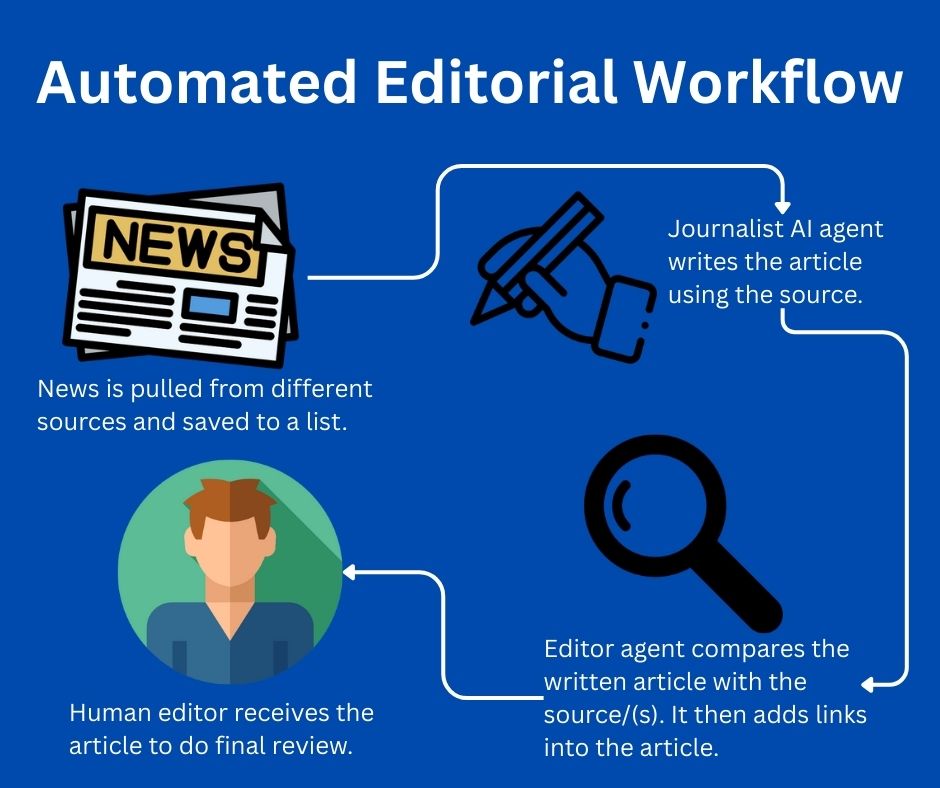
After selection, the system generated each article at a steady pace of roughly one article per minute (a deliberate throttle to stay within OpenAI and Gemini API limits). Once drafted, an editor agent compared the generated article to the original source material to catch any hallucinations, factual inaccuracies, or grammatical issues. It logged its findings, published the polished draft to Google Docs, and notified the human editor.
With throttling enabled, the system produced triple the article throughput of a seven-person newsroom. Journalist workloads dropped significantly—editors only needed to review and enhance articles—resulting in a 50% reduction in operational costs.
After further review, we found that the system could run almost entirely autonomously with only a single human editor overseeing output, reducing overall costs by up to 90%. While the workflow currently depends on several third-party services, there are clear paths to minimizing or replacing these dependencies over time.
AI-Powered Market Analysis Team
We partnered with an investment-focused client who needed a unified system capable of monitoring and analyzing global markets across equities, commodities, crypto, FX, and emerging digital assets. Their objective was clear: identify volatility early, pair it with real-time fundamental insights, and execute trades autonomously with minimal human supervision.
To achieve this, we built an integrated market-intelligence and automated-trading platform. The system continuously scanned thousands of trading pairs and instruments across multiple asset classes, ranking them by volatility, liquidity, and unusual market behavior. It then overlaid this data with real-time fundamental signals—including earnings reports, macroeconomic updates, and breaking news—to determine which assets warranted immediate attention.
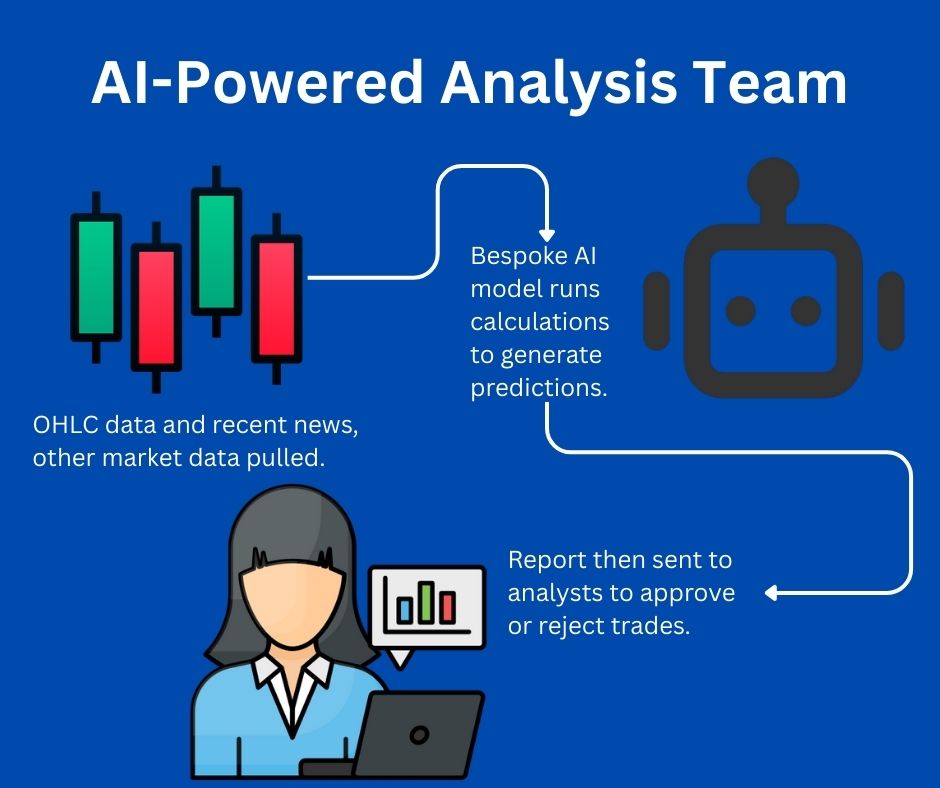
Once high-opportunity setups were identified, the system generated trade theses, assessed risk, and executed orders automatically based on pre-defined strategies and confidence thresholds. All decisions were logged and paired with the underlying market rationale, giving human supervisors full transparency into why each trade was taken.
The trading engine operated around the clock, adapting instantly to changing market conditions—something human traders could never match at scale. It continuously recalibrated its strategy based on live performance data, macro shifts, and updated fundamentals, ensuring it remained aligned with market reality rather than static assumptions.
The results were substantial. The system consistently surfaced high-volatility, high-opportunity setups faster than human analysts could, reducing research time by over 80%. It also executed trades at a speed and frequency impossible for manual teams, enabling the client to capture opportunities in equities, commodities, and crypto markets simultaneously.
From an efficiency standpoint, the platform automated nearly the entire research and execution pipeline. Analysts only needed to review strategy reports and performance summaries, allowing the client to reallocate staff to higher-value tasks while the system handled continuous market surveillance and autonomous trading.
In short, the solution delivered a scalable, multi-asset trading intelligence engine that combined quantitative and fundamental analysis—while operating with virtually zero downtime. It gave the client a competitive edge in markets where speed, insight, and adaptability determine performance.
Unlock Real ROI With AI That Actually Moves the Needle
If you’re ready to turn AI from an experiment into a measurable profit driver, our team can help. We build custom AI systems, automate complex workflows, and offer pre-built AI agents that deliver results from day one.
Let’s build your next competitive advantage.
Frequently Asked Questions
What tools can measure the ROI of AI initiatives?
Several tools help quantify AI ROI across operations, marketing, finance, and engineering. Popular options include analytics suites like Tableau, Power BI, Looker, Databricks, Snowflake, and HubSpot (for marketing/sales ROI).
AI-specific monitoring platforms such as Weights & Biases, Arize AI, Fiddler AI, and MLflow track performance, drift, and prediction accuracy—critical inputs for ROI calculations. Many companies also build custom ROI dashboards that tag machine-generated outputs, making it possible to measure revenue uplift, cost savings, and performance improvements directly attributable to AI.
How do you measure the ROI of AI in operations?
Operational ROI focuses on efficiency, throughput, and cost reduction. Start by baselining the manual process (time, cost, volume). Then measure the AI-assisted process and calculate:
ROI = (Hours saved × Fully loaded hourly rate) + (Throughput increase × business value per unit) – AI TCO.
Executives also measure reductions in error rates, downtime, defect rates, and time-to-completion. For example, if AI accelerates operational workflows by 30% while cutting rework by half, both the time saved and quality improvements contribute to real ROI.
How do you measure the ROI of AI adoption?
AI adoption ROI is measured by comparing business outcomes before vs. after implementation. This includes productivity gains, revenue improvements, cost avoidance, faster decision-making, reduced headcount requirements, and higher customer satisfaction.
The most reliable method is impact chaining—tracing how an AI action (e.g., automated insight, draft, or prediction) triggers downstream business value. Tagging workflows as AI-generated vs. human-generated creates a clear attribution path, allowing executives to quantify how AI changed the outcome.
What’s the ROI of GPU-powered AI systems?
GPU-powered AI systems offer strong ROI when workloads involve heavy computation—large-model inference, training, financial modeling, simulations, or real-time analytics.
ROI is calculated by measuring the performance gain per dollar spent. For example, if GPU clusters accelerate model training from 12 hours to 1 hour, the time saved translates directly into faster deployment cycles, lower cloud cost per experiment, and greater organizational agility. Many enterprises see 2–5× ROI from GPU adoption, especially for high-volume inference or generative AI workloads.
How to measure the ROI of AI in knowledge management?
Knowledge-management ROI focuses on how AI improves information retrieval, decision support, and institutional knowledge reuse. Key metrics include:
- Reduced time spent searching for information
- Fewer duplicate efforts
- Faster onboarding and training
- Improved decision accuracy
- Reduced dependency on human SMEs
Executives quantify the ROI by calculating hours saved per employee per week, multiplying by fully loaded labor cost, then subtracting AI system expenses. If AI reduces search time from 5 hours to 1 hour per week for a 200-person team, the productivity savings are enormous—and measurable.
How to measure the ROI of AI adoption?
The most accurate method is to define clear business metrics upfront: cost per lead, conversion rate, uptime, cost per ticket, revenue per rep, or man-hours saved. Then baseline performance before AI, compare after AI deployment, and factor in total cost of ownership. Successful measurement blends:
- Hard ROI (revenue uplift, cost reduction)
- Soft ROI (employee satisfaction, faster decision-making)
- Risk-adjusted ROI (error reduction, quality improvements)
Impact chaining is the gold standard for isolating AI’s contribution at each step.
What is the ROI of using AI for SEO tasks?
AI delivers ROI in SEO by increasing content output, search visibility, ranking velocity, and reducing content production costs. AI-powered SEO tools can:
- Reduce content creation time by up to 80%
- Increase organic traffic through better optimization
- Lower cost-per-article and cost-per-lead
- Identify high-impact keywords faster
ROI can be measured as (Traffic increase × value per organic visitor) + (Content cost savings) minus tool and compute costs. Many businesses report 300–500% ROI from AI-driven SEO workflows because organic traffic compounds over time.

Steven Walgenbach is an AI Engineer specializing in AI agents, large language models, retrieval-augmented generation and business process automation. He designs and builds practical AI systems that connect with existing tools, data sources and workflows to help businesses reduce manual work, improve decision-making and scale more efficiently.
His work includes developing multi-agent systems, private and locally hosted AI solutions, custom knowledge assistants, SEO automation pipelines and LLM-powered applications using Python, LangGraph, CrewAI, the OpenAI Agents SDK and other modern AI frameworks.
Through AIMEC, Steven helps businesses move beyond AI experimentation and identify practical opportunities where artificial intelligence can deliver measurable operational and commercial value.