
Generating leads is rarely the biggest problem in sales. The harder problem is figuring out which leads are actually worth pursuing. A sales team might have hundreds or thousands of companies sitting in a spreadsheet, CRM, prospecting platform, or search result. Someone still has to determine whether those companies fit the ideal customer profile, whether they have a genuine business need, whether there are signs of buying intent, and what approach is most likely to start a conversation. This is where AI lead qualification becomes useful.
Instead of relying entirely on static scoring rules or having salespeople manually research every company, AI agents can research prospects, gather evidence, evaluate opportunities against predefined criteria, and recommend what should happen next.
I have experimented with several versions of this approach, including a workflow that connects a SERP API directly to an AI agent. What makes these systems interesting is that AI does not have to simply score an existing list of leads. It can participate in the entire process of finding, researching, qualifying, prioritizing, and preparing leads for outreach.
What Is AI Lead Qualification?
AI lead qualification is the use of artificial intelligence to determine how closely a prospect matches a company’s target customer profile and how likely that prospect is to represent a worthwhile sales opportunity.
Traditional qualification might rely on factors such as:
- Company size
- Industry
- Location
- Job title
- Revenue
- Form submissions
- Email engagement
AI allows that process to become much more contextual. An AI system can examine a company’s website, search results, hiring activity, technology changes, recent news, business expansion, content strategy, and other signals before forming an opinion about the opportunity.
The important distinction is that the AI can evaluate evidence, not just database fields. For example, two companies might both have 100 employees and operate in the same industry. One may have no obvious requirement for your service.
The other might have just advertised several AI-related positions, launched a digital transformation initiative, expanded into a new market, and published a job listing describing a manual business process your company could automate.
On paper, they look similar. From a sales perspective, they are very different leads. This difference is where AI becomes particularly valuable.
How I Connected a SERP API to an AI Agent for Lead Research
One approach I have used is connecting a SERP API to an AI agent. SERP API provides structured search engine results programmatically. Instead of somebody manually opening Google, searching for companies, clicking through results, and copying information into a spreadsheet, an agent can perform those steps as part of an automated workflow.
A simplified version looks like this:
Sales objective → AI agent → search queries → SERP API → company research → qualification → recommended next actionSuppose I want to identify companies that might benefit from AI automation. Instead of searching for a broad term, the agent can generate searches related to specific signals.
It could investigate companies that are:
- Hiring automation specialists
- Recruiting AI engineers
- Expanding operational teams
- Implementing new enterprise software
- Discussing digital transformation
- Experiencing obvious workflow inefficiencies
- Investing in AI initiatives
- Expanding into new markets
The SERP API returns the search results, after which the agent can inspect the available evidence. It can then research the company and answer questions such as:
- Does this company fit our target market?
- What evidence suggests it might need our service?
- What problem could we potentially solve?
- How strong is the evidence?
- How recent is the signal?
- What should the salesperson research next?
That last point is important. An effective AI qualification system should not simply output: Lead score: 82/100. It should explain why the lead received that score.
AI Lead Qualification Should Be Evidence-Based
One of the principles I have used when designing lead research workflows is separating verified information from assumptions. AI models are very good at making connections between pieces of information. This ability is useful for sales research, but it can also become dangerous if the system starts treating reasonable assumptions as established facts.
A qualification agent might find that:
- A company is hiring AI engineers.
- It recently expanded.
- Several operational positions are open.
- Its website discusses digital transformation.
The agent can reasonably identify this as a potentially interesting lead.
But it should not conclude: This company is currently looking for an AI automation agency. unless there is actual evidence supporting that statement. A better qualification report would say:
Observed signal: Company is hiring two AI engineering positions.

Possible implication: The company appears to be increasing its investment in internal AI capabilities.

Potential opportunity: AI implementation, agent development, infrastructure, or consulting may be relevant.

Confidence: Medium.
That makes the output far more useful to the person deciding whether to contact the prospect.
Using Search Signals to Find Better Leads
Search engines contain an enormous amount of commercial intelligence. This is why the SERP API approach can go beyond simply searching for lists of businesses. An agent can deliberately search for events that indicate potential demand.
Some of the signals I have experimented with or incorporated into lead-generation concepts include:
Hiring Activity
Job listings can reveal what is happening inside a company before that information appears anywhere else.
If a company suddenly starts hiring:
- AI engineers
- Automation specialists
- Data engineers
- Operations staff
- Sales development representatives
- Integration specialists
there may be an underlying business initiative creating those roles. The AI agent can inspect those signals and determine whether they align with the services being sold.
Company Expansion
Expansion can create operational problems. New offices, markets, product lines, customers, and employees usually create more processes that need to be coordinated. An AI qualification agent can therefore treat expansion as a research signal rather than automatically assuming expansion equals buying intent.
AI Initiatives
Companies announcing AI projects are particularly interesting for an AI consultancy. An agent could search for announcements involving:
- AI pilots
- Generative AI
- Customer service automation
- Internal copilots
- AI transformation
- AI infrastructure
- Agentic AI
The system can then determine whether the company’s initiative overlaps with the capabilities being offered.
Workflow Inefficiencies
Sometimes the opportunity is visible directly on the company’s website or in its processes. A business might require customers to manually email information that could be captured automatically. Another might operate a large support function where many questions could potentially be handled through an AI assistant. The goal is not to automatically declare these companies leads. The goal is to identify evidence of a problem worth investigating.
Using SEO and Website Data for Lead Qualification
Another interesting source of qualification data is a company’s web presence. Because I work extensively with SEO automation, I have also explored systems that analyze search performance and SERPs. This follows a similar principle to my broader approach to AI implementation for SEO, where the value comes from connecting data collection, analysis and automated decision-making into one system.
For example, a workflow can identify:
- Weak search visibility
- Content gaps
- Competitors dominating important queries
- Missing featured snippets
- Poor coverage of commercial search terms
- Opportunities where competitors consistently outrank the company
That information can become a qualification signal for SEO, content, automation, or AI services.
Instead of sending an email saying: We help businesses improve their SEO. the research system can potentially identify a specific opportunity first.
The qualification becomes:
Company: Example Ltd
Observed problem: Competitors dominate several high-intent search queries.
Potential opportunity: SEO content automation and search strategy.
Evidence: Search result data.
Recommended outreach angle: Discuss identified visibility gap.
The same architecture can therefore be adapted to different services simply by changing the research and qualification criteria. I have used a similar system-oriented approach in my AI editorial workflow, where agents and automation handle different stages of the content production process.
Monitoring Intent Signals
Another method I have explored is using intent signals. These signals could come from public information or, where appropriate and lawfully collected, a company’s own first-party data.
Examples include:
- Pricing-page visits
- Repeat website visits
- Funding announcements
- New job postings
- Product launches
- Expansion news
- Technology migrations
- Leadership changes
- AI initiatives
An isolated signal may mean very little. The real value comes from combining signals.
For example: Company matches ICP + recently raised funding + hiring operations staff + researching relevant services
is substantially more interesting than: Company has 150 employees.
AI is well suited to combining these weak signals and determining whether they form a meaningful pattern.
Finding Leads Through LinkedIn and Company Databases
I have also worked with lead-generation concepts involving sources such as LinkedIn and company databases like Crunchbase. These sources are useful for establishing basic company information and identifying potential decision-makers. However, firmographic information alone is not necessarily enough for good qualification.
Knowing that someone is the COO of a 200-person software company tells you who they are. It does not necessarily tell you why you should contact them today. This is where combining structured databases with agent-driven research becomes much more powerful.
The database helps identify the prospect. The research agent investigates the opportunity. The qualification agent evaluates the evidence. The SDR system prepares the outreach. Each component has a different job.
From Lead Discovery to an AI SDR
Qualification is also not where the workflow has to end. I have also built and experimented with AI SDR systems capable of preparing professional outreach, which creates the possibility of connecting qualification directly to the next stage of the sales process.
A more complete system might therefore look like this:
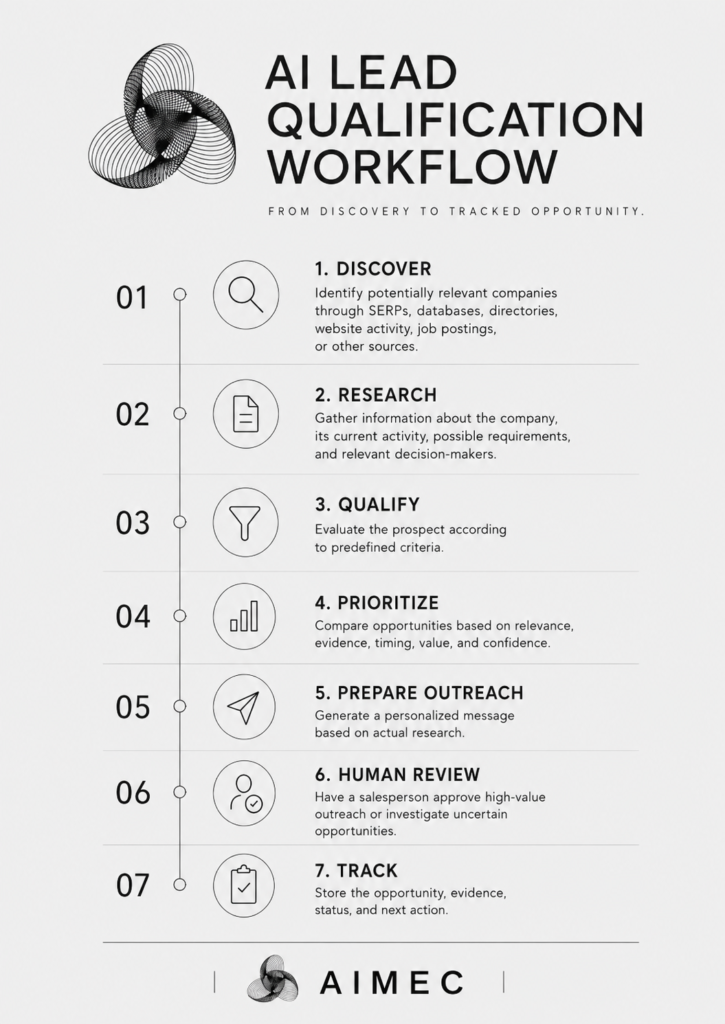
AI lead qualification workflow
This is much closer to an actual sales agent than a conventional lead-scoring algorithm.
What Should an AI Lead Qualification Agent Evaluate?
The exact criteria depend on the business. For an AI consultancy, I might evaluate factors such as:
| Qualification Factor | What the Agent Looks For |
| Business relevance | Does the company fit the target customer profile? |
| Business need | Is there evidence of a problem we can solve? |
| AI activity | Is the company exploring or implementing AI? |
| Hiring | Are relevant jobs being advertised? |
| Expansion | Is the company growing or changing operations? |
| Workflow opportunity | Are manual or inefficient processes visible? |
| Technology changes | Is the business implementing new systems? |
| Search opportunity | Are there obvious SEO or content gaps? |
| Potential value | Could solving the problem create meaningful value? |
| Recency | How recent is the evidence? |
| Contactability | Can an appropriate decision-maker be identified? |
| Confidence | How strong is the available evidence? |
An AI agent can then generate both a score and an explanation.
For example:
Qualification score: 8.4/10

Reason: Strong ICP match, recent AI hiring activity, evidence of operational expansion, and clear overlap with our automation capabilities.

Risk: No explicit evidence that the company is currently purchasing outside AI services.

Recommended next step: Research the operations or technology executive responsible for the initiative before outreach.
This is significantly more actionable than an unexplained number.
AI Can Also Ask Qualification Questions
AI lead qualification can continue after a prospect responds. An AI SDR can use natural language processing to identify information about:
- Business problem
- Urgency
- Budget
- Company size
- Existing systems
- Decision-making authority
- Implementation timeline
- Technical requirements
Instead of forcing somebody through a rigid form, the agent can ask context-sensitive follow-up questions. If a prospect says: We want to automate customer support but everything currently runs through Zendesk and our internal CRM. the agent does not necessarily need to ask: What software do you currently use?
It already has the answer. It can move on to the next relevant qualification question. This creates a more natural qualification process while still collecting structured sales information.
AI Business Assessments Can Generate Qualified Inbound Leads
Another approach I have been developing around AIMEC is using AI assessment tools as lead-generation mechanisms. Rather than placing a generic “Contact Us” form on a website, businesses can offer tools such as:
- AI readiness assessments
- Automation opportunity scanners
- Process bottleneck finders
- AI use-case generators
- ROI calculators
The visitor receives something valuable immediately. At the same time, their answers provide useful qualification context. For example, an AI automation assessment might discover that a business has:
- 25 employees manually processing customer documents
- Multiple disconnected software platforms
- High volumes of repetitive email
- A defined AI budget
- An implementation target within six months
That is far more useful sales information than:
Name: John
Company: Example Ltd
Message: Interested in AI.
The assessment itself becomes part of the qualification process.
AI Lead Qualification Does Not Mean Removing Humans
The objective should not necessarily be fully autonomous sales. For high-value B2B deals, human judgment remains extremely useful. AI is better used to remove the research bottleneck.
Instead of a salesperson spending 30 minutes researching every company, an agent might analyze a much larger pool and surface the opportunities deserving human attention.
The salesperson can then concentrate on:
- Relationship building
- Complex discovery
- Negotiation
- Understanding organizational politics
- Validating AI assumptions
- Closing deals
The machine handles breadth. The human handles depth.
The Biggest Advantage Is Research at Scale
The biggest improvement I have found when thinking about AI lead qualification is not the scoring itself. Scoring leads has existed for years. The interesting change is that AI agents can perform much of the research that previously had to happen before a score could mean anything. A traditional system might know: Company has 250 employees.
An agentic system can potentially know:
Company has 250 employees, recently expanded into another market, is hiring three automation-related roles, mentions an AI initiative in recent search results, has several visible workflow inefficiencies, and operates software that our integration stack already supports.
That produces a fundamentally richer sales signal.
Building an AI Lead Qualification Workflow
A relatively simple architecture could consist of:
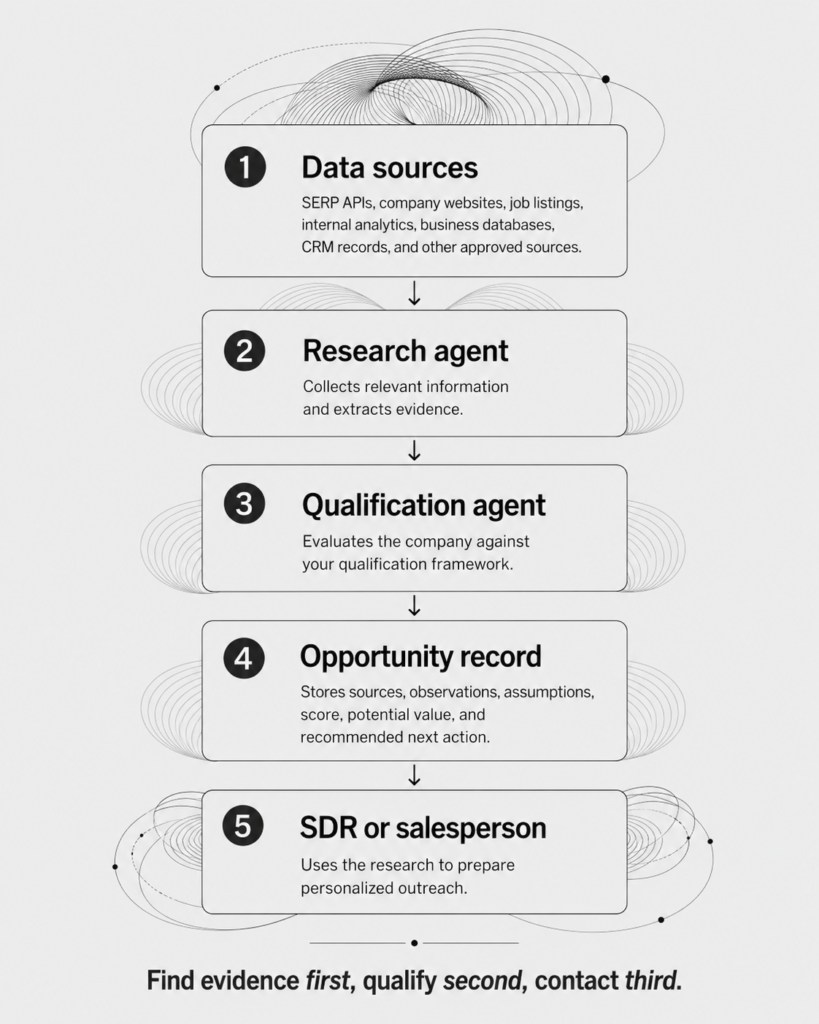
AI lead qualification workflow
The Future of AI Lead Qualification Is Agentic
The next evolution of sales automation is unlikely to be another database that gives every prospect a score. It will be agents capable of actively investigating opportunities. The agent does not have to wait for a lead to arrive.
It can search for companies, investigate business changes, inspect public information, compare evidence against a target customer profile, identify likely pain points, and prepare the findings for a salesperson.
That is what makes AI lead qualification particularly interesting. It turns lead qualification from a static filtering problem into an ongoing research process. And when SERP APIs, research agents, intent signals, business assessments, CRM data, and SDR agents are connected together, the result starts to resemble something much more valuable than a lead-scoring tool.
It becomes an automated sales research system designed to answer the question that actually matters: Which company should we speak to next — and why?

Steven Walgenbach is an AI Engineer specializing in AI agents, large language models, retrieval-augmented generation and business process automation. He designs and builds practical AI systems that connect with existing tools, data sources and workflows to help businesses reduce manual work, improve decision-making and scale more efficiently.
His work includes developing multi-agent systems, private and locally hosted AI solutions, custom knowledge assistants, SEO automation pipelines and LLM-powered applications using Python, LangGraph, CrewAI, the OpenAI Agents SDK and other modern AI frameworks.
Through AIMEC, Steven helps businesses move beyond AI experimentation and identify practical opportunities where artificial intelligence can deliver measurable operational and commercial value.