
Building an artificial intelligence system involves far more than paying for an AI model or subscribing to a software platform. A realistic AI implementation budget must account for the work required to understand the business problem, prepare data, build the solution, connect it to existing systems, test it thoroughly and support it after launch.
Businesses frequently underestimate AI costs because they focus primarily on the visible technology. They budget for model access, development hours or an AI platform subscription, but overlook the operational work needed to turn the technology into a dependable business system.
The result is often a promising proof of concept that cannot be deployed safely, integrated into daily workflows or scaled across the organization.
A stronger budgeting process treats AI implementation as a complete business transformation project rather than a standalone software purchase.
This guide explains how to structure an AI implementation budget across five essential areas:
- Discovery and planning
- AI system development
- Business system integration
- Testing and validation
- Ongoing support and optimization
What Should an AI Implementation Budget Include?
An AI implementation budget should include every activity required to move from an initial business problem to a reliable production system.
The following diagram shows what an AI budget should cover at a minimum. This is based on our years of work in the AI trenches, where we’ve helped businesses integrate with AI.
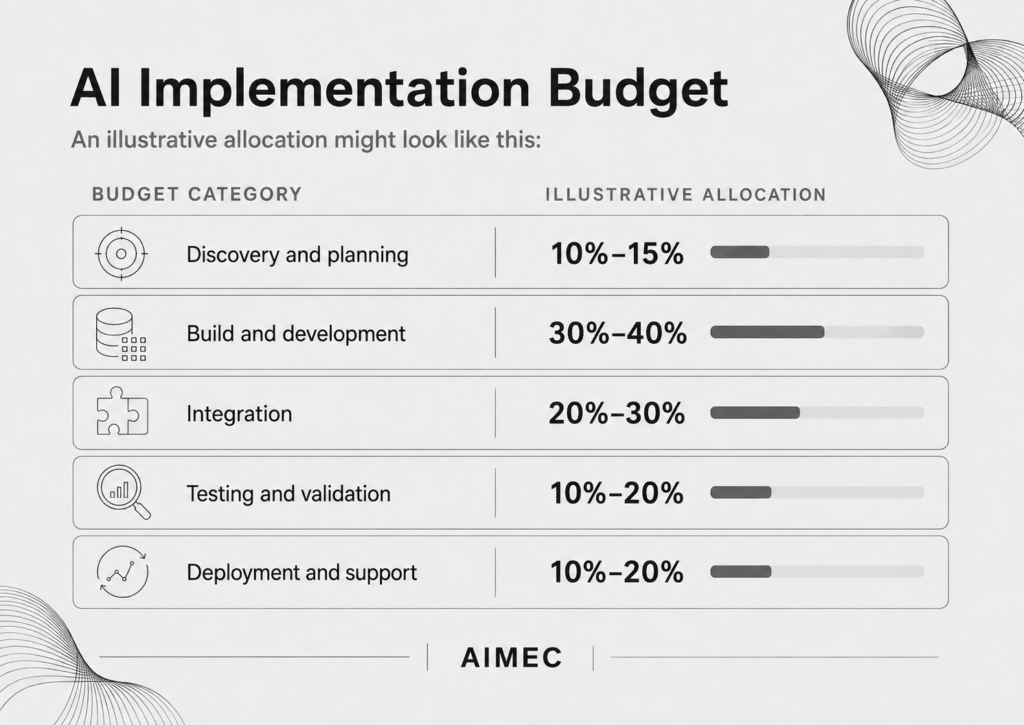
Diagram of what an AI implementation budget should cover at a minimum
The exact allocation will depend on the complexity of the use case.
A simple internal document assistant may require limited integration and relatively light infrastructure. An AI agent that accesses customer information, updates records, executes transactions and coordinates multiple business systems will require significantly more engineering, testing and governance.
The most important budgeting principle is therefore: Budget according to the business process the AI must operate within, not merely the model it will use.
Why AI Projects Are Often Underbudgeted
Traditional software budgets are usually based on features, development hours and infrastructure. AI introduces several additional layers of uncertainty.
The system may need to interpret unstructured information, generate variable responses or make recommendations based on incomplete context. Its output cannot always be validated using the same deterministic rules applied to conventional software.
Costs can also increase when businesses discover that:
- Their data is fragmented or poorly structured
- Existing systems lack suitable APIs
- Permissions differ across departments
- Outputs require human verification
- The AI performs well during demonstrations but struggles with real-world edge cases
- Model usage becomes expensive at production scale
- Additional security controls are required
- Employees need training before the system can be adopted
A reliable AI implementation budget should make room for these realities before development begins.
A Practical AI Implementation Budget Framework
One way to structure the budget is to divide it across the implementation lifecycle.
Here is what an illustrative allocation might look like:
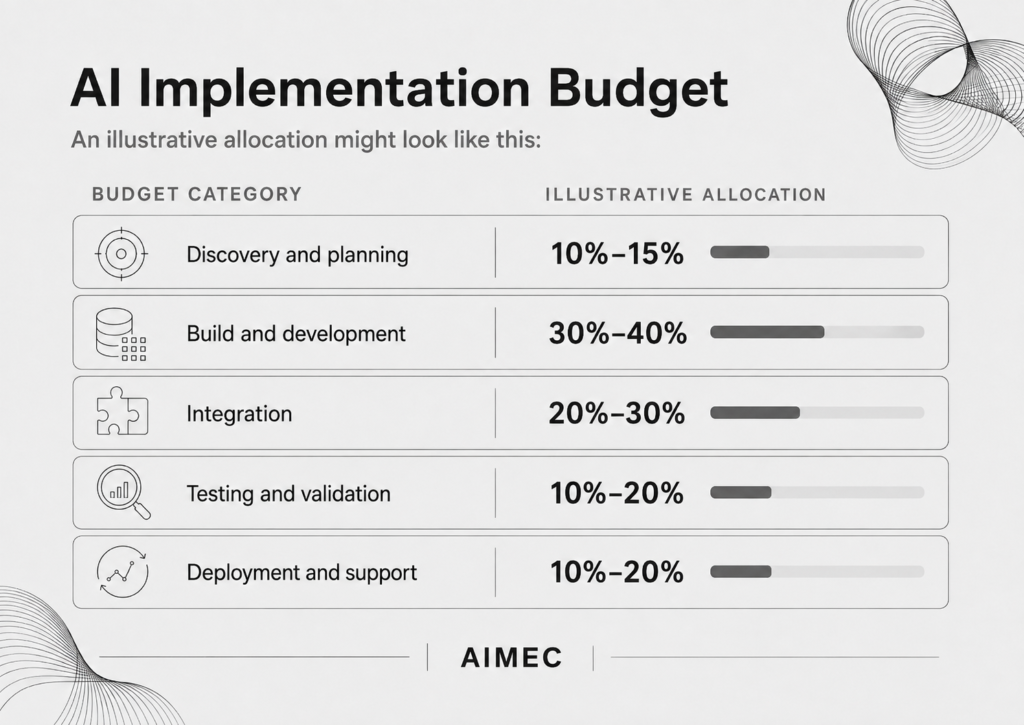
Diagram of allocation for AI budget by different stages
These percentages are not fixed pricing rules. They are a planning framework. For example, integration may consume a much larger share of the budget when an AI agent needs to work across an enterprise resource planning platform, customer relationship management system, email environment and private company database.
Similarly, testing may become one of the largest cost categories when the AI supports regulated, financial, legal or customer-facing decisions.
1. Budgeting for AI Discovery and Planning
Discovery is the process of defining what the AI system should accomplish, how it will fit into the organization and what conditions must be met for the project to succeed.
Businesses sometimes try to reduce costs by moving directly into development. This can create expensive rework when the team later discovers that the original use case was poorly defined or the required data is unavailable.
A proper discovery phase should answer several questions:
- What business problem is being solved?
- Who currently performs the work?
- What systems and data sources are involved?
- Which decisions can the AI make?
- Which decisions require human approval?
- What level of accuracy is acceptable?
- What are the security and compliance requirements?
- How will the organization measure success?
Process mapping
Before building an AI solution, the existing workflow must be documented. The project team should identify:
- What triggers the process
- What information enters the workflow
- Which decisions are made
- Which systems are updated
- Where delays and errors occur
- Which exceptions require human judgment
- What the final output should look like
This prevents the AI from being designed around an incomplete understanding of the business process.
Data readiness assessment
The discovery budget should also include an assessment of the available data. This may involve reviewing:
- File formats
- Database structure
- Document quality
- Data ownership
- Access permissions
- Missing information
- Duplicate records
- Outdated content
- Sensitive or regulated data
An AI system cannot reliably use information that is inaccessible, inconsistent or poorly governed.
In many implementations, data preparation becomes a significant project of its own. Identifying this requirement during discovery allows the business to budget for it instead of encountering an unexpected delay during development.
Feasibility and architecture planning
The project team must determine whether the proposed solution requires:
- A standard automation workflow
- A retrieval-augmented generation system
- A conversational assistant
- A tool-using AI agent
- A multi-agent architecture
- A custom model
- A cloud deployment
- An on-premises deployment
- A hybrid architecture
Not every problem requires an autonomous AI agent. Some processes are more reliable and affordable when implemented using deterministic automation. Discovery should separate tasks that require AI reasoning from tasks that can be handled through conventional software rules.
Success metrics
The discovery phase should define measurable outcomes such as:
- Time saved per task
- Reduction in manual processing
- Faster customer response times
- Lower error rates
- Increased conversion rates
- Reduced support volume
- Improved document retrieval
- Higher employee productivity
- Increased process capacity
Without these metrics, the business cannot determine whether the AI implementation produced a return on investment.
2. Budgeting for the AI Build
The build phase covers the design and development of the AI system itself. The cost will depend on how much customization is required and how many capabilities the system must support.
Model selection
Businesses may choose between:
- Commercial AI model APIs
- Open-weight models hosted in the cloud
- Models hosted on private infrastructure
- Fine-tuned or specialized models
- Multiple models assigned to different tasks
The lowest-cost model is not automatically the most economical option.
A cheaper model that frequently produces incorrect outputs may create higher review costs, more customer complaints and greater operational risk. A more capable model may cost more per request but reduce the total cost per successfully completed task.
The budget should therefore evaluate model costs in relation to business outcomes rather than token prices alone.
Prompt and workflow development
A production AI system usually requires more than a single prompt. Development may include:
- System instructions
- Context assembly
- Prompt templates
- Tool-selection logic
- Workflow routing
- Error recovery
- Output validation
- Escalation rules
- Memory management
- Human approval steps
This logic determines how the AI behaves within the business process. For example, a customer service agent may need to identify the customer, retrieve account information, classify the request, search internal documentation, draft a response and escalate sensitive cases to a human representative. Each step must be designed and tested.
Retrieval and knowledge systems
When the AI needs access to company information, the build budget may include a retrieval-augmented generation system.
This can involve:
- Collecting source documents
- Cleaning and formatting content
- Dividing documents into retrievable sections
- Creating embeddings
- Configuring a vector database
- Applying permissions
- Ranking search results
- Managing document updates
- Tracking source citations
A basic demonstration can often retrieve information from a small document collection. A production system must consistently retrieve the correct information while respecting access controls and identifying outdated sources.
Agent tools and actions
An AI agent becomes more valuable when it can take action rather than only generate text. Tools may allow the agent to:
- Search internal databases
- Create support tickets
- Update CRM records
- Send emails
- Generate reports
- Schedule meetings
- Process forms
- Create invoices
- Retrieve inventory information
- Trigger existing automation workflows
Every tool requires development, authentication, permission controls, error handling and audit logging. The more systems the AI can modify, the greater the need for safeguards.
Infrastructure
The build budget should also account for infrastructure such as:
- Model hosting
- Application servers
- Databases
- Vector storage
- File storage
- Queueing systems
- Logging platforms
- Monitoring tools
- Authentication services
- Backup systems
- Development and staging environments
Infrastructure costs may be relatively small during a pilot but increase as usage grows. The budget should estimate expected production volume, including:
- Number of users
- Requests per user
- Average input size
- Average output size
- Number of model calls per task
- Document storage requirements
- Peak usage periods
A single user request may trigger several model calls, searches and system actions. This should be reflected in the usage forecast.
3. Budgeting for Integration
Integration is often one of the most underestimated parts of an AI implementation budget. An AI solution only creates value when it can access the information and systems required to complete the business process.
Connecting existing systems
Depending on the use case, the AI may need to connect to:
- Customer relationship management software
- Enterprise resource planning systems
- Email platforms
- Internal databases
- Cloud storage
- Accounting software
- E-commerce platforms
- Customer support tools
- Human resources systems
- Communication platforms
- Custom internal applications
Each integration may involve different authentication standards, data formats, rate limits and permission structures. Modern platforms with well-documented APIs are generally easier to connect. Legacy systems may require custom middleware, database-level access or robotic process automation.
Data transformation
Information rarely moves cleanly between systems. Integration work may include:
- Mapping fields between applications
- Standardizing dates and currencies
- Converting file formats
- Resolving duplicate records
- Normalizing customer information
- Handling incomplete data
- Synchronizing updates
- Preventing conflicting writes
These tasks are essential even though they may not be visible to the end user.
Identity and permissions
The AI should not automatically have access to every piece of company information. The integration budget should include controls that determine:
- Which users can access the AI
- Which data each user may retrieve
- Which actions the AI may perform
- Which actions require approval
- How credentials are stored
- How access is revoked
- How actions are logged
Permissions become especially important when the system contains financial, customer, employee or confidential business information.
Human approval workflows
Some actions should remain under human control. For example, the AI may be allowed to draft a supplier payment request but not release the payment. It may prepare a customer refund but require a manager to approve the transaction.
Approval workflows may involve:
- Notifications
- Review dashboards
- Permission checks
- Escalation paths
- Time limits
- Audit records
- Rejection and revision processes
These controls should be included in the initial architecture rather than added after deployment.
4. Budgeting for Testing and Validation
AI testing is not limited to confirming that the application loads correctly. The project team must evaluate whether the system produces useful, accurate and safe outcomes across a wide range of real-world situations.
Functional testing
Functional testing confirms that the overall workflow operates as intended. This includes checking whether the system can:
- Retrieve the correct data
- Call the appropriate tools
- Complete actions in the correct order
- Handle missing information
- Recover from system failures
- Escalate cases correctly
- Record actions accurately
AI output evaluation
The team must also evaluate the quality of the model’s responses. Relevant criteria may include:
- Accuracy
- Completeness
- Relevance
- Consistency
- Tone
- Instruction adherence
- Source quality
- Hallucination rate
- Correct use of tools
- Appropriate escalation
A structured evaluation dataset should contain representative examples from the real business process. The dataset should include ordinary requests as well as:
- Ambiguous requests
- Incomplete information
- Unusual customer situations
- Conflicting documents
- Incorrect inputs
- Sensitive requests
- Attempts to bypass instructions
- Tool failures
- Permission restrictions
Testing only ideal scenarios creates an unrealistic impression of system performance.
Security testing
AI systems introduce security risks that may not appear in conventional applications.
Testing may include:
- Prompt injection resistance
- Unauthorized data retrieval
- Credential exposure
- Malicious document content
- Permission bypass attempts
- Sensitive information leakage
- Unsafe tool execution
- Excessive agent permissions
- Audit-log completeness
The testing budget should increase according to the sensitivity of the information and the potential consequences of an incorrect action.
Load and performance testing
The system should also be evaluated under realistic usage conditions.
Performance testing may measure:
- Response times
- Concurrent users
- Model throughput
- Database latency
- Retrieval speed
- Failure rates
- Queue lengths
- Infrastructure utilization
- Cost per completed task
A system that works during a small pilot may struggle when deployed across an entire department.
User acceptance testing
Employees who perform the current process should be involved before launch. They can identify operational issues that may not be visible to developers, such as:
- Missing workflow steps
- Unclear outputs
- Incorrect terminology
- Unrealistic approval processes
- Information presented in the wrong format
- Edge cases that occur frequently in practice
User acceptance testing also helps build trust and improve adoption.
5. Budgeting for Deployment and Ongoing Support
AI implementation does not end when the system goes live. Production AI systems require monitoring, maintenance and continuous improvement.
Deployment costs
The launch budget may include:
- Production infrastructure
- Security configuration
- User account setup
- Data migration
- Employee onboarding
- Training materials
- Technical documentation
- Rollout management
- Backup procedures
- Incident response planning
A phased rollout is often safer than launching to the entire organization at once. The business may start with a limited user group, monitor performance and gradually expand access.
Model and infrastructure usage
Recurring technical costs may include:
- AI model API usage
- Cloud compute
- Private model hosting
- Database hosting
- Vector database storage
- Monitoring software
- Logging
- Backups
- Third-party integrations
- Automation platforms
- Security services
These costs should be projected across several usage scenarios.
For example:
- Low adoption
- Expected adoption
- High adoption
- Peak seasonal demand
This helps the organization understand how costs may change as usage grows.
Monitoring and quality control
AI behavior can change when:
- Source documents are updated
- User behavior changes
- New use cases emerge
- Models are upgraded
- Integrations are modified
- Business rules change
Monitoring should track:
- Accuracy
- Failed tasks
- Escalation rates
- User feedback
- Response times
- Tool errors
- Model costs
- Security events
- Business outcomes
The goal is not merely to confirm that the system is online. The organization must determine whether it continues to produce acceptable business results.
Maintenance and improvement
Ongoing work may involve:
- Updating prompts
- Adding new tools
- Fixing integrations
- Refreshing knowledge sources
- Improving retrieval
- Expanding evaluation datasets
- Adjusting permissions
- Replacing models
- Reducing usage costs
- Supporting new departments
An AI system should be managed as an evolving operational capability rather than a finished software product.
User support
Employees will need a way to report:
- Incorrect responses
- Missing information
- Failed actions
- Access problems
- Workflow suggestions
- New use cases
The support budget should define who investigates these issues and how quickly they must be resolved.
Additional AI Implementation Costs to Consider
The five core categories provide the foundation of an AI implementation budget, but several additional costs may apply.
Data preparation
The organization may need to:
- Digitize documents
- Remove duplicates
- Improve metadata
- Classify content
- Correct inaccurate records
- Apply retention policies
- Establish document ownership
- Create access controls
Poor data quality can become one of the largest barriers to production deployment.
Governance and compliance
Depending on the industry and use case, the project may require:
- Privacy assessments
- Legal review
- Data processing agreements
- AI usage policies
- Risk assessments
- Model documentation
- Decision audit trails
- Retention controls
- Human oversight policies
These requirements should be identified during discovery.
Change management
An effective AI system can still fail when employees do not trust it or understand how to use it.
Change management may include:
- Stakeholder workshops
- Employee training
- Usage guidelines
- Process documentation
- Internal communications
- Feedback sessions
- Department champions
- Adoption tracking
The budget should account for the human side of implementation, particularly when the system changes established roles or workflows.
Contingency
AI projects involve uncertainty, especially during initial implementation.
A contingency allocation can cover:
- Unexpected data cleanup
- Integration limitations
- Additional testing
- Infrastructure changes
- Revised security requirements
- Scope adjustments
- Additional employee training
The appropriate contingency depends on how clearly the requirements and technical environment are understood.
To recap:
| Additional cost category | What the budget may need to cover | Why it matters | Budgeting consideration |
| Data preparation | Document digitization, duplicate removal, metadata improvement, content classification, record correction, retention policies, document ownership and access controls | AI systems depend on accurate, accessible and well-structured information. Poor data quality can delay deployment and reduce output reliability. | Assess data quality during discovery and budget separately for cleanup, migration and governance where necessary. |
| Governance and compliance | Privacy assessments, legal review, data processing agreements, AI usage policies, risk assessments, model documentation, audit trails, retention controls and human oversight policies | These controls help the organization manage legal, privacy, security and decision-making risks. | Requirements vary by industry, data sensitivity and use case, so they should be identified before development begins. |
| Change management | Stakeholder workshops, employee training, usage guidelines, process documentation, internal communications, feedback sessions, department champions and adoption tracking | Even a technically effective AI system can fail when employees do not understand, trust or adopt it. | Allocate more funding when the implementation changes established roles, responsibilities or workflows. |
| Contingency | Unexpected data cleanup, integration limitations, additional testing, infrastructure changes, revised security requirements, scope adjustments and extra training | AI projects often uncover technical and operational issues that were not visible during initial planning. | The contingency allocation should reflect how well the requirements, systems, data and risks are understood. |
How to Estimate Your AI Implementation Budget
A practical budgeting process can be completed in six steps.
Step 1: Define the business outcome
Start with the result the business wants to achieve. Avoid beginning with a broad objective such as “implement AI.”
A stronger goal might be:
- Reduce support ticket handling time
- Automate supplier document processing
- Improve internal knowledge retrieval
- Generate sales proposals faster
- Identify high-risk customer accounts
- Reduce manual order administration
A clear outcome makes it easier to determine the required capabilities.
Step 2: Map the complete workflow
Document every step from the initial request to the final business outcome. Identify the people, systems, information and decisions involved.
Step 3: Separate AI tasks from deterministic tasks
Determine which steps require interpretation or reasoning and which can be handled through fixed business rules. This can reduce costs and improve reliability.
For example, AI may extract information from an email, while deterministic software validates the account number and calculates the invoice total.
Step 4: Assess data and integration readiness
Review whether the necessary information is available and whether the relevant systems can be connected. This step will often reveal hidden costs before development begins.
Step 5: Estimate initial and recurring costs
Separate the budget into:
Initial implementation costs
- Discovery
- Architecture
- Development
- Integration
- Testing
- Deployment
- Training
Recurring operating costs
- Model usage
- Infrastructure
- Monitoring
- Support
- Maintenance
- Security
- Continuous evaluation
A project that appears affordable based on initial development costs may become expensive when operating costs are considered.
Step 6: Compare cost with measurable value
Estimate the financial impact of the proposed system.
Potential value may come from:
- Hours saved
- Increased process capacity
- Reduced errors
- Faster response times
- Lower outsourcing costs
- Increased revenue
- Improved customer retention
- Reduced operational risk
The comparison should be based on completed business outcomes rather than the number of AI interactions.
A useful calculation is: Cost per successful outcome = total AI operating cost ÷ number of correctly completed business outcomes
This provides a more meaningful measure than cost per token or cost per conversation.
Example AI Implementation Budget
Consider a company building an AI assistant that processes incoming customer requests, retrieves account information, drafts responses and updates its CRM.
A simplified budget could include:
Diagram of what a simplified budget could include
The model itself may represent only a small portion of the total implementation cost. Most of the budget is spent turning the model into a secure and dependable operational system.
How to Reduce AI Implementation Costs Without Creating More Risk
Businesses can control costs by reducing complexity rather than removing essential safeguards.
Start with one high-value workflow
A narrow implementation is easier to build, evaluate and improve. Instead of launching an organization-wide AI platform immediately, begin with a process that has:
- Clear inputs
- Repetitive work
- Measurable outcomes
- Available data
- A manageable risk level
Use existing infrastructure where appropriate
Existing databases, automation tools and business systems may already provide part of the required functionality. AI should be added where interpretation or reasoning creates value, rather than replacing every component of the technology stack.
Keep humans in high-risk decisions
Human approval can make an initial implementation safer and less complex. As the system demonstrates reliability, additional steps can be automated gradually.
Build reusable components
Authentication, audit logging, document retrieval and model monitoring can often be reused across future AI projects. This reduces the cost of subsequent implementations.
Measure before scaling
Expansion should be based on evidence that the first implementation produces reliable results and measurable value. Scaling an unproven workflow only increases usage costs and operational risk.
Common AI Budgeting Mistakes
Budgeting only for the prototype
A proof of concept demonstrates that an idea may work. It does not include everything required for production deployment.
Ignoring integration
An AI assistant that cannot access the right systems will create additional manual work instead of eliminating it.
Underfunding testing
AI systems require systematic evaluation across realistic and adversarial scenarios.
Failing to budget for data preparation
Incomplete, inconsistent or inaccessible data can delay the entire implementation.
Treating support as optional
Models, workflows and business systems change. Without maintenance, performance will eventually decline.
Measuring activity instead of value
The number of prompts, users or generated responses does not prove that the implementation is creating value. Budgets should be linked to successful business outcomes.
Building a Realistic AI Implementation Budget
A strong AI implementation budget accounts for the complete journey from business problem to production operation.
Discovery ensures that the organization is solving the right problem. Development creates the AI capability. Integration connects it to real business processes. Testing establishes whether the system can be trusted. Ongoing support protects the investment after launch.
Organizations that budget only for model access or initial development frequently encounter additional costs later. Organizations that plan across the entire lifecycle are better positioned to deploy AI systems that are secure, reliable and financially sustainable.
At AIMEC, we help businesses assess AI readiness, identify high-value use cases and design implementation plans that account for development, integration, governance and long-term operating costs.
A well-designed budget does more than estimate project expenditure. It establishes what the organization must invest to turn AI from an experiment into dependable business infrastructure.

Steven Walgenbach is an AI Engineer specializing in AI agents, large language models, retrieval-augmented generation and business process automation. He designs and builds practical AI systems that connect with existing tools, data sources and workflows to help businesses reduce manual work, improve decision-making and scale more efficiently.
His work includes developing multi-agent systems, private and locally hosted AI solutions, custom knowledge assistants, SEO automation pipelines and LLM-powered applications using Python, LangGraph, CrewAI, the OpenAI Agents SDK and other modern AI frameworks.
Through AIMEC, Steven helps businesses move beyond AI experimentation and identify practical opportunities where artificial intelligence can deliver measurable operational and commercial value.