An AI implementation timeline can range from a few weeks for a focused internal tool to more than a year for a complex enterprise system. The difference comes down to scope. A broader AI implementation for business may involve data preparation, system integrations, governance and operational change, while a basic chatbot may only require a focused knowledge base and website interface.
For most businesses, a realistic AI implementation takes between six weeks and six months. Small proofs of concept can be completed faster, while production systems involving sensitive data, multiple integrations or autonomous actions usually take longer.
The important question is not simply how quickly an AI demonstration can be built. It is how long it takes to deploy a system that is accurate, secure and reliable enough for real business use. An early AI readiness assessment can identify data, integration and governance issues before they delay development.
Typical AI Implementation Timeline by Project Type
The following ranges provide a practical starting point for estimating how long an AI project will take.
| AI project type | Typical implementation timeline |
| Basic FAQ chatbot | 2–6 weeks |
| Internal knowledge assistant | 6–12 weeks |
| Retrieval-augmented generation system | 8–16 weeks |
| AI workflow automation | 8–20 weeks |
| Transactional AI assistant | 3–6 months |
| Multi-agent system | 4–9 months |
| Predictive machine learning system | 3–9 months |
| Enterprise-wide AI implementation | 6–18+ months |
These ranges assume that the business has access to the required data, decision-makers are available and the project is being implemented by an experienced team. Poor data quality, unclear requirements and slow internal approvals can extend the timeline considerably.
Basic FAQ Chatbot: 2–6 Weeks
A basic FAQ chatbot is normally one of the fastest AI projects to implement.
These systems answer a limited set of questions using predefined content, decision trees or a relatively small knowledge base. They usually do not need deep access to internal systems and cannot complete complex tasks on behalf of the user.
A simple implementation may include:
- A chat interface
- Frequently asked questions
- Basic intent recognition
- Escalation to a human
- Website integration
- Basic analytics
A prototype can sometimes be assembled within days. However, preparing the content, testing the responses and integrating the chatbot into an existing website usually pushes the full implementation timeline closer to two to six weeks. The project may take longer when content is inconsistent, outdated or spread across multiple departments.
If you want to see an example of such a bot, you can visit the Aimec homepage and talk to our assistant.
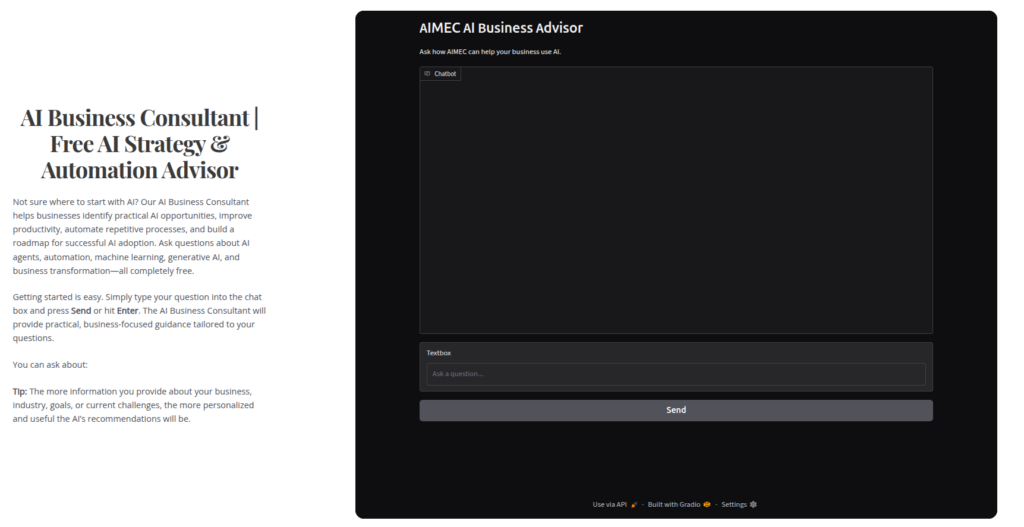
Screenshot of Aimec’s AI chat assistant
Internal Knowledge Assistant: 6–12 Weeks
An internal knowledge assistant helps employees find information across company policies, manuals, reports or operational documents. Unlike a simple FAQ bot, the assistant must retrieve information dynamically from a private knowledge base. This usually requires a retrieval-augmented generation, or RAG, architecture.
Retrieval quality also depends on how well the organisation’s information reflects its real processes, terminology and decision-making context. This is why organizational context is critical to AI success.
The project often includes:
- Document collection
- File parsing
- Data cleaning
- Chunking and indexing
- Embedding generation
- Vector database configuration
- Retrieval logic
- Answer generation
- Citations or source links
- User access controls
The first working prototype may be available within two to four weeks. The remaining time is usually spent improving retrieval accuracy, testing unusual questions and resolving problems in the source data. This was the case for one project we assisted a client with. We connected to the various tools they use within their organization, that range from coding tools and repos to ticketing and communication applications. This is still an ongoing task, as the system needs to constantly update its context as more information comes in.
RAG Implementation: 8–16 Weeks
A production RAG system normally takes between two and four months to implement. RAG allows a large language model to answer questions using private, current or domain-specific information. The model does not rely only on what it learned during training. It retrieves relevant information from an external knowledge source before generating a response.
The final schedule is closely tied to the project budget because document ingestion, retrieval infrastructure, evaluation and maintenance all contribute to RAG implementation costs.
The basic workflow sounds straightforward, but production RAG requires more than connecting a model to a vector database.
The implementation team must decide:
- Which documents should be included
- How frequently the knowledge base should update
- How documents should be divided into chunks
- Which embedding model to use
- How many search results to retrieve
- How to rank or rerank results
- How to handle conflicting documents
- How to show sources
- How to enforce user permissions
- How to measure answer quality
A RAG proof of concept can often be built within two or three weeks. Turning it into a dependable business system usually requires another six to twelve weeks of data preparation, evaluation and integration.
AI Workflow Automation: 8–20 Weeks
AI workflow automation uses models to perform or support steps within an existing business process.
Examples include:
- Categorising customer enquiries
- Extracting information from documents
- Drafting reports
- Updating CRM records
- Routing support tickets
- Generating product descriptions
- Analysing sales calls
- Preparing SEO recommendations
The timeline depends heavily on the number of systems involved and whether the AI is only generating recommendations or actively changing business data. A workflow that summarises incoming documents may take six to eight weeks. A workflow that reads emails, makes decisions and updates multiple systems could take three to five months.
Below shows the four layers usually involved in this implementation.
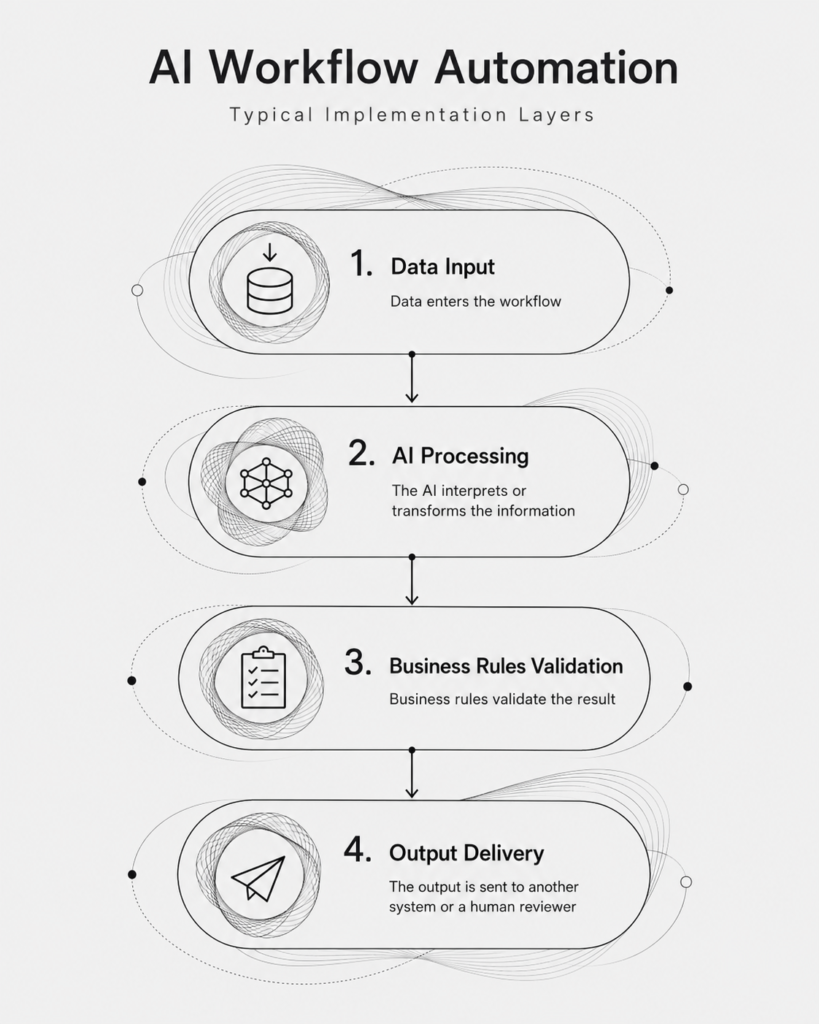
Four layers involved in RAG implementation
More time is required when the workflow needs exception handling, approval steps, audit logs or recovery mechanisms.
Transactional AI Assistant: 3–6 Months
A transactional AI assistant does more than answer questions. It can complete tasks.
For example, the assistant may:
- Create a support ticket
- Schedule an appointment
- Update a customer profile
- Search product inventory
- Prepare an order
- Generate a quotation
- Retrieve account information
- Start a refund process
These projects typically take between three and six months because the assistant must interact safely with business systems. The language model may correctly understand what the user wants, but the implementation must also determine whether the user is authorised to perform the action, whether the request contains all required information and whether the transaction succeeded.
A reliable transactional assistant requires:
- Tool-calling logic
- API integrations
- Authentication
- Permission management
- Input validation
- Confirmation steps
- Error handling
- Transaction logging
- Human escalation
- Security testing
The higher the potential cost of an incorrect action, the more testing and control the system needs.
Multi-Agent AI System: 4–9 Months
A multi-agent system uses several specialised AI agents to complete different parts of a process.
One agent may research information, another may analyse the findings and a third may prepare an output. A coordinator agent can assign tasks, review progress and decide what should happen next.
Multi-agent systems can support complex workflows such as:
- Market research
- Software development
- SEO monitoring
- Sales prospecting
- Compliance review
- Operational reporting
- Supply chain analysis
These projects generally take longer than single-agent applications because the agents need clear roles, shared context and coordination rules.
The development team must solve questions such as:
- Which agent owns each task?
- What information can agents share?
- How are conflicting outputs resolved?
- When should a task be retried?
- Who checks the final result?
- How are costs and token usage controlled?
- How does the system recover when one agent fails?
A basic multi-agent demonstration may be built within a few weeks. A stable system capable of handling live business processes normally requires four to nine months.
Predictive Machine Learning System: 3–9 Months
Not every AI implementation is based on generative AI. Predictive machine learning systems use historical data to estimate future outcomes. Common examples include:
- Sales forecasting
- Customer churn prediction
- Fraud detection
- Lead scoring
- Demand forecasting
- Predictive maintenance
- Credit risk analysis
The model itself may take only a few weeks to train. Data preparation is usually the larger part of the implementation timeline.
The business must collect historical records, define the outcome being predicted and confirm that the data is accurate enough to support the use case.
A predictive AI implementation often follows this timeline:
| Phase | Typical duration |
| Data collection and preparation | 4–12 weeks |
| Model development | 2–6 weeks |
| Validation and testing | 2–6 weeks |
| System integration | 4–12 weeks |
| Monitoring setup | 2–4 weeks |
The project can take longer when historical data is incomplete or stored across incompatible systems.
Enterprise AI Implementation: 6–18+ Months
Enterprise AI implementation is usually a programme rather than a single project. A large organisation may need to introduce several AI systems while also creating the technical, legal and operational foundations required to support them.
An enterprise initiative may include:
- AI strategy
- Use-case prioritisation
- Data governance
- Security policies
- Vendor assessment
- Model selection
- Infrastructure deployment
- Employee training
- Integration standards
- Evaluation frameworks
- Risk management
- Change management
The first use case may go live within three to six months. Expanding AI across departments can take a year or longer.
This does not mean the organisation must wait 18 months before seeing value. A strong programme delivers smaller systems in stages while developing the broader AI capability in parallel.
The Main Stages of an AI Implementation Timeline
Although every project is different, most AI implementations move through six broad stages.
1. Discovery and Use-Case Definition
Typical duration: 1–3 weeks
The first stage determines what the AI system should achieve. This includes identifying the users, the business process, the available data and the expected outcome. The team also needs to define what the system will not do.
A narrow problem such as “help support agents find policy information” is easier to implement than a broad goal such as “use AI to improve customer service.”
We have found that a useful discovery phase should answer:
- Who will use the system?
- What task will it perform?
- What information does it need?
- What systems must it access?
- What does a successful result look like?
- What happens when the AI is uncertain?
- Which risks need to be controlled?
Projects often run late because development begins before these decisions have been made.
2. Data Assessment and Preparation
Typical duration: 2–8 weeks
AI systems depend on the quality of their data. For a RAG assistant, this may involve collecting and cleaning documents. For a predictive system, it may involve preparing historical records. For an AI agent, it may involve documenting the available tools, APIs and business rules.
Data preparation can include:
- Removing duplicates
- Correcting formatting problems
- Converting file types
- Extracting text
- Adding metadata
- Identifying outdated content
- Mapping permissions
- Resolving conflicting information
- Creating test datasets
This phase is one of the most common causes of delays because businesses frequently overestimate how organised and accessible their data is.
3. Prototype Development
Typical duration: 2–6 weeks
The prototype tests whether the core idea works. It may use a limited dataset, a simple interface and only one or two integrations. The objective is to validate the use case before investing in the full production system.
A good prototype should answer questions such as:
- Can the model understand the task?
- Can it retrieve the correct information?
- Is the output useful to the intended user?
- Are the required integrations technically possible?
- What are the likely operating costs?
- Which risks need further work?
The prototype should not be confused with the finished product. Demonstrations often work under carefully controlled conditions but fail when exposed to real users and real data.
4. Production Engineering and Integration
Typical duration: 4–12 weeks
The next stage turns the prototype into a production application. This may involve building APIs, user interfaces, authentication, databases, monitoring systems and connections to existing software.
The team also needs to make the system reliable under different conditions. That includes handling missing information, model timeouts, malformed files, failed API calls and unexpected user requests.
This stage often takes longer than the initial AI development because the model is only one part of the complete system.
5. Testing and Evaluation
Typical duration: 2–6 weeks
Traditional software can often be tested using predictable inputs and expected outputs. Generative AI is less deterministic, so evaluation requires a broader approach.
Testing may include:
- Answer accuracy
- Retrieval relevance
- Hallucination rates
- Tool-selection accuracy
- Security vulnerabilities
- Prompt injection resistance
- Response time
- Cost per request
- User satisfaction
- Failure recovery
The project should be tested using realistic examples from the intended business process, not only a few ideal questions prepared by the development team.
High-risk systems may need longer testing periods and formal approval from legal, compliance or information security teams.
6. Deployment and Continuous Improvement
Typical duration: 1–4 weeks for the initial launch
Deployment is not the end of an AI implementation. Models change, data changes and users discover questions the development team did not anticipate. The system therefore needs ongoing monitoring and improvement.
After launch, the team should track:
- Failed requests
- Low-confidence answers
- User feedback
- Retrieval quality
- Model costs
- Latency
- Tool errors
- Data freshness
- Security events
Many businesses launch the system to a small user group before making it widely available. This phased rollout reduces risk and provides useful feedback.
What Can Extend an AI Implementation Timeline?
Several factors can turn an eight-week project into a six-month project.
Unclear Scope
AI projects expand quickly when the team continues adding new use cases during development. A chatbot may begin as a tool for answering questions, then grow into a system that also manages orders, accesses customer accounts and produces personalised recommendations.
Each new capability introduces additional data, integrations and testing requirements. Defining a clear first release helps prevent the implementation timeline from expanding unnecessarily.
Poor Data Quality
Documents may be outdated, duplicated or contradictory. Databases may contain missing values. Important information may exist only in emails or employee knowledge. The AI system cannot compensate for every underlying data problem.
Cleaning and organising the source information may take longer than building the model integration itself.
Legacy System Integrations
Older systems may not provide modern APIs or clear documentation. The development team may need to build custom connectors, automate browser interfaces or introduce middleware before the AI can perform useful actions.
Integration work becomes particularly time-consuming when the system is business-critical and cannot be changed easily.
Security and Compliance Requirements
AI systems that process personal, financial, legal or medical information need stronger controls.
The project may require:
- Data residency controls
- Encryption
- Access management
- Audit logs
- Private model hosting
- Vendor assessments
- Penetration testing
- Legal review
- Compliance approval
These requirements add time, but they should not be skipped to meet an unrealistic launch date.
Slow Internal Decision-Making
Development can pause while teams wait for access to data, approval from stakeholders or answers about business rules.
A project moves much faster when one product owner has the authority to make decisions and the required departments are involved from the beginning.
Unrealistic Accuracy Expectations
AI systems rarely achieve perfect accuracy. A project can become stuck in testing when stakeholders expect the model to answer every possible question correctly. A more practical approach is to define acceptable performance levels and clear fallback behaviour.
The system should know when to ask for more information, refer the user to a source or escalate the task to a person.
How to Shorten the AI Implementation Timeline
Businesses can accelerate implementation without cutting important quality controls.
Start With One High-Value Workflow
The first release should solve one specific problem. For example, an internal assistant could begin with human resources policies rather than every document in the organisation. A customer service agent could begin by categorising tickets before it is allowed to send responses.
A smaller scope makes it easier to validate the business value and identify technical problems.
Prepare the Data Early
Data discovery should begin before or during the use-case definition stage. The team should identify where the information is stored, who owns it, how frequently it changes and whether it can legally be used.
Early data preparation prevents development from stopping later.
Use Existing Models and Infrastructure
Most businesses do not need to train a large language model from scratch. Using an existing commercial or open-weight model can reduce the timeline considerably. The implementation team can focus on retrieval, prompting, integrations, security and evaluation.
The business must still decide whether to use packaged software or commission a more flexible system. The comparison between custom AI agents and off-the-shelf SaaS solutions explains the cost, control and integration trade-offs.
Custom model training should be considered only when the use case cannot be solved adequately using existing models.
Build Human Review Into the First Version
AI does not need full autonomy to create value. A system can generate drafts, recommendations or classifications that employees approve before they are used. This reduces the risk of incorrect outputs and allows the business to deploy sooner.
More automation can be added after the system has demonstrated reliable performance.
Reuse Integration and Evaluation Components
A business implementing multiple AI tools should avoid rebuilding authentication, logging, model access and evaluation from scratch for every project.
Shared infrastructure can shorten future AI implementation timelines and make the systems easier to govern.
Proof of Concept vs Production AI Timeline
One of the biggest sources of confusion is the difference between a proof of concept and a production implementation.
| Project stage | Typical timeline |
| Technical demonstration | A few days to 2 weeks |
| Proof of concept | 2–6 weeks |
| Minimum viable product | 6–12 weeks |
| Production implementation | 3–6 months |
| Enterprise rollout | 6–18+ months |
A proof of concept only needs to show that the idea is technically possible. A production AI system must work consistently, protect sensitive information, support real users and recover when something goes wrong.
Businesses should be cautious when an AI provider promises a complete production implementation within a few days. The provider may be describing the time needed to configure the model rather than the time required to build the full business system.
How Much Time Should Be Reserved for Testing?
Testing should normally account for at least 20% to 30% of the total AI implementation timeline. A 12-week project may therefore require two to four weeks of structured evaluation.
The testing period should be longer when the system:
- Makes financial decisions
- Processes sensitive data
- Communicates directly with customers
- Changes business records
- Operates without human approval
- Supports a regulated process
Testing an AI system is not only about checking whether it produces a good response. The team must also examine how it behaves when the information is missing, the user is unclear or an external tool fails.
Can AI Be Implemented in 30 Days?
A useful AI system can be implemented in 30 days when the scope is narrow and the required data is already available.
Suitable 30-day projects may include:
- A limited internal document assistant
- A content classification workflow
- An AI report summariser
- A support-ticket routing tool
- A controlled FAQ chatbot
- An employee drafting assistant
A 30-day implementation is less realistic when the project requires several custom integrations, complex permissions, autonomous transactions or enterprise-wide adoption.
The system delivered within the first month should generally be treated as an initial version rather than the final state of the product.
How to Create a Realistic AI Implementation Plan
A realistic plan should include more than the development work.
The schedule should account for:
- Stakeholder interviews
- Data access
- Data cleaning
- Prototype development
- Integration work
- Security review
- User testing
- Model evaluation
- Employee training
- Deployment
- Post-launch monitoring
It is also useful to divide the implementation into milestones.
For example:
| Milestone | Target |
| Use case and success criteria approved | Week 2 |
| Data pipeline completed | Week 4 |
| Working prototype | Week 6 |
| Integrations completed | Week 9 |
| Evaluation passed | Week 11 |
| Controlled production launch | Week 12 |
This structure makes delays easier to identify and prevents the team from spending months developing a system without testing it with real users.
The delivery model also affects the schedule. An individual consultant, specialist agency and internal team each offer different levels of capacity and integration support. AIMEC’s comparison of an AI consultant, AI agency and in-house team can help businesses choose the appropriate approach.
Final Thoughts on the AI Implementation Timeline
For most businesses, an AI implementation timeline falls between six weeks and six months.
A basic chatbot or focused internal assistant may be delivered relatively quickly. A RAG platform, transactional assistant or AI agent connected to multiple business systems requires more engineering, testing and governance.
The fastest successful projects are not necessarily the projects with the most developers. They are the projects with the clearest use case, the cleanest data and the fewest unresolved decisions.
Businesses should therefore avoid choosing an arbitrary launch date before assessing the workflow, information sources, integration requirements and risks.
A small AI prototype can be built quickly. Implementing an AI system that employees and customers can depend on takes longer, but the additional time is what turns an interesting demonstration into reliable business infrastructure.
Frequently Asked Questions
How long does AI implementation take?
Most AI implementations take between six weeks and six months. Basic FAQ chatbots may take two to six weeks, while transactional assistants and multi-agent systems can take several months.
How long does it take to implement an AI chatbot?
A simple FAQ chatbot may take two to six weeks. A RAG chatbot connected to private company information generally takes eight to 16 weeks. A chatbot that can complete transactions may take three to six months.
How long does a RAG implementation take?
A production RAG implementation usually takes eight to 16 weeks. The timeline depends on the volume and quality of the documents, retrieval requirements, user permissions and system integrations.
Can a business implement AI in one month?
A business can implement a narrowly scoped AI tool in one month, particularly when the data is ready and few integrations are required. The first version will normally be a pilot or minimum viable product rather than a complete enterprise system.
What is the fastest type of AI project to implement?
Basic document summarisation, content classification and FAQ chatbots are among the fastest AI projects to implement. These systems can sometimes be launched within two to six weeks.
Why do enterprise AI projects take so long?
Enterprise projects involve more data sources, users, integrations, security requirements and approval processes. They may also require employee training, governance policies and changes to existing business workflows.
What is the difference between an AI proof of concept and a production implementation?
A proof of concept demonstrates that an idea can work, usually within two to six weeks. A production implementation must also include security, integrations, monitoring, testing, user management and failure handling.
What causes delays in an AI implementation?
The most common causes include unclear scope, poor data quality, legacy integrations, security reviews, slow internal decisions and unrealistic accuracy expectations.
Should an AI system be fully automated at launch?
Not necessarily. Many businesses launch with human review and increase automation after the system has demonstrated reliable performance. This approach can reduce risk and shorten the initial implementation timeline.

Steven Walgenbach is an AI Engineer specializing in AI agents, large language models, retrieval-augmented generation and business process automation. He designs and builds practical AI systems that connect with existing tools, data sources and workflows to help businesses reduce manual work, improve decision-making and scale more efficiently.
His work includes developing multi-agent systems, private and locally hosted AI solutions, custom knowledge assistants, SEO automation pipelines and LLM-powered applications using Python, LangGraph, CrewAI, the OpenAI Agents SDK and other modern AI frameworks.
Through AIMEC, Steven helps businesses move beyond AI experimentation and identify practical opportunities where artificial intelligence can deliver measurable operational and commercial value.