
SEO monitoring often consists of moving between dashboards, exporting spreadsheets and manually trying to connect changes in rankings, traffic, engagement and website structure. We wanted something different for Aimec.
Instead of building another static SEO dashboard, we developed an AI SEO monitoring system that can collect live data, investigate individual pages, compare content with competitors and return the information in a format an AI agent can use.
The system combines:
- Google Search Console performance data
- Google Analytics 4 website data
- Bing Webmaster Tools data
- Google search results through SerpAPI
- WordPress content
- Custom n8n workflows
- A Python website crawler
- An Obsidian-based visualization of the website
The result is not simply an automated report. It is a growing SEO intelligence layer that allows an AI system to inspect the website, identify opportunities and support decisions about what should be updated next.
What Is AI SEO Monitoring?
AI SEO monitoring is the use of artificial intelligence to continuously collect, interpret and connect search performance, website analytics, content and technical SEO data. Traditional monitoring tools generally present metrics in predefined dashboards. They may show that clicks decreased, a keyword moved or a page lost traffic. In one project we worked on, we built a reporting solution that connected to various Google tools, including GA4, GSC, and GMC via API. We quickly realized how limited the UI dashboards these tools offered were. For instance, the UI showed around 1,000 results at a time. With the API calls, we were able to pull 25,000 records at a time. It was this realization that led us to build our own AI SEO monitoring system that was capable of going further.
It can combine data from multiple sources, inspect the affected content, compare it with competing pages and explain what may need to change.
For example, the system can investigate questions such as:
- Which pages receive a high number of impressions but have a weak click-through rate?
- Which queries rank between positions four and 20?
- Has an article’s traffic increased without producing better engagement?
- Which topics are covered by competitors but missing from our article?
- Which pages are poorly connected to the rest of the website?
- Are Google and Bing showing different search-demand patterns?
- Which article should be updated first?
However, answering those questions requires more than a single API connection. It requires a coordinated group of workflows that can retrieve, standardize and supply the right context to an AI agent.
Why We Built Our Own SEO Monitoring System
Commercial SEO platforms are useful, but most are built around a fixed reporting model. They decide which metrics appear together, how opportunities are scored and how website information is represented. This becomes limiting when the goal is to build an AI agent that can investigate the website dynamically.
We wanted the system to be able to:
- Query different data sources on demand.
- Change dimensions, metrics, filters and date ranges depending on the question.
- Retrieve the actual content of an Aimec article.
- compare that article with current search competitors.
- inspect the internal structure of the website.
- return structured data that an LLM could reliably interpret.
- create reports and recommendations without rebuilding the workflow for every request.
We therefore designed the system as a collection of reusable tools rather than one large monthly reporting workflow.
The Core Architecture
Effective AI implementation for SEO depends on more than connecting an LLM to analytics platforms. The surrounding workflows, data structures and controls determine whether the system can produce reliable recommendations.
The system has four main layers. The first layer collects search, analytics and website data. The second layer uses n8n to validate requests, call external services and normalize the responses.
The third layer gives an AI agent access to those workflows as tools. The fourth layer uses a custom crawler and Obsidian graph to represent the website as a connected content network.
This separation is important. The AI model does not need to know how to authenticate with Google Search Console, construct a GA4 request or parse a WordPress response. It only needs to choose the appropriate tool and supply valid arguments. The workflows handle the deterministic work. The AI handles interpretation.
Using n8n as the SEO Data Layer
We use n8n to connect the AI system to external platforms. Each major capability is exposed through a webhook. The webhook includes a description and input schema that explain what the tool does and which arguments it accepts.
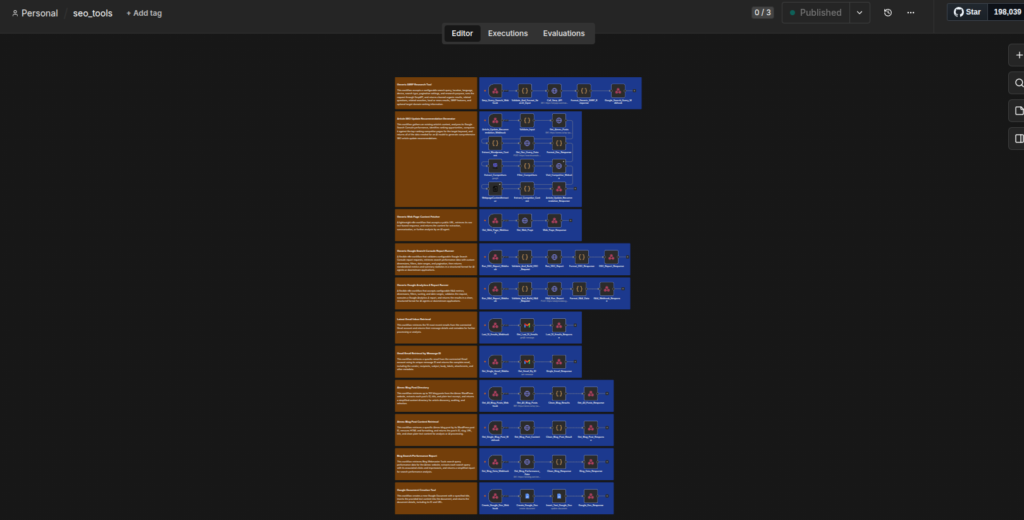
Screenshot of the SEO tools workflow being run by our system
This means the AI agent can discover and use the workflows as callable tools. The attached implementation includes reusable tools for SERP research, article analysis, Google Search Console, GA4, Bing data, WordPress content retrieval and document creation.
The workflows do not simply return raw API responses. They validate inputs, restrict unsupported fields, normalize values and produce predictable JSON structures. This makes the data considerably easier for both downstream applications and language models to use.
Our Generic Google Search Console Workflow
Google Search Console is one of the main data sources in the system. However, we did not want to create a separate workflow for every possible report. Instead, we built a configurable Google Search Console report runner that the AI can then choose how to use.
The workflow accepts parameters such as:
- Start and end dates
- Dimensions
- Row limits
- Pagination offsets
- Dimension filters
- Filter operators
- Aggregation settings
This lets the agent retrieve data at different levels. It can request query-level information to find keyword opportunities, page-level data to compare articles or date-level data to detect performance trends.
The response is then standardized into metrics such as:
- Clicks
- Impressions
- Click-through rate
- Average position
Summary statistics are also returned, allowing the agent to understand the size and shape of the dataset before interpreting individual rows. This is far more flexible than building one fixed “SEO report” workflow.
Our Generic GA4 Reporting Workflow
Search visibility is only one part of SEO performance. A page may gain clicks but still fail to engage visitors or generate business value. For that reason, we built a configurable GA4 report runner alongside the Search Console workflow.
The GA4 tool can request supported combinations of metrics and dimensions, including:
- Sessions
- Users
- Engaged sessions
- Engagement rate
- Bounce rate
- Average session duration
- Page views
- Key events
- Transactions
- Ecommerce purchases
- Purchase revenue
- Landing pages
- Traffic sources
- Devices
- Locations
The workflow validates requested fields before sending the report to GA4. This protects the system from malformed tool calls and prevents the AI from requesting arbitrary or unsupported values. The GA4 response is then converted into a consistent structure containing dimensions, metrics, totals, maximums, minimums and metadata. As a result, the AI agent can connect search visibility to website behaviour.
For example, it can distinguish between an article that has lost traffic and one that has gained low-quality traffic.
Monitoring Bing Alongside Google
Most SEO monitoring systems focus almost entirely on Google. We also connected Bing Webmaster Tools. The Bing workflow retrieves search query performance for Aimec and simplifies the response into query, click and impression data.
Bing is unlikely to contribute the same volume of data as Google for most websites. However, it provides another view of search demand and can reveal queries that do not yet appear prominently in Google Search Console. It also makes the monitoring system less dependent on one search platform.
Retrieving Aimec’s Existing Content
Performance data is difficult to act on without the page itself. We therefore created WordPress workflows that allow the AI agent to retrieve:
- A directory of Aimec blog posts
- Individual post IDs
- Titles
- Excerpts
- Slugs
- URLs
- Full article content
The content is cleaned before it is returned. HTML tags and unnecessary formatting are removed so the AI receives readable text rather than raw WordPress markup.
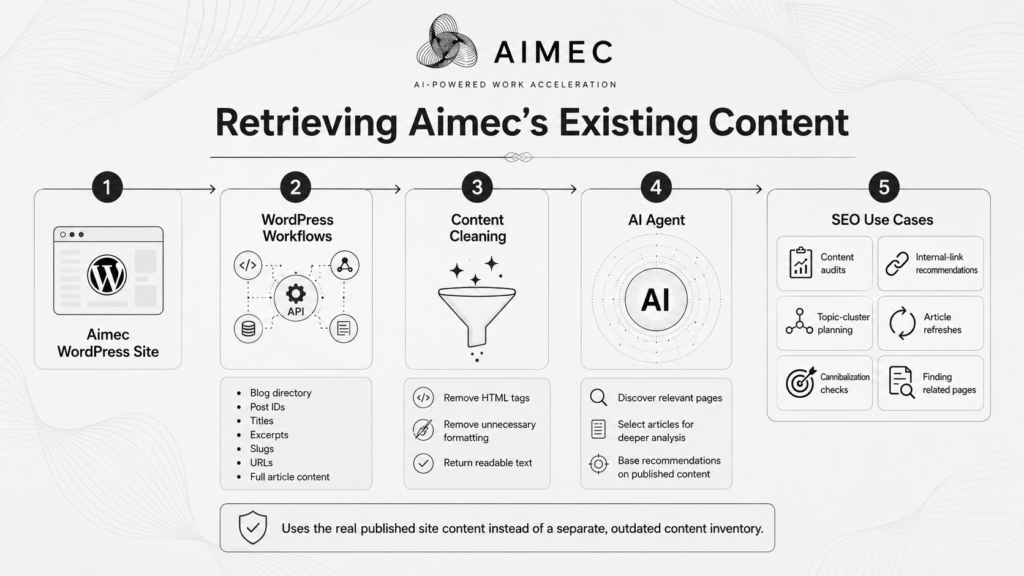
The blog directory helps the agent discover relevant pages. It can search the available content before selecting an individual article for deeper analysis. This is especially useful for:
- Content audits
- Internal-link recommendations
- Topic-cluster planning
- Article refreshes
- Cannibalization checks
- Finding related pages
It also means the agent can base recommendations on what is actually published instead of relying on a separate, potentially outdated content inventory. The same WordPress access can support a broader AI editorial workflow for WordPress, allowing agents to retrieve, analyse and eventually help update published content.
The Article Update Recommendation Workflow
One of the most useful parts of the system is the article update recommendation workflow. The workflow accepts three inputs:
- The article URL
- Its target keyword
- Its WordPress slug
It then gathers several forms of context. First, it retrieves the current article from WordPress and extracts its title, excerpt, headings, plain-text content and word count. Next, it requests the last 90 days of Google Search Console query data for that exact URL.
The system identifies the article’s target query and searches for opportunity queries with meaningful impressions and average positions between four and 20.
These are often the terms for which a page already has some relevance but may need stronger coverage, better matching sections or improved on-page optimization. The workflow then searches Google for the target keyword using SerpAPI. It removes Aimec from the results, selects competing pages and retrieves their content.
The collected information gives the AI model a complete update package:
- The existing Aimec article
- Its current headings
- Its word count
- Its target-query performance
- Related queries receiving impressions
- Ranking opportunities
- Current search competitors
- Competitor content
The AI can then recommend changes based on evidence rather than generic SEO rules.
Building a Reusable SERP Research Tool
We also built a generic search tool for broader SEO research. It accepts a query and optional parameters for:
- Location
- Country
- Language
- Device
- Pagination
- Number of results
- Search type
- Target domain
- Research purpose
The same workflow can support keyword research, competitor analysis, ranking checks, brand monitoring, content-gap analysis and local market research. It returns more than standard organic listings. Depending on the search, the output may include:
- Organic results
- Related questions
- Related searches
- News results
- Image results
- Local results
- Knowledge Graph information
- Answer boxes
- AI Overview data
- Target-domain positions
- Pagination details
This matters because modern search results are no longer just ten blue links. An AI SEO monitoring system needs to understand the entire search environment surrounding a query.
Why We Added a Custom Website Crawler
Platform data cannot fully explain the structure of a website. Google Search Console shows how pages perform in search. GA4 shows how visitors behave. Neither provides a complete, controllable map of how every page connects to every other page. We therefore built a custom Python crawler.
The crawler stays on the starting hostname and visits the website page by page. It removes query strings by default to reduce duplicate URLs, while allowing them to be retained when parameters represent genuinely different pages.
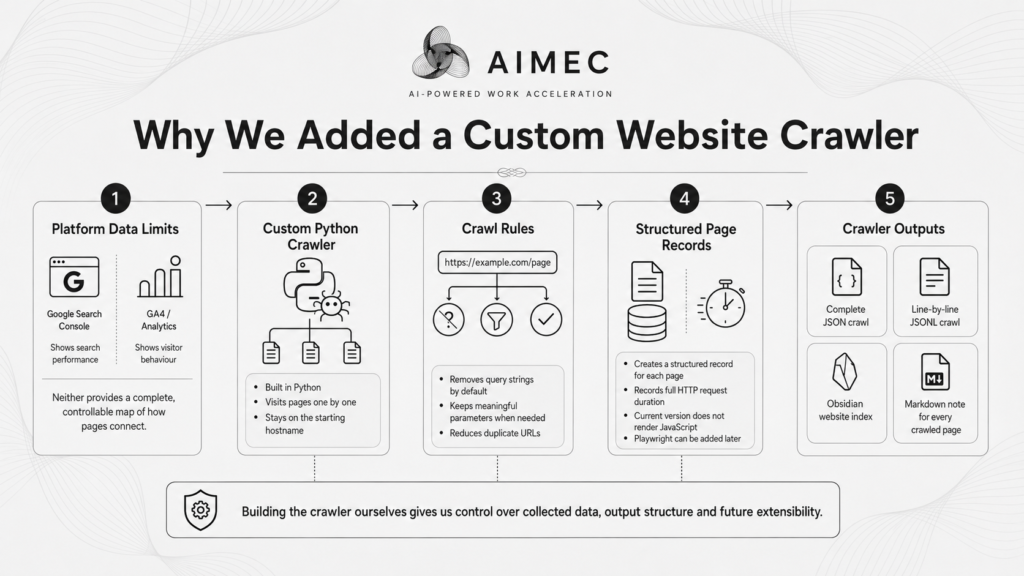
For each page, the crawler can create a structured record that can later be inspected, filtered or supplied to another system.
Its output includes:
- A complete JSON crawl
- A line-by-line JSONL crawl
- An Obsidian website index
- A separate Markdown note for every crawled page
The crawler records the full HTTP request duration for each page. This is useful for comparative monitoring, although it should not be confused with browser-based Core Web Vitals. The current version does not render JavaScript-generated content. Playwright can be added later for websites where important content or links only appear after client-side rendering.
Building the crawler ourselves gives us control over which data points are collected and how the output is represented. We can extend it as the monitoring system evolves.
Turning the Website Into an Obsidian Graph
The crawler does not only produce rows of data. It converts every page into an Obsidian note and represents internal links as connections between those notes. Opening the generated vault in Obsidian creates a visual graph of the website.
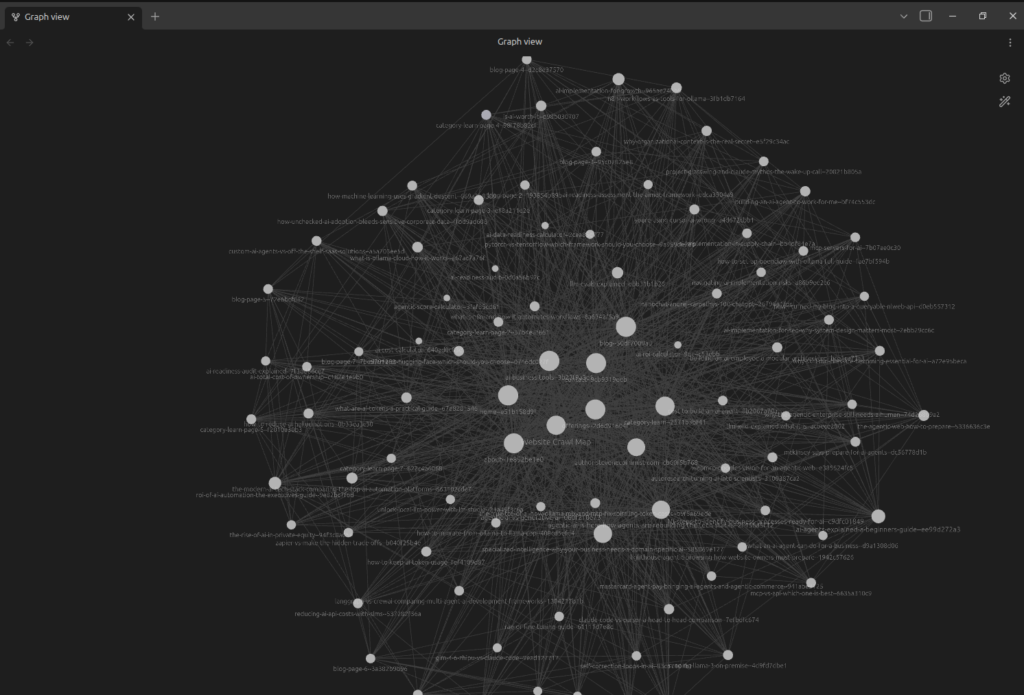
Screenshot of Obsidian graph view of URLs on Aimec
Instead of seeing the site as a sitemap or spreadsheet, we can see it as a network of connected knowledge. Large clusters begin to emerge around heavily linked topics. Isolated pages become immediately visible. Thin connections between otherwise related articles are easier to spot.
This visualization can expose issues such as:
- Orphaned or weakly linked pages
- Articles disconnected from their main topic cluster
- Overly dominant hub pages
- Separate clusters that should be connected
- Old content that is no longer integrated into the site
- Areas where internal links are concentrated too heavily
- New opportunities for pillar and supporting content
The Obsidian graph is not itself an SEO scoring system. A highly connected page is not automatically a strong page, and every article does not need dozens of internal links. Its value is in making website structure understandable. It gives humans a visual way to inspect the same relationships that the AI system can analyze programmatically.
Combining Performance Data With Website Structure
The strongest part of the system is not any individual workflow. It is the ability to combine them.
Suppose Google Search Console shows that an article has strong impressions, an average position of eight and a weak click-through rate. The AI agent can retrieve the article, inspect its title and content, compare it with competing pages and identify related queries. The crawler can then show whether the article is well connected to the rest of its topic cluster. GA4 can reveal whether visitors engage with the page after clicking.
The final recommendation may therefore include several different actions:
- Improve the title to better match search intent
- Add a section targeting an opportunity query
- Strengthen the introduction
- Add internal links from related articles
- Link the page back to its main pillar
- Update outdated content
- Improve the page’s call to action
- Continue monitoring engagement after the update
That is much more useful than simply receiving an alert that rankings changed.
Why This Is an AI System Rather Than Basic Automation
Not every part of the architecture needs artificial intelligence. API authentication, date validation, pagination and metric formatting are deterministic tasks. n8n and conventional code handle them more reliably. AI becomes valuable once the system must choose what to investigate and interpret information from several sources.
The agent can decide:
- Which report to run
- Which dimensions are relevant
- Whether a problem appears technical, content-related or behavioural
- Which competitors need to be reviewed
- Which query represents the strongest opportunity
- Which pages should be internally linked
- How the evidence should be explained to a human
This distinction is important. We are not replacing every SEO process with an LLM. We are using deterministic workflows to give an AI agent controlled access to reliable data.
Designing the System Around Tools
Each n8n webhook is treated as a tool. The tool definition describes the workflow’s name, purpose, method and required input fields. The AI agent can load these definitions and decide when to call them. This modular design means new capabilities can be added without rewriting the entire agent.
We use the same general approach described in our guide to connecting n8n workflows as AI tools: each workflow exposes a defined capability that the agent can call when it needs specific information.
{
  "name": "generic_serp_search",
  "description": "Runs a configurable Google search through SerpAPI and returns structured search results for SEO research, competitor analysis, content discovery, ranking checks, company research, news research, and local market research.",
  "type": "tool",
  "method": "POST",
  "input_schema": {
    "type": "object",
    "properties": {
      "query": {
        "type": "string",
        "description": "The search query to run."
      },
      "location": {
        "type": "string",
        "description": "The geographic search location, such as 'South Africa' or 'Johannesburg, Gauteng, South Africa'."
      },
      "country_code": {
        "type": "string",
        "description": "Two-letter Google country code, such as 'za', 'us', or 'gb'."
      },
      "language_code": {
        "type": "string",
        "description": "Google interface language, such as 'en'."
      },
      "device": {
        "type": "string",
        "enum": ["desktop", "mobile", "tablet"],
        "description": "The device type used for the search."
      },
      "start": {
        "type": "number",
        "description": "The result offset used for pagination. Use 0 for the first page, 10 for the second page, and so on."
      },
      "result_count": {
        "type": "number",
        "description": "The requested number of search results."
      },
      "search_type": {
        "type": "string",
        "enum": ["web", "news", "images", "local"],
        "description": "The type of Google search to run."
      },
      "domain": {
        "type": "string",
        "description": "Optional domain to find or analyse in the results."
      },
      "purpose": {
        "type": "string",
        "enum": [
          "general_research",
          "competitor_analysis",
          "content_gap",
          "keyword_research",
          "search_intent",
          "ranking_check",
          "company_research",
          "brand_monitoring",
          "news_research",
          "local_prospecting"
        ],
        "description": "Explains how the agent intends to use the search results."
      }
    },
    "required": ["query"]
  }
}
Once the workflow is exposed through the same tool interface, the agent can use it alongside the existing system.
Language models are good at interpreting text, but unreliable data structures can still cause problems. For that reason, each workflow returns a predictable result. Metrics are converted into appropriate numeric values. Dimensions are named. Empty fields are handled. Inputs are validated against allowed lists. This reduces ambiguity and helps prevent the AI from inventing missing details.
It also allows the same outputs to be reused in dashboards, reports, documents or other software. The AI is one consumer of the data, not the only one.
What the System Can Do Today
The current AI SEO monitoring system can:
- Retrieve Google Search Console reports dynamically
- Retrieve GA4 reports with configurable metrics and filters
- Review Bing search-query performance
- List and retrieve Aimec WordPress posts
- Run Google searches through SerpAPI
- Inspect organic results and SERP features
- Compare an article with competing pages
- Identify query-level ranking opportunities
- Generate the context required for article update recommendations
- Crawl the website
- Export crawl data as JSON and JSONL
- Convert the website into an Obsidian knowledge graph
- Create Google Documents for reports or content outputs
These are individual capabilities, but together they form the foundation of a persistent SEO intelligence system.
What We Are Building Toward
The long-term goal is not to produce more automated reports. It is to create an AI system that understands the website well enough to monitor it continuously and recommend the next best action.
Future versions could detect meaningful changes automatically. For example, the system could notify us when:
- An important page loses clicks
- Rankings fall across a topic cluster
- A high-impression query has unusually low CTR
- A newly published article remains isolated
- A competitor adds substantial new coverage
- Organic traffic grows while conversion performance falls
- Bing begins showing demand for a topic that is still weak in Google
- An old article becomes a candidate for consolidation
- Internal links disappear after a site update
The agent could then gather the relevant context before sending the alert. Instead of saying, “Traffic declined,” it could explain which queries changed, what competitors are doing and which update should be considered.
Lessons From Building the System
One of the main lessons was that AI is only as useful as the tools and context available to it. Connecting an LLM directly to a large collection of raw exports would not create a reliable SEO monitoring system. The data first had to be made accessible, structured and safe to query.
Another lesson was that SEO data should not be treated in isolation. Search rankings, visitor behaviour, content quality and internal website structure describe different parts of the same system.
A ranking change may be caused by weaker content, shifting intent, poor internal support, stronger competition or a broader change in demand. No single dashboard can provide the full explanation.
Finally, visual representations still matter. The Obsidian graph gives us a way to see the structure of the website that is difficult to reproduce in a conventional table. It complements the AI rather than replacing human analysis.
AI SEO Monitoring Should Support Decisions
The purpose of AI SEO monitoring is not to generate a larger volume of data. It is to reduce the distance between a change and a useful decision. By combining n8n workflows, search and analytics APIs, WordPress content, custom crawling and an Obsidian visualization, we have started turning Aimec’s website into a queryable SEO system.
The AI agent can ask for the information it needs, retrieve the relevant evidence and connect performance data with the content and structure of the website. This allows SEO monitoring to become more investigative, more contextual and ultimately more actionable.
For businesses already collecting data from Google Search Console, GA4, Bing or other platforms, the next step may not be another dashboard. It may be an intelligence layer capable of understanding how those systems relate.
Build an AI SEO Monitoring System for Your Business
Every website has different content, analytics, commercial goals and reporting requirements.
At Aimec, we build AI and automation systems that connect business data, software and workflows into tools that support real decisions. Our SEO automation reviews examine how your team currently collects data, identifies opportunities and turns findings into action.
The result can range from a focused reporting workflow to a custom AI SEO monitoring system connected to your existing platforms.
Speak to Aimec about an SEO automation review.

Steven Walgenbach is an AI Engineer specializing in AI agents, large language models, retrieval-augmented generation and business process automation. He designs and builds practical AI systems that connect with existing tools, data sources and workflows to help businesses reduce manual work, improve decision-making and scale more efficiently.
His work includes developing multi-agent systems, private and locally hosted AI solutions, custom knowledge assistants, SEO automation pipelines and LLM-powered applications using Python, LangGraph, CrewAI, the OpenAI Agents SDK and other modern AI frameworks.
Through AIMEC, Steven helps businesses move beyond AI experimentation and identify practical opportunities where artificial intelligence can deliver measurable operational and commercial value.