Retrieval-augmented generation (RAG) can make an artificial intelligence system significantly more useful by allowing it to answer questions using private, current or domain-specific information. However, estimating RAG implementation costs is not as simple as adding the price of a vector database to the cost of an AI model.
A production RAG system is a complete information pipeline. Documents must be collected, cleaned, divided into usable chunks, converted into embeddings, stored, retrieved and supplied to a large language model. The system must then be evaluated, monitored and updated as its underlying knowledge changes.
In my experience building RAG pipelines and agentic systems, the biggest cost is rarely the initial proof of concept. A basic demonstration can be assembled relatively quickly. The cost increases when the system must handle real business documents, enforce permissions, deliver consistently accurate answers and remain reliable as information changes.
A small RAG proof of concept may cost a few thousand dollars to develop, while a production implementation can range from approximately $15,000 to more than $100,000. Enterprise deployments involving sensitive data, on-premises infrastructure, multiple departments or complex access rules can cost considerably more.
The final price of a RAG implementation depends on four major cost areas:
| Cost area | What it includes | Main cost drivers |
| Data ingestion and preparation | Collecting, extracting, cleaning, deduplicating and chunking documents before they enter the RAG system | Number of data sources, document formats, OCR requirements, data quality and ingestion frequency |
| Embedding generation and vector database infrastructure | Converting document chunks into embeddings and storing them in a searchable vector database | Data volume, embedding model, vector dimensions, query traffic, storage and managed versus self-hosted infrastructure |
| Evaluation and quality assurance | Testing retrieval accuracy, answer quality, faithfulness, citations and refusal behaviour | Evaluation dataset size, subject-matter expert involvement, automated testing and human review |
| Ongoing maintenance and monitoring | Keeping data current, tracking system performance, resolving failures and updating models or dependencies | Update frequency, monitoring requirements, user volume, model changes and support needs |
These areas should be budgeted separately because each one can grow independently as the document collection, number of users and reliability requirements increase. Understanding these components makes it easier to create a realistic RAG budget.
What Is a RAG System?
Retrieval-augmented generation, commonly called RAG, is an architecture that connects a large language model to an external source of information.
<iframe width=”560″ height=”315″ src=”https://www.youtube.com/embed/T-D1OfcDW1M?si=iFNe4ShJFvZ_Jp-W” title=”YouTube video player” frameborder=”0″ allow=”accelerometer; autoplay; clipboard-write; encrypted-media; gyroscope; picture-in-picture; web-share” referrerpolicy=”strict-origin-when-cross-origin” allowfullscreen></iframe>
Instead of relying only on knowledge learned during model training, the system searches a collection of relevant documents when it receives a question. The most relevant sections are inserted into the model’s context before it generates an answer.
A typical RAG pipeline works as follows:
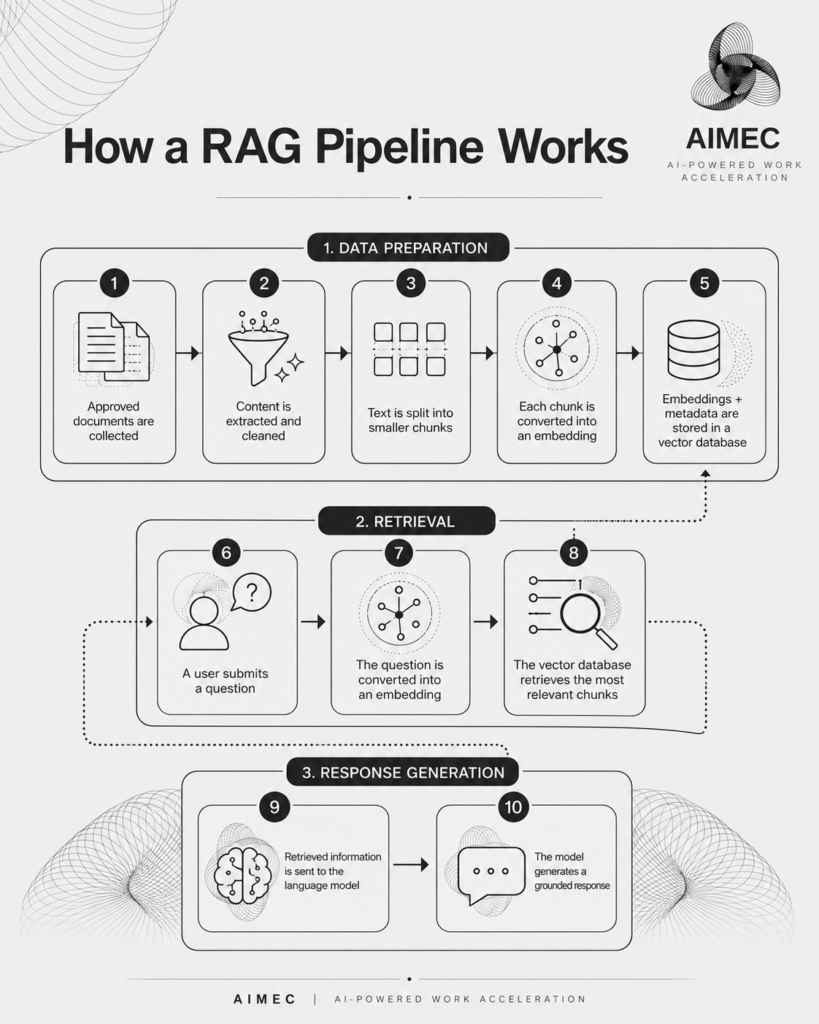
Each stage introduces development, infrastructure and maintenance costs.
How Much Does RAG Implementation Cost?
RAG implementation costs can be divided into several broad project levels.
A limited proof of concept using a small, clean document collection may cost between $3,000 and $15,000. This type of system is normally intended to validate whether retrieval works for a particular use case. It may have a simple interface, limited security controls and little automated evaluation.
A production RAG implementation commonly costs between $15,000 and $75,000. It may include several data sources, scheduled ingestion, metadata filtering, authentication, monitoring and a formal evaluation process.
More complex enterprise systems can exceed $100,000. Costs rise when the implementation requires on-premises deployment, strict document permissions, thousands of users, multilingual retrieval, high availability or integration with several internal platforms.
These figures are illustrative rather than fixed quotes. The amount of data alone does not determine the cost. A small collection of inconsistent, scanned or permission-sensitive documents can be more expensive to implement than a much larger collection of clean, well-structured files.
Data Ingestion Is Often the First Major Cost
Data ingestion is the process of moving information from its original sources into the RAG pipeline. A demonstration might only need to process a folder containing a few PDF files. A production system may need to retrieve content from Google Drive, SharePoint, a customer relationship management platform, a product catalogue, support tickets, internal APIs and several databases.
Each source may store content in a different format. It may also have its own authentication system, metadata structure and update frequency.
Document Extraction
The first ingestion cost involves extracting usable text. Plain text files, modern PDFs and well-structured web pages are relatively straightforward. Costs increase when the source contains:
- Scanned documents
- Images containing important text
- Complex tables
- Multi-column PDFs
- Handwritten content
- Headers and footers repeated on every page
- Poorly structured HTML
- Spreadsheets containing several unrelated tables
- Presentations where meaning depends on visual layout
Scanned files may require optical character recognition. Tables may need specialised extraction or document-understanding models. In some cases, a standard text parser will extract the words but lose the relationships that give those words meaning. This is why ingestion costs should be based on document complexity rather than only document count.
Cleaning and Normalisation
Extracted content is rarely ready for retrieval. Documents may contain duplicate paragraphs, navigation menus, legal disclaimers, page numbers, broken characters or outdated content. These elements can reduce retrieval quality by adding irrelevant information to the vector database.
A cleansing process may need to:
- Remove duplicated content
- Standardise headings and formatting
- Detect document language
- Preserve tables and section relationships
- Extract dates, categories and document owners
- Identify sensitive information
- Remove or mask personally identifiable information
- Mark documents as active, archived or expired
This work can be completed using deterministic code, natural language processing, language models or a combination of methods. The more inconsistent the source data is, the more engineering and testing the ingestion layer requires.
Chunking Strategy
RAG systems normally divide documents into smaller units called chunks. Chunking appears simple, but it can have a significant effect on answer quality. If chunks are too small, important context may be separated. If they are too large, retrieval may return excessive or irrelevant information.
A basic implementation may split text after a fixed number of characters or tokens. A stronger implementation may use document structure, headings, paragraph boundaries, tables or semantic similarity.
Specialised content may require a custom strategy. Product documentation, contracts, source code, financial reports and customer support conversations should not necessarily be chunked in the same way.
Developing and testing the correct chunking approach adds to the implementation cost, but poor chunking can make the entire system appear unreliable.
Initial and Ongoing Ingestion
Businesses should distinguish between initial ingestion and ongoing ingestion. Initial ingestion processes the existing document collection. Ongoing ingestion ensures that new or modified information is added to the system.
A production pipeline may need to:
- Detect newly created documents
- Reprocess edited files
- Remove deleted content
- avoid indexing the same content twice
- Track ingestion failures
- Retry interrupted jobs
- Preserve document version history
- Refresh embeddings when models change
These workflows commonly require scheduled jobs, queues, webhooks or automation tools. The recurring ingestion process is often more technically demanding than the first bulk import.
Embedding Generation Costs
Embeddings convert text into numerical representations that can be compared mathematically. They are what allow the RAG system to find passages that are semantically related to a user’s question. Embedding costs depend on the volume of text, the selected model and how frequently content must be reprocessed.
For a small document collection, the direct model cost may be relatively low. However, embedding expenses can increase when a system contains millions of chunks or regularly re-embeds changing data. The business must also decide between hosted and locally deployed embedding models.
A hosted embedding API reduces the infrastructure required to launch the system. The business pays according to usage and depends on an external provider. A local embedding model gives the business more control over its data and operating environment. However, it introduces hosting, deployment and monitoring costs. Local models may be attractive when the documents are sensitive, the volume is high or the RAG system must operate inside a private network.
The cheapest embedding model is not always the least expensive choice overall. A weaker model may reduce retrieval accuracy, leading to more development time, larger prompts and a higher rate of unusable answers.
Vector Database Costs
The vector database stores embeddings and returns the pieces of information most relevant to a query. Popular deployment options include managed vector database services, self-hosted vector databases and traditional databases that support vector search.
Managed Vector Databases
A managed service can reduce the work required to configure, scale and monitor the database. This is often useful for teams that want to reach production quickly. The initial monthly bill may be low for a small implementation. It can grow as the collection, number of users and query frequency increase.
The development savings may justify the higher recurring infrastructure cost, especially when the internal team does not have database operations experience.
Self-Hosted Vector Databases
Self-hosting can provide more control over security, performance and data location. It may also reduce per-query platform fees at scale. However, self-hosting does not make the database free.
The business must pay for:
- Compute resources
- Storage
- Backups
- Updates
- Security hardening
- Logging
- Monitoring
- Scaling
- Failover
- Staff time
An internal vector database running on a single machine may be sufficient during development. A production deployment usually needs a more resilient architecture.
The right decision depends on the organisation’s data requirements, internal engineering capability and expected usage. A hybrid model is also possible, with sensitive collections hosted locally and less sensitive workloads handled by managed services.
Metadata and Access Control
The database must often store more than embeddings. Metadata may include the source document, department, publication date, product category, customer, region, confidentiality level and access permissions.
This information allows the retriever to filter results before they reach the language model. Without these controls, an employee could receive information from a document they were not authorised to view.
Permission-aware retrieval can become one of the most expensive parts of an enterprise RAG implementation. The system must synchronise its access rules with the original data source and apply them during every search.
This requires more engineering than simply placing all company documents into one shared vector collection.
Retrieval and Reranking Costs
Vector similarity is only one method for retrieving information. Production systems may combine semantic vector search with keyword search, metadata filtering and reranking. This is often called hybrid retrieval.
A reranking model reviews the initial search results and places the most relevant chunks first. It can improve answer quality, especially when documents contain similar terms or when precise wording matters. However, reranking adds another processing step and potentially another model cost to every request.
The retrieval layer may also need query rewriting. For example, the system could convert a conversational question into a clearer search query, generate several alternative queries or divide a complex question into subquestions.
These techniques can improve results but increase latency, token usage and implementation complexity.
Language Model Costs
Although a RAG system retrieves information, a large language model still generates the final response. Poor retrieval can increase language model costs. When the system sends too many chunks to the model, each request uses more input tokens. The model may also become less accurate because the relevant information is buried in unnecessary context.
A carefully designed RAG pipeline can therefore reduce both hallucinations and model expenses.
Local language models may reduce reliance on external APIs, but they require suitable hardware and operational support. A lightweight local deployment may run on a workstation or modest server. Larger models, higher concurrency and longer context windows may require more powerful GPUs or dedicated inference infrastructure.
RAG Evaluation Costs
Evaluation is frequently left out of early RAG cost estimates. A chatbot that produces fluent answers can appear successful during a demonstration. That does not prove that it consistently retrieves the correct information, cites the right source or refuses to answer when evidence is unavailable. Evaluation determines whether the system is actually suitable for business use.
Building an Evaluation Dataset
A useful evaluation process begins with a collection of representative questions and expected outcomes. The dataset should include:
- Common user questions
- Difficult or ambiguous questions
- Questions requiring information from several documents
- Questions with no valid answer
- Questions involving outdated information
- Permission-sensitive requests
- Different phrasings of the same request
- Adversarial or misleading prompts
Creating this dataset requires input from subject-matter experts. Their time can become a meaningful part of the project budget, especially in legal, financial, medical or highly technical environments.
Measuring Retrieval Quality
Retrieval evaluation checks whether the correct document chunks appear in the search results. Useful measurements may include whether a relevant passage was retrieved, how highly it ranked and how much irrelevant context was returned.
A system can fail even when the final answer sounds reasonable. If the retriever selected the wrong source, the model may have generated a plausible answer using unrelated information. Retrieval and generation should therefore be evaluated separately.
Measuring Answer Quality
The generated response can be assessed for:
- Factual accuracy
- Faithfulness to the retrieved evidence
- Relevance
- Completeness
- Citation accuracy
- Tone
- Safety
- Correct refusal behaviour
Some checks can be automated using rules or model-based evaluators. Others require human review. Automated evaluation reduces the amount of manual work, but it should not be treated as perfect. The evaluating model may make mistakes or reward answers that sound good without being fully correct. The most reliable approach combines automated testing with periodic human review.
Regression Testing
Every change to the RAG pipeline can affect performance. Changing the embedding model, chunk size, retrieval settings, prompt or reranker may improve one category of questions while making another worse.
A regression suite reruns a stable set of questions after each major change. This makes it possible to measure whether the system has actually improved instead of relying on a few manually selected examples. Building this evaluation infrastructure increases the initial cost, but it can greatly reduce the risk of releasing silent quality regressions.
RAG Maintenance Costs
RAG is not a one-time implementation. The system’s knowledge, models, integrations and user requirements will continue to change. Ongoing maintenance should be included in the budget from the beginning.
Data Freshness
Documents may be added, updated, moved or deleted. The RAG index must reflect those changes. If the database retains outdated chunks after the original document is replaced, the system may return conflicting information. The model may then choose an old policy instead of the current one.
Maintenance workflows should detect content changes and update only the affected chunks where possible. Reprocessing the entire collection after every change may be unnecessarily expensive.
Monitoring
A production RAG system should monitor more than server uptime. Useful signals include:
- Failed ingestion jobs
- Documents that could not be parsed
- Retrieval latency
- Language model latency
- Empty search results
- Token usage
- Cost per request
- User feedback
- Frequently unanswered questions
- Low-confidence responses
- Access-control failures
These signals can reveal whether the problem lies in the documents, retrieval logic, prompt, model or user interface. Without monitoring, the team may not know that the system’s quality has declined until users stop trusting it.
Model and Dependency Updates
Embedding models, language models and retrieval libraries continue to evolve. A new model may improve accuracy or lower inference costs, but migrating to it can require the entire document collection to be re-embedded. Changes to vector dimensions may require a new database index.
Software dependencies also require security patches and compatibility updates. Self-hosted components generally create more maintenance responsibility than managed services.
Human Feedback and Content Governance
Users will identify missing documents, incorrect answers and unclear responses. A process is needed to turn that feedback into system improvements. The business must also decide who owns the knowledge base. Someone should be responsible for determining which sources are authoritative, which documents should be archived and how conflicting information should be handled. RAG maintenance is therefore not only an engineering task. It also requires content governance.
Hidden RAG Implementation Costs
Several costs are easy to overlook during planning.
Security and Compliance
Sensitive information may require encryption, audit logs, private networking, data retention controls and regional hosting. The system may also need to redact personal or client information before sending prompts to a third-party model. These requirements can substantially increase development and infrastructure costs.
User Interface Development
The RAG pipeline is only the backend. Users may need a web application, internal chat interface, document viewer, feedback controls, source citations or integration with Microsoft Teams, Slack or WhatsApp. A stronger interface can also make the system safer by showing where information came from and allowing users to inspect the original source.
Authentication and Permissions
Connecting the application to an organisation’s identity provider and enforcing document-level permissions can require considerable work. This is particularly important when the same RAG system serves multiple departments, clients or business units.
Observability and Support
When an answer is wrong, developers need to understand what happened. A useful trace may need to record the original question, rewritten query, retrieved chunks, relevance scores, applied filters, model prompt, model response and evaluation result. Building this observability layer adds cost, but it significantly reduces debugging time.
How to Reduce RAG Implementation Costs
The most effective way to control costs is to begin with a narrow, valuable use case. Instead of indexing every document in the organisation, start with a clearly defined collection and a known group of users. This makes it easier to measure whether the system is useful.
Businesses can also reduce costs by:
- Prioritising clean, authoritative data sources
- Starting with a managed vector database
- Using simple retrieval before adding complex agent workflows
- Creating an evaluation dataset early
- Limiting the number of chunks sent to the language model
- Reprocessing only documents that have changed
- Tracking model and infrastructure spending per request
- Using smaller models for query rewriting or evaluation
- Applying deterministic rules where an AI model is unnecessary
- Introducing on-premises infrastructure only when there is a clear reason
A RAG system should not become complex simply because more techniques are available. Every additional model call, retriever and integration should solve a measurable problem.
RAG Proof of Concept vs Production System
A proof of concept answers the question: can this information be retrieved well enough to support the use case? A production system must answer much harder questions:
- Can it handle incorrect or incomplete documents?
- Can it prevent unauthorised access?
- Can it identify when no answer is available?
- Can it remain accurate when data changes?
- Can developers investigate bad answers?
- Can it support the expected number of users?
- Can its performance be measured over time?
- Can the business predict and control its operating costs?
This distinction explains why a RAG demonstration may cost a few thousand dollars while the production version costs several times more. The additional cost is not necessarily caused by the AI model. It comes from building the controls and infrastructure required to make the system dependable.
Is RAG Worth the Cost?
RAG can be worth the investment when employees or customers repeatedly need information from a large or frequently changing knowledge base. The return on investment usually comes from reducing search time, improving access to institutional knowledge, accelerating support responses or allowing AI agents to complete more useful tasks.
However, RAG may not be necessary when the information is small, static and already easy to access. A structured database query, search engine or deterministic workflow may be cheaper and more reliable.
Final Thoughts on RAG Implementation Costs
The cost of implementing RAG is not limited to a vector database or an embedding API. A reliable system requires data ingestion, cleansing, chunking, retrieval, evaluation, security, monitoring and ongoing maintenance. In many projects, data quality and integration work cost more than the AI components themselves.
A small proof of concept can be affordable, but moving into production requires a larger investment in accuracy and reliability. Businesses should budget for the full lifecycle of the system rather than focusing only on the initial build.
The best RAG implementation is not necessarily the one using the most advanced model or the most complicated architecture. It is the one that retrieves the right information, respects access controls, produces measurable value and can be maintained at a sustainable cost.
Frequently Asked Questions
How much does it cost to build a RAG system?
A basic RAG proof of concept may cost between approximately $3,000 and $15,000. Production implementations often range from $15,000 to $75,000, while complex enterprise or on-premises systems can exceed $100,000. The final cost depends on data complexity, integrations, security, evaluation and expected usage.
What is the most expensive part of RAG implementation?
Data ingestion and preparation are often among the largest expenses. Extracting, cleaning, classifying and synchronising business documents can require more work than configuring the vector database or connecting a language model.
How much does a vector database cost?
Vector database costs depend on the number of vectors, storage, query volume, replication and performance requirements. Managed services create a recurring platform expense, while self-hosted databases require compute infrastructure and operational support.
Does RAG reduce AI costs?
RAG can reduce costs by allowing a smaller or less specialised model to answer questions using retrieved business context. However, inefficient retrieval can increase costs if too many document chunks are included in every prompt.
Why does a RAG system need evaluation?
Evaluation determines whether the system retrieves the correct evidence and produces an accurate, grounded answer. Without formal testing, a system may produce convincing responses while relying on irrelevant or outdated sources.
How often does a RAG database need to be updated?
The update frequency should match the rate at which the source information changes. Frequently changing data may need near-real-time or daily synchronisation, while stable archives may only require periodic updates.
Can a RAG system be hosted on-premises?
Yes. The embedding model, vector database and language model can all be hosted within an organisation’s infrastructure. This can improve data control but increases hardware, deployment, security and maintenance costs.
What ongoing costs should be included in a RAG budget?
Ongoing costs can include model usage, vector database hosting, compute, storage, ingestion jobs, monitoring, evaluation, software updates, support and human review.

Steven Walgenbach is an AI Engineer specializing in AI agents, large language models, retrieval-augmented generation and business process automation. He designs and builds practical AI systems that connect with existing tools, data sources and workflows to help businesses reduce manual work, improve decision-making and scale more efficiently.
His work includes developing multi-agent systems, private and locally hosted AI solutions, custom knowledge assistants, SEO automation pipelines and LLM-powered applications using Python, LangGraph, CrewAI, the OpenAI Agents SDK and other modern AI frameworks.
Through AIMEC, Steven helps businesses move beyond AI experimentation and identify practical opportunities where artificial intelligence can deliver measurable operational and commercial value.